The hard part of a bulk safety shoe order is not the price, it is the size run. Order a flat quantity of every size and you will be short at UK 9 within a fortnight while holding unissued size 13s for a year. This page gives you a distribution to start from, the fitting method that makes it accurate, and the cost comparison that should decide which grade you buy.
Safety footwear is usually the largest single line in a PPE budget, and the one most often mishandled at the ordering stage. Not because buyers choose badly most know roughly what grade they need but because a 200-pair order is treated as one decision when it is really three: which specification, how many of each size, and which grade actually costs less over a year.
The size run: what to order
If you have no fitting data at all, start from this shape rather than a flat run. It is the distribution we see most often for a predominantly male Malaysian industrial workforce, and it will be far closer than equal quantities.
| UK size | Share of order | Per 100 workers | Per 200 workers | Per 500 workers |
|---|---|---|---|---|
| UK 5 | 2% | 2 | 4 | 10 |
| UK 6 | 5% | 5 | 10 | 25 |
| UK 7 | 12% | 12 | 24 | 60 |
| UK 8 | 20% | 20 | 40 | 100 |
| UK 9 | 24% | 24 | 48 | 120 |
| UK 10 | 18% | 18 | 36 | 90 |
| UK 11 | 12% | 12 | 24 | 60 |
| UK 12 | 5% | 5 | 10 | 25 |
| UK 13 | 2% | 2 | 4 | 10 |
Three adjustments worth making to that starting point. If your workforce includes a significant number of women, add weight at UK 4 to 6 and ask about ladies' fit models rather than simply ordering small men's sizes - the last is a different shape. If you employ a lot of Nepali or Bangladeshi workers the distribution often sits slightly smaller; if the work is heavy and the crew skews taller, it sits larger. And always hold a small buffer at UK 9 and 10 rather than at the tails, because that is where new starters will land.
How to run a fitting day
The single most useful thing on that strip is the first step. Feet swell over a shift, and a boot fitted at 8am to a bare foot will be uncomfortably tight by mid-afternoon. Workers do not usually complain about it - they just wear the boot unlaced, or leave it off in the yard, which defeats the purpose of buying it.
Record what each person takes. That register becomes next year's order, and it turns a guess into an exact quantity by size.
Which grade actually costs less
The comparison that matters is cost per month of service, not price per pair. A budget import at a low unit price that fails in six months costs substantially more per month than a certified mid-range boot lasting over a year - before counting the re-order admin, the freight on each replacement round, and the period where someone is working in a boot whose sole has already delaminated.
You do not have to take that on trust. Issue ten pairs of each candidate on one line, log the date each pair goes out of service, and divide. Two months of data settles the argument permanently, and we will supply the sample pairs for it.
Specifying before you ask for a quote
Six decisions determine both price and suitability. Settle them before requesting a quotation and you will get one accurate number instead of three rounds of revisions.
| Decision | Options | How to choose |
|---|---|---|
| Safety class | S1P, S3, and variants | S1P covers toe cap and pierce-resistant midsole; S3 adds water resistance. Wet processes and outdoor sites want S3. |
| Toe cap | Steel or composite | Steel is cheaper and rated to 200 J. Composite is lighter, non-conductive and does not set off metal detectors - relevant on food lines and at airport-adjacent sites. |
| Midsole | Steel plate or textile | Steel plate for sites with nails and sharp debris. Textile is more flexible and lighter but check the penetration rating. |
| Cut height | Low, mid or high cut | High cut supports the ankle on uneven ground and keeps splash out; low cut is cooler and preferred indoors. Expect to order both. |
| Sole compound | PU, rubber, dual density | Match to the floor: oil and chemical resistance for workshops, heat resistance for hot work, SRA/SRC slip rating for wet floors. |
| Extras | ESD, metatarsal, anti-fatigue insole | ESD for electronics, metatarsal guards for heavy handling. Anti-fatigue insoles matter more than buyers expect on twelve-hour shifts. |
Send us the work description rather than a product code and we will specify against it - including telling you where you are over-specified. Ask for a recommendation →
What we stock
Black Hammer 4000 Series
SIRIM and DOSH approved. Steel toe cap rated to 200 J impact and 15,000 N compression (EN 12568), certified steel puncture-resistant midsole, slip-resistant sole for wet and oily surfaces, double lock stitch on genuine leather uppers.
Beethree BT8834 High Cut
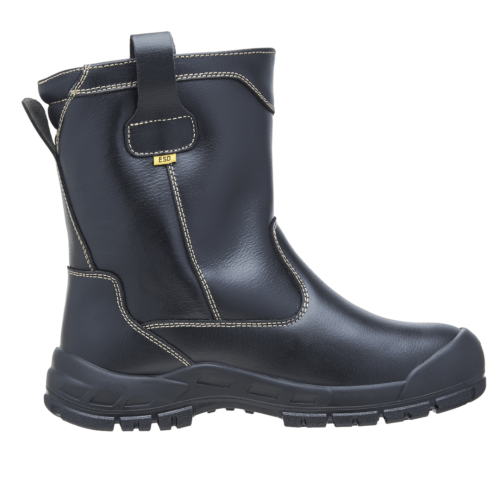
S3 SRA, SIRIM QAS certified, DOSH certified and CE type examined. Carbon steel toe cap to 200 J, pierce-resistant steel midsole, slip-resistant PU sole with oil, acid and alkali resistance, anti-fatigue insole, antistatic, and an Asian fit last.
Beethree BT-8700 Low Cut
S1P SRA, 4.5 inch low cut leather laced. The indoor counterpart to the high cut — cooler over a full shift on a dry floor, and usually the larger half of a mixed order for a factory with both production and yard work.
We also carry Goodyear and Oliver ranges, dielectric boots for electrical work, and ladies' fit models. If you are still deciding between toe cap materials, our guide on steel toe versus composite toe covers the trade-off properly.
MOQ, lead time and re-ordering
| Situation | What to expect |
|---|---|
| Common sizes, stocked model | Fastest option. UK 7 to 11 in the ranges we hold move quickly. |
| Full size run for a large crew | The tails often need to come in. Give us the distribution early and the order lands complete rather than in two parts. |
| Outlier sizes | UK 4 and below, UK 13 and above. Order these first, not last - they take longest and they are always the reason a mobilisation is short. |
| Ladies' fit | A different last, not a small men's shoe. Specify it explicitly. |
| Repeat order | Send your issue register. We will quote exactly against it instead of you re-estimating. |
| Trial pairs | Ask. Ten pairs on one line for a month is worth more than any specification sheet. |
Get a size run priced properly
Send your headcount, the type of work and whether you have fitting data. If you do not, we will start from the distribution above and build the order around it.
Haisar Supply & Services Sdn Bhd · No. 7501, Jalan Enggang 19, Bandar Putra, 81000 Kulai, Johor · Seremban branch 011-3307 7509 · contact details
Bulk order questions
How many of each size should I order?
Start from the distribution above rather than a flat run: roughly 62% of a typical order sits in UK 8, 9 and 10, with thin tails at each end. For 200 workers that is about 40 pairs at UK 8, 48 at UK 9 and 36 at UK 10. Confirm it by running a fitting day, and the second order becomes exact.
Is there a minimum order for safety shoes?
Small orders are fine, and pricing improves with quantity. Ask us to quote both your immediate need and the full size run so you can see the difference before deciding.
Steel toe or composite toe?
Steel is cheaper and rated to 200 J. Composite is lighter, non-conductive and does not trigger metal detectors, which matters on food lines and at security-screened sites. Both meet the same impact rating - the choice is about weight, conductivity and detection.
Can we get ladies' fit safety shoes?
Yes, and you should specify them rather than ordering small men's sizes. A ladies' last is a different shape, not just a smaller one, and a badly fitting boot ends up not being worn.
How long should a pair of safety boots last?
It depends on the grade and the floor. A certified mid-range boot in general factory use typically outlasts a budget import several times over, which is why cost per month of service is the number to compare rather than unit price. Run a ten-pair trial and measure it on your own site.
Can you supply SIRIM and DOSH certified footwear?
Yes. Black Hammer and Beethree lines in our range carry SIRIM and DOSH certification, and documentation is issued with the delivery order when you request it at quotation stage.