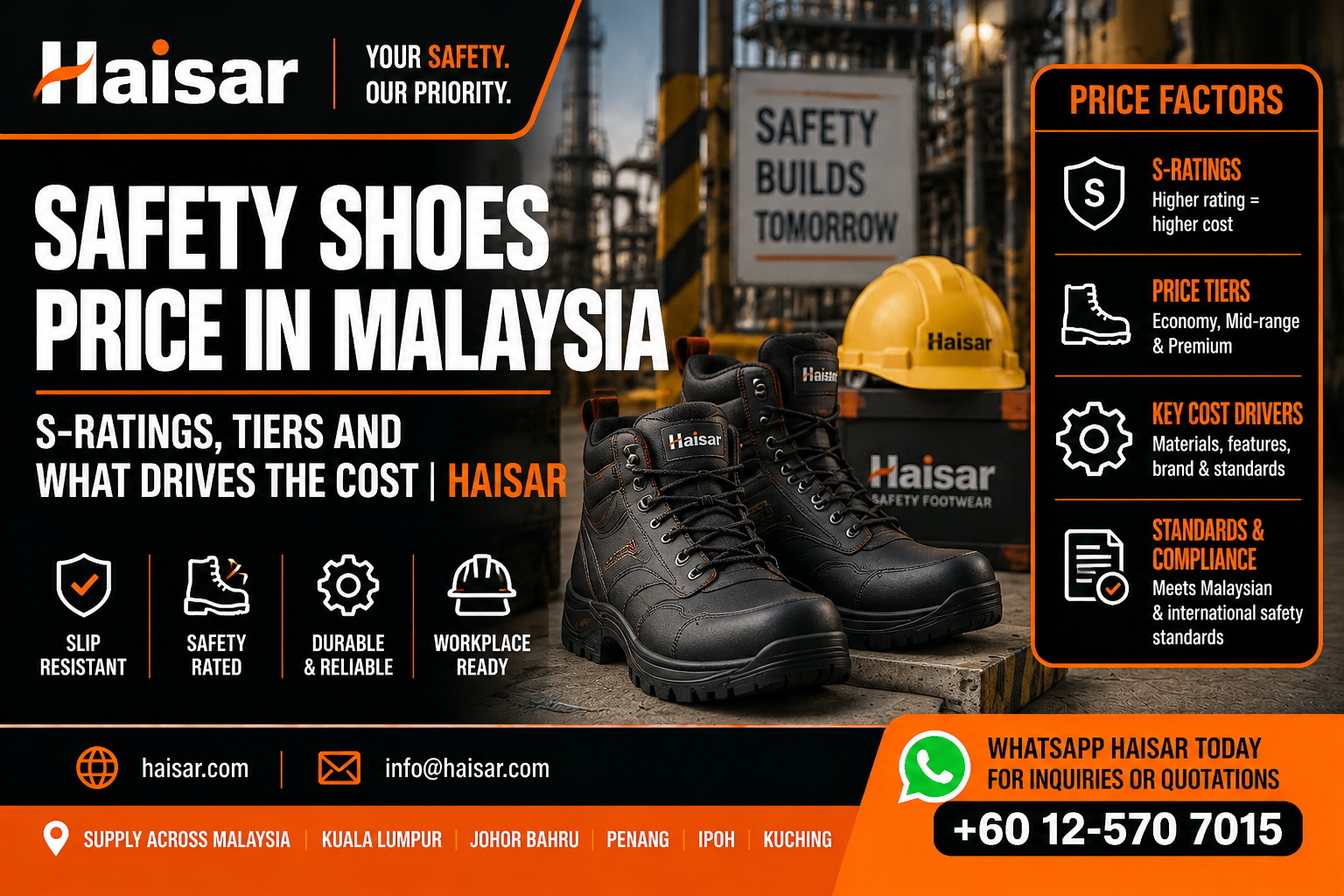
Short answer: There is no single price for safety shoes in Malaysia, because the category spans the full S-rating ladder - from a basic slip-on rated for dry indoor floors, up to a fully waterproof pull-up boot built for wet, puncture-risk sites. A low-cut S1 slip-on and an S5 waterproof boot are different purchases even when both get quoted under the same line item, “safety shoes.” This page explains what actually drives the price, how to budget for a workforce with mixed sizes rather than one uniform order, and what a cheap pair is quietly missing - then you can ask us for current figures against your actual S-rating and quantity.

Get today's pricing Browse safety footwear

Buyers searching for a safety shoe price are usually doing one of two things: sanity-checking a quotation against what a HIRARC assessment says the site actually needs, or budgeting a yearly footwear allowance for a workforce that will not all wear out their boots on the same day. Both need the same thing - not a single ringgit figure, but an understanding of which S-rating the job calls for, since footwear is one of the few PPE categories where over-specifying genuinely costs comfort as well as money.

As with our other equipment pricing guides, this is written as ratios and cost drivers rather than fixed figures, because a published shoe price goes stale fast and a stale number is worse than an honest “ask us.” The ratios and the logic hold; send us your S-rating and sizes for the current amount.

What actually drives the price

What you are actually paying for Two pairs that look similar on a shelf can differ threefold in price. This is where the money goes. toe cap, midsole plate, outsole, stitched upper Toe cap material Steel, composite or aluminium. Composite costs more but is required near live electrical work. Midsole plate Penetration-resistant plate is what turns S1 into S1P, and adds real cost. Outsole compound Slip-resistance rating and cleated tread cost more than a flat, uncleated sole. Upper material Genuine leather and double lock stitching cost more than glued synthetic uppers. S-rating features Each step from SB to S5 is cumulative — you are paying for everything below it too. Certification MS EN ISO 20345 / ASTM F2413 plus SIRIM or DOSH approval. The line not to economise on.
Six components, one price. Knowing which one a quotation has economised on is the whole skill.

Of those six, two deserve emphasis because they are where buyers most often economise and most often regret it.

The midsole plate. This is the single feature that turns a basic S1 shoe into an S1P or S3 shoe, and it is invisible once the shoe is assembled. A quotation that jumps from S1 to S3 pricing with no visible difference in the product photo is usually the midsole plate, and it is not a feature you can verify by looking.

The certification. MS EN ISO 20345 or ASTM F2413, plus SIRIM or DOSH approval where the line carries it. As our own safety shoes buying guide covers in more depth, “looks like a work boot” is not a certification, and this is the first thing missing from a suspiciously cheap pair.

The four tiers, and who needs which one

The four tiers, priced relative to each other Shown as a multiple of the entry-level slip-on, because ratios stay true when prices move. Ask us for today's figures. S1 slip-on Basic toe cap, antistatic, no midsole plate. Dry indoor floors. ×1 S1P / S3 lace-up Genuine leather, steel midsole, slip-resistant sole. The all-rounder. ×1.5 S3 high-cut zip boot Ankle support and coverage, zip entry for uneven or rough ground. ×2 S5-style pull-up boot Waterproof upper, full coverage, for standing water and wash-down areas. ×2.8 Most Johor sites standardise on tier two for general work. Tier four is a genuine need for wet, standing-water areas, not a comfort upgrade to hand out by default.
Ratios rather than ringgit, so the page stays true as prices move.
TierWhat you getRight forWatch out for
S1 slip-on Protective toe cap, antistatic properties, heel energy absorption, no midsole plate Dry indoor floors with no puncture risk - light assembly, office-adjacent factory areas No penetration resistance - not suitable the moment loose nails, offcuts or rebar are present
S1P / S3 lace-up Genuine leather upper, steel or composite toe cap, steel midsole plate, slip-resistant soleEN 12568 certified toe cap and midsole in the model we stock General construction and manufacturing - the practical default for most Johor sites Confirm whether it is S1P (no water resistance) or full S3 (adds water-resistant upper) before ordering for outdoor work
S3 high-cut zip boot Same S3-equivalent protection as above, extended ankle coverage, zip closure for faster donning Uneven ground, rebar and debris exposure, roles needing ankle support over a full shift Zip closures need the same daily inspection as laces — a jammed zip that gets forced open damages the seal
S5-style pull-up boot Fully waterproof pull-up construction, high coverage, penetration-resistant sole Standing water, wash-down areas, wet-season outdoor work, marine and shipyard tasks Only worth the premium where the site genuinely has standing water — otherwise it is heat and cost with no protection benefit in Johor's climate

Not sure which tier your site needs? Tell us the hazard profile from your HIRARC and we will recommend a tier - including saying so if you are over-specified. Ask for a recommendation →

Budgeting for a mixed-size workforce

Where the quantity break actually is Indicative shape of the curve, not a price list. A workforce order is a size spread, not one SKU. 100% 1 pair 88% 10 pairs 80% 50 pairs 74% 100 pairs 70% 200 pairs 68% 500 pairs list price most of the saving happens here Past a few hundred pairs the curve flattens. Beyond that point, getting the size spread right matters more than chasing another percentage point.
Consolidate the order across the whole site. Past the flattening point, size accuracy matters more than volume.

Footwear is the one PPE category where “order more, save more” runs into a real limit: a workforce isn't one size. Ordering to a standard bell-curve size distribution without checking it against your actual roster is the single most common reason a bulk footwear order arrives with three boxes of a size nobody on site wears and a shortfall in the size most of the floor actually needs. Measure the workforce, or at minimum pull sizes from existing issued stock, before the purchase order goes out.

The other factor worth planning around is Johor's climate. Leather uppers and adhesive bonding age faster in heat and humidity than a temperate-climate service-life figure assumes, which is part of why the replacement schedule below leans on condition, not a fixed calendar interval alone.

The number that matters: cost per worker per year

Unit price is the wrong comparison for the same reason it is with any consumable PPE: the honest annual cost depends on how long the shoe survives correct use, not what it cost on day one.

FactorWhy it changes the annual figure
Sole wear and delaminationTread worn smooth or the sole separating from the upper both retire the shoe immediately — slip resistance and water resistance are both compromised at that point, not just cosmetic wear.
Toe cap impactAny dropped-object strike retires the shoe even without visible damage, because the toe cap may have absorbed a one-time impact it cannot repeat.
Comfort and correct fitA certified S3 boot a worker quietly swaps for trainers by lunchtime because it is too hot or the wrong size protects nobody — and means buying it twice, once for the audit file and once for the worker who actually needs footwear.
Storage and climateHeat and humidity degrade leather and adhesive bonding faster than a temperate-climate figure assumes, which is part of why condition-based replacement outperforms a fixed calendar in Johor.
Certification legibilityA label that has worn illegible is a compliance gap at audit even if the shoe itself is structurally sound — budget for early replacement on high-wear roles rather than waiting for a failed check.

Run those together and the honest annual figure for a properly fitted, correctly specified tier-two boot, replaced on condition rather than convenience, is usually lower than the figure teams get from re-buying a cheaper pair twice as often because the sole delaminated or the fit was wrong from day one.

What a suspiciously cheap pair is missing

  • An S-rating printed on the shoe or the packaging. Not a verbal “meets international standards” claim, an actual SB–S5 rating referencing MS EN ISO 20345 or ASTM F2413.
  • A verifiable certificate. SIRIM certification or an equivalent CE / ASTM test report, available on request. Ask us to supply it with the delivery order.
  • A genuine midsole plate on S1P and above. This is the feature most often quietly dropped, since it is invisible until someone steps on the wrong nail.
  • Stitched, not just glued, sole-to-upper construction. Double lock stitching survives Johor's heat and repeated flexing far longer than adhesive alone.
  • The correct toe cap for the environment. Steel toe caps conduct electricity and temperature not the right choice near live electrical work regardless of price.
  • A real size range for your actual workforce. A supplier who can only offer a narrow band of sizes is not equipped for a full-site rollout, whatever the unit price looks like.

What we stock

Steel toe slip-on safety shoes, durable and easy to wear, entry level S1 rated

Steel Toe Slip-On Safety Shoes

Easy-wear low-cut slip-on for dry indoor floors with no puncture risk. The tier-one entry point — not a substitute for a midsole plate once debris or nails are present.

Ask for quantity pricing →

Black Hammer 4000 Series mid cut lace up safety shoes, SIRIM and DOSH approved, steel toe and steel midsole

Black Hammer 4000 Series Lace-Up

Steel toe cap and steel midsole (EN 12568 certified), slip-resistant sole, genuine leather upper with double lock stitching. SIRIM and DOSH approved — our practical S3-equivalent default.

Compare safety footwear →

Black Hammer 4000 Series men safety high cut boots with zip closure, ankle support

Black Hammer High Cut With Zip BH 4665

Extended ankle coverage with a fast zip entry, on the same steel toe cap and midsole platform. For uneven ground and debris exposure over a full shift.

Ask for quantity pricing →

BEETHREE BT-8835 pull-up leather safety boots, high coverage waterproof style construction boot

BEETHREE BT-8835 Pull-Up Boots

Full pull-up leather construction with high coverage, built for standing water and wash-down areas. Specified where the site genuinely has a wet-condition hazard, not as a default upgrade.

Ask for quantity pricing →

We also stock BEETHREE, SOBAR, Good Year, and Oliver ranges across the full S-rating ladder, plus dielectric safety boots for high-voltage electrical work where standard EH-rated footwear is not sufficient.

Get a real number against your spec

Tell us the S-rating your HIRARC calls for, the size spread across your workforce, and the quantity. We will come back with current pricing and the tier that actually fits the job.

WhatsApp +60 12-570 7015 Call 07-595 5658 Request a quotation

Haisar Supply & Services Sdn Bhd · No. 7501, Jalan Enggang 19, Bandar Putra, 81000 Kulai, Johor · Seremban branch 011-3307 7509 · contact details

Pricing questions

How much do safety shoes cost in Malaysia?

It depends entirely on S-rating and construction. Across the four tiers described above the range is roughly threefold, from a basic S1 slip-on to a fully waterproof S5-style pull-up boot. Most Johor sites standardise on tier two for general work. Send us the S-rating and quantity and we will give you a current figure rather than a stale published one.

What S-rating do I actually need?

That comes from your site's documented HIRARC hazard assessment, not from habit or the previous purchase order. As a working rule, S1P suits dry indoor work with a puncture risk, S3 is the practical default for general outdoor construction and industrial work, and S5 is reserved for fully wet, puncture-risk environments. Tell us the task and we will point you toward the tier typically specified for it.

Steel toe or composite toe — which is cheaper and which is safer for my site?

Steel toe is generally the lower-cost option and is fine for general impact protection without electrical exposure. Composite toe costs more but is the correct, non-conductive choice for electrical work, airport-style metal-detector environments, and roles with temperature-sensitive handling. Price should follow the hazard, not the other way round.

How do you price a bulk order across a whole workforce?

By quantity and by size spread. Order quantity moves the unit price the way it does for any PPE item, but the bigger cost risk in footwear is ordering to an assumed size distribution rather than your actual roster. Send us your real size breakdown alongside the quantity and we will quote against it directly.

How long do safety shoes last, and when should they be replaced?

On condition, not a fixed calendar. Replace immediately after a toe-cap impact event even without visible damage, when the sole tread is worn smooth, when the sole is separating from the upper, or when the certification label is no longer legible. Johor's heat and humidity shorten leather and adhesive life compared with temperate-climate estimates, so inspect more often than the number on the box suggests.

Can you supply SIRIM or CE/ASTM certification documents with the order?

Yes, on the lines that carry them. Ask at quotation stage and the documentation is issued with the delivery order, so your audit file is complete before a client or a DOSH inspector asks for it.