Can't find what you're looking for? Get in touch!



Short answer: There is no single price for an arc flash suit in Malaysia, because “arc flash suit” covers a wide span of products — from a single-layer FR daily-wear coverall rated for routine panel work, up to a full Category 4 switching suit with an integrated hood built for the highest-energy work on medium-voltage switchgear. A 45-cal chargeman suit and a 12-cal daily-wear coverall are not the same purchase, even though both get called an “arc flash suit” in a quotation. This page explains what actually drives the price, how many suits a team really needs, and what a cheap one is quietly missing - then you can ask us for current figures against your actual cal rating and voltage class.
Buyers searching for an arc flash suit price are usually doing one of two things: checking a supplier's quotation against a specification a client or an electrical safety study has already handed them, or building a budget line for a team of authorised switching operators before the number of cal-rated hours is even confirmed. Both need the same thing — not a single ringgit figure, but an understanding of which tier the job actually calls for, because over-specifying and under-specifying are both expensive in their own way.
As with our other equipment pricing guides, this is written as ratios and cost drivers rather than fixed figures. A published price for a cal-rated garment goes stale quickly, and the risk of quoting last year's number against this year's incident-energy study is not one we are willing to take on your behalf. The ratios and the logic hold; ask us for the current amount against your actual specification.
What actually drives the price
Of those six, two deserve emphasis because they are where buyers most often economise and most often regret it.
The cal rating itself. This is not a marketing figure, it is the arc thermal performance value the garment was actually tested to. A suit sold simply as an “arc flash suit” with no cal rating printed on the label or the invoice is not a specification, it is a guess — and it is usually a guess in the seller's favour, not yours.
The certification. IEC 61482-1-1 or ASTM F1506 test data, plus SIRIM or DOSH approval where the line carries it. This is the first thing an auditor or a client's HSE representative asks to see on a site visit, and it is the first thing that goes missing from a suspiciously cheap quotation.
The four tiers, and who needs which one
| Tier | What you get | Right for | Watch out for |
|---|---|---|---|
| Daily-wear FR coverall | Single-layer FR coverall, Cat 2 range, no separate hood | Routine panel reading, inspection and meter work with no live switching | Not a substitute for a rated suit the moment the task involves switching or racking |
| LV jacket & pants | Two-piece FR jacket and pants, higher cal range, worn over base layers | Low-voltage switchboard operation, MCC work, distribution board tasks | Check whether the hood and gloves are included or sold separately — they often are not |
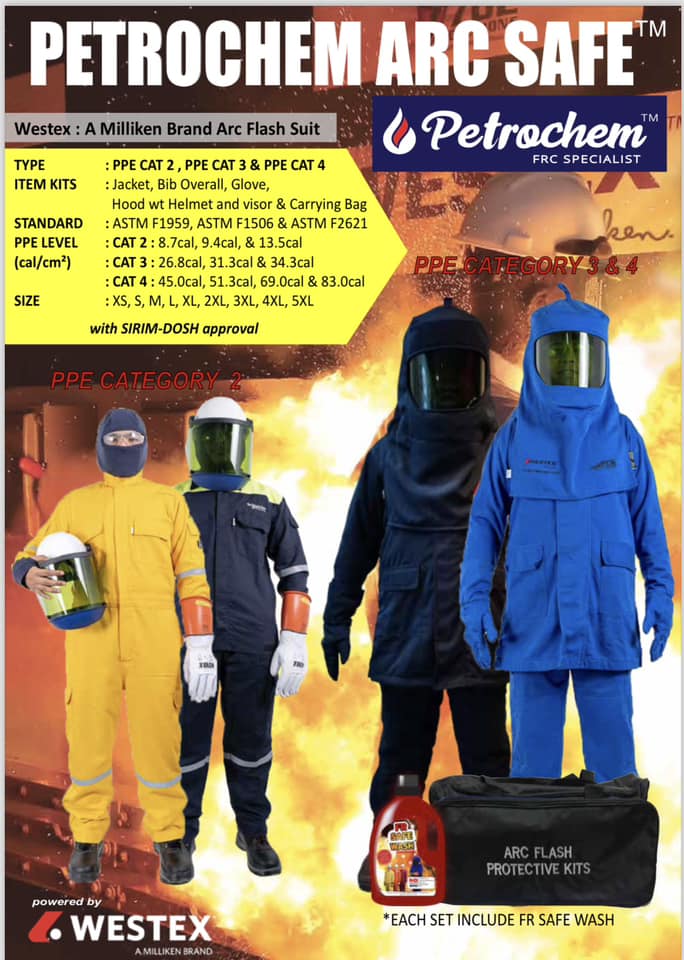
| MV chargeman suit | Full jacket and bib overall, integrated hood and visor, gloves, carrying bag | Medium-voltage switching, chargeman duties, switchgear and substation entry | Confirm the hood's own arc rating — it is tested separately from the body fabric |
| Cat 4 high-energy suit | Highest cal rating in the range, reinforced seams, full hood system | Petrochemical, high fault-current switchgear, substations, wherever the incident-energy study calls for it | Only worth the premium where the study actually requires this cal rating — over-specifying adds cost and heat stress for no protection benefit |
Not sure which tier your site needs? Tell us the voltage class and the task and we will recommend a tier — including saying so if you are over-specified. Ask for a recommendation →
How many suits you actually need
The question we actually get asked more often than “what's your price for 20 units” is “do we need one suit per person, or can the team share?” The honest answer: it depends on how the work is scheduled, not on headcount alone. A reasonable starting allocation is one suit per authorised switching operator on a given shift, plus a rotation spare for roughly every three to five operators to cover washing, inspection and the occasional suit that fails a pre-use check. Shared pool suits work for infrequent, planned switching tasks; they do not work well for teams doing switching daily across overlapping shifts, where the suit that should be available is the one currently in the wash.
Two things move a quotation more than most buyers expect on the way to that number. Mixed cal ratings and mixed sizes turn one order into several part numbers rather than one, which affects both pricing and lead time — get sizing done properly before the order goes out, not after the first suit arrives too small. And rush orders on a specific cal rating and voltage class are a lead-time item, not stock supply, so a fixed mobilisation date is worth flagging at enquiry stage rather than at delivery stage.
The number that matters: cost per certified worker per year
Unit price is the wrong comparison here even more than it is for general PPE, because an arc flash suit's working life is governed by wash cycles and exposure events, not just a calendar.
| Factor | Why it changes the annual figure |
|---|---|
| Wash-cycle limit | Arc-rated fabric is tested and rated for a stated number of industrial wash cycles before the manufacturer no longer stands behind the arc rating. A suit washed on-site with the wrong detergent or too often reaches that limit sooner than the roster assumes. |
| Retirement on exposure | Any actual arc exposure event retires the suit immediately, regardless of visible damage or age. This is a hard rule, not a judgement call, and the annual budget should assume it will happen at least once across a large enough team. |
| Contamination | Oil, grease or flammable-liquid contamination on the fabric can compromise the arc rating even without a switching incident. A suit that has been contaminated needs assessment before it goes back into rotation, not a quick wipe-down. |
| Hood and visor lens | Scratched or clouded visor lenses are typically replaced separately from the body of the suit, and a scratched lens can affect both visibility and the arc rating of the assembly. Budget for this as a consumable, not a one-time cost. |
| Storage conditions | Heat and humidity in Malaysian stores degrade FR fabric and elastic components faster than a temperate-climate service-life figure assumes. A suit stored in a hot, poorly ventilated cabinet has already used part of its life before it is ever issued. |
Run those together and the honest annual figure for a properly specified tier two or three suit, inspected and laundered correctly, is usually lower than the figure teams get from buying the cheapest suit twice as often because it failed inspection or an exposure event sooner than expected.
What a suspiciously cheap arc flash suit is missing
- A cal rating printed on the garment label. Not a verbal claim from the seller, an actual ATPV figure on the care label alongside the test standard it was tested to.
- A verifiable test certificate. IEC 61482-1-1 / 1-2 or ASTM F1506 test data, and SIRIM or DOSH approval documentation on the lines that carry it. Ask us to supply it with the delivery order.
- A hood and visor rated in their own right. The body fabric and the visor lens are tested separately. A high-cal jacket paired with an unrated visor is a suit that is only as strong as its weakest component.
- Gloves matched to the voltage class. A “complete kit” with gloves that are not rated for your system voltage is not complete, it is a gap dressed up as a solution.
- Genuinely arc-rated outer fabric. Aramid or a proper FR-treated blend self-extinguishes. A synthetic blend melts onto the skin instead of self-extinguishing, which is the opposite of what the suit is for.
- Stated wash limits and care instructions. Without these, nobody on your safety team can actually manage when the suit needs retiring.
What we stock
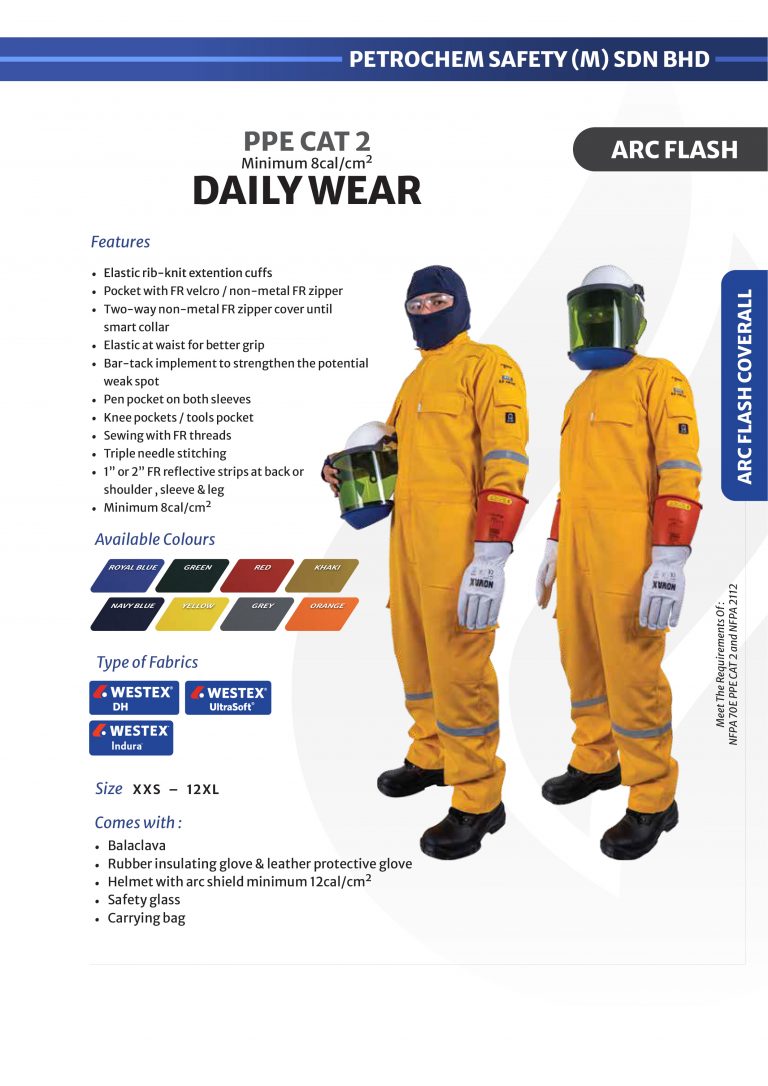
Petrochem Cat 2 FR Coverall
Fire retardant daily-wear coverall for routine panel and meter work in a Cat 2 exposure environment. The tier-one entry point — not a substitute for a rated suit once the task involves live switching.
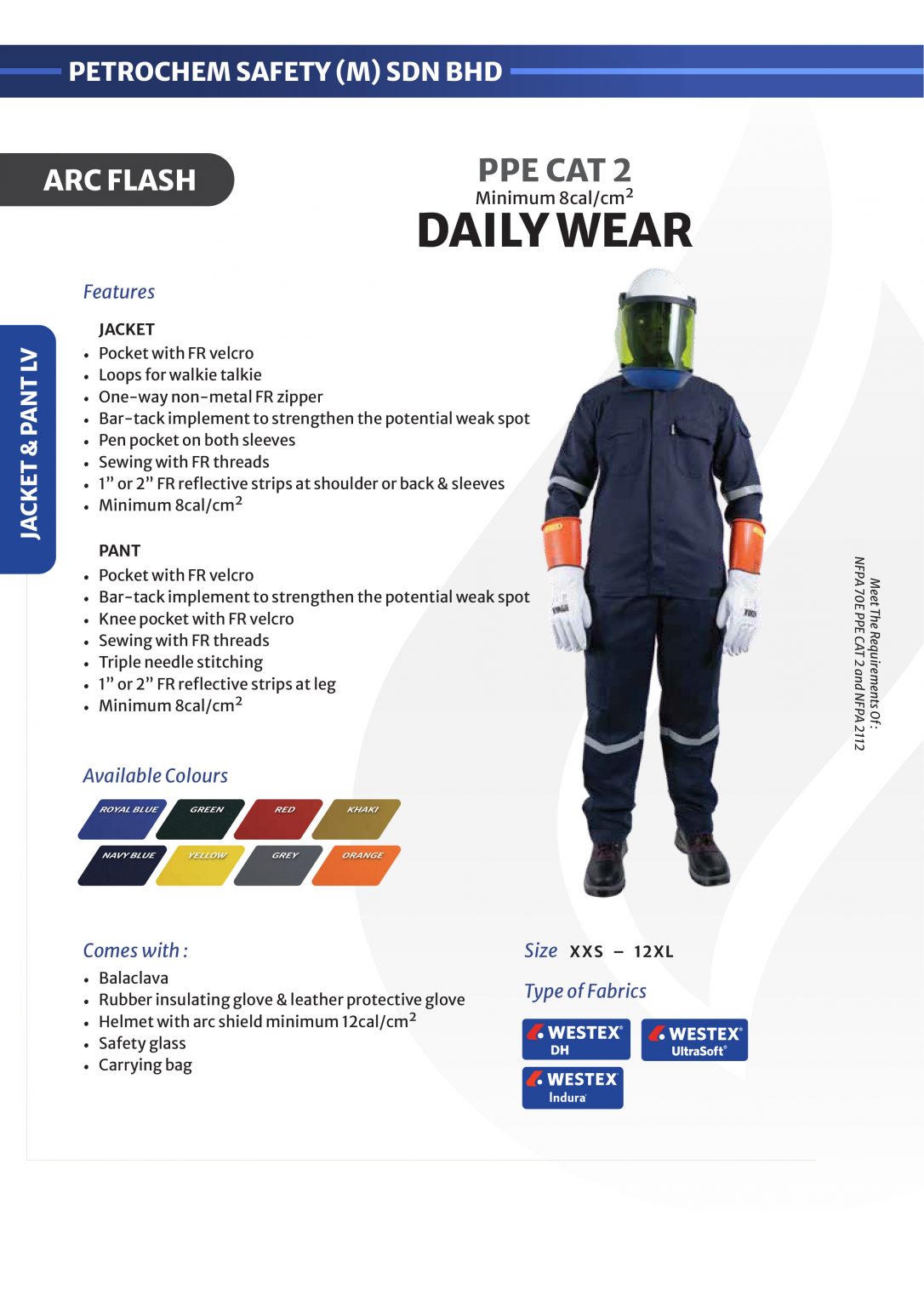
LV Jacket & Pants Arc Flash
Two-piece FR jacket and pants for low-voltage switchboard and MCC work. Confirm hood and glove compatibility against your voltage class before ordering.
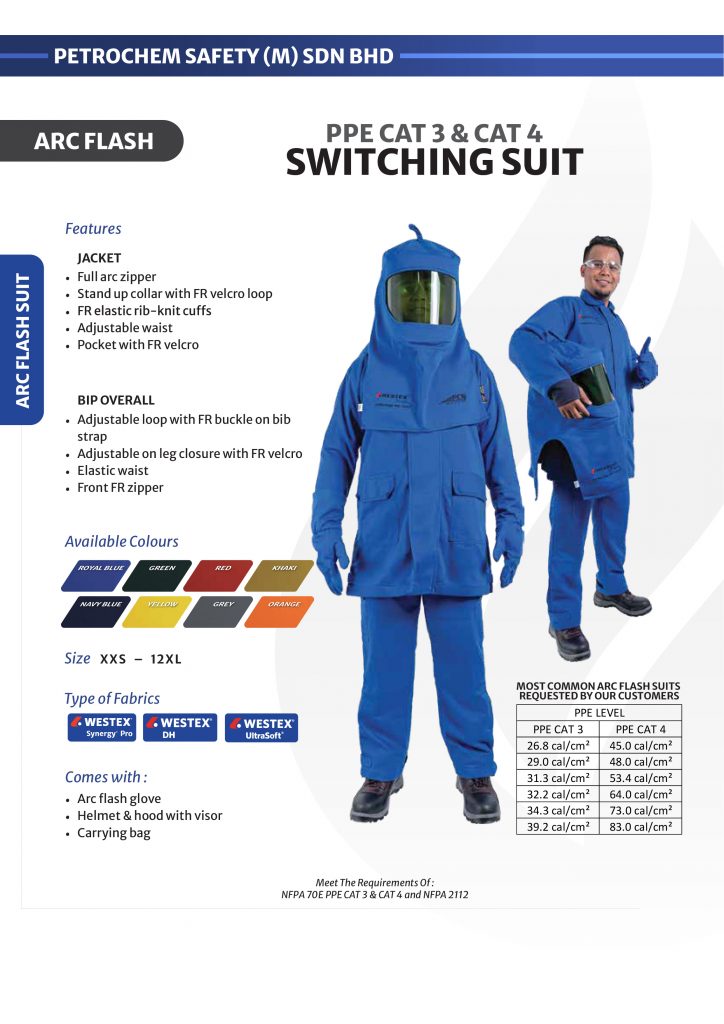
33kV / 45 Cal Chargeman Suit
Full jacket and bib overall with FR Velcro closures, comes complete with arc flash gloves, helmet and hood with visor, and a carrying bag. SIRIM and DOSH approved for medium-voltage switching and switchgear work.
Petrochem Cat 4, 43/69 Cal
Three-layer protection, bib-style pant, 2″ FR reflective strips, Aramid thread throughout and a storm guard over the front zipper. Specified where the incident-energy study calls for the highest tier.
We also carry the FCA8 arc flash face shield and visor as a standalone replacement, plus NOVAX voltage-rated insulating gloves by class, so a torn or expired component does not mean replacing the whole suit.
Get a real number against your spec
Tell us the cal rating or the voltage class, the quantity, and whether you need the hood, gloves and bag included or separate. We will come back with current pricing and the tier that actually fits the task.
Haisar Supply & Services Sdn Bhd · No. 7501, Jalan Enggang 19, Bandar Putra, 81000 Kulai, Johor · Seremban branch 011-3307 7509 · contact details
Pricing questions
How much does an arc flash suit cost in Malaysia?
It depends entirely on tier. Across the four tiers described above the range is roughly fourfold, from a daily-wear FR coverall to a Category 4 high-energy switching suit with a full hood system. Most Malaysian sites need tier two or three. Send us the cal rating or voltage class and the quantity, and we will give you a current figure rather than a stale published one.
What cal rating do I need for my site?
That comes from an incident-energy assessment against your system voltage and fault current, not from a general rule of thumb. If you already have that figure from an electrical safety study, tell us the number. If you do not, tell us the task and the voltage class and we will point you toward the tier that is typically specified for it, and flag where you should get a proper study done first.
Do I need one suit per worker, or can the team share?
It depends on scheduling more than headcount. A reasonable starting point is one suit per authorised switching operator on a given shift, plus a rotation spare for roughly every three to five operators to cover washing and inspection. Shared pools work for infrequent, planned tasks; they struggle where switching happens daily across overlapping shifts.
How long does an arc flash suit last, and how many washes?
Arc-rated fabric is tested and rated for a stated number of industrial wash cycles, after which the manufacturer no longer stands behind the arc rating — ask us for the figure on the specific line you are buying. Separately, any actual arc exposure event retires the suit immediately regardless of age or visible damage, and contamination with oil, grease or flammable liquid should trigger an assessment before the suit goes back into rotation.
Can you supply IEC or ASTM test certificates and SIRIM/DOSH approval?
Yes, on the lines that carry them. Ask at quotation stage and the documentation is issued with the delivery order, so your audit file is complete before a client or a DOSH inspector asks for it.
What is the difference between an arc flash suit and a normal FR coverall?
An FR coverall resists ignition and self-extinguishes, which is the baseline for daily wear around energised equipment. An arc flash suit is tested and rated to a specific cal number for the thermal energy of an actual arc event, and at the higher tiers includes an integrated hood, visor and gloves rated as part of the same system. The two are not interchangeable once the task involves live switching.
