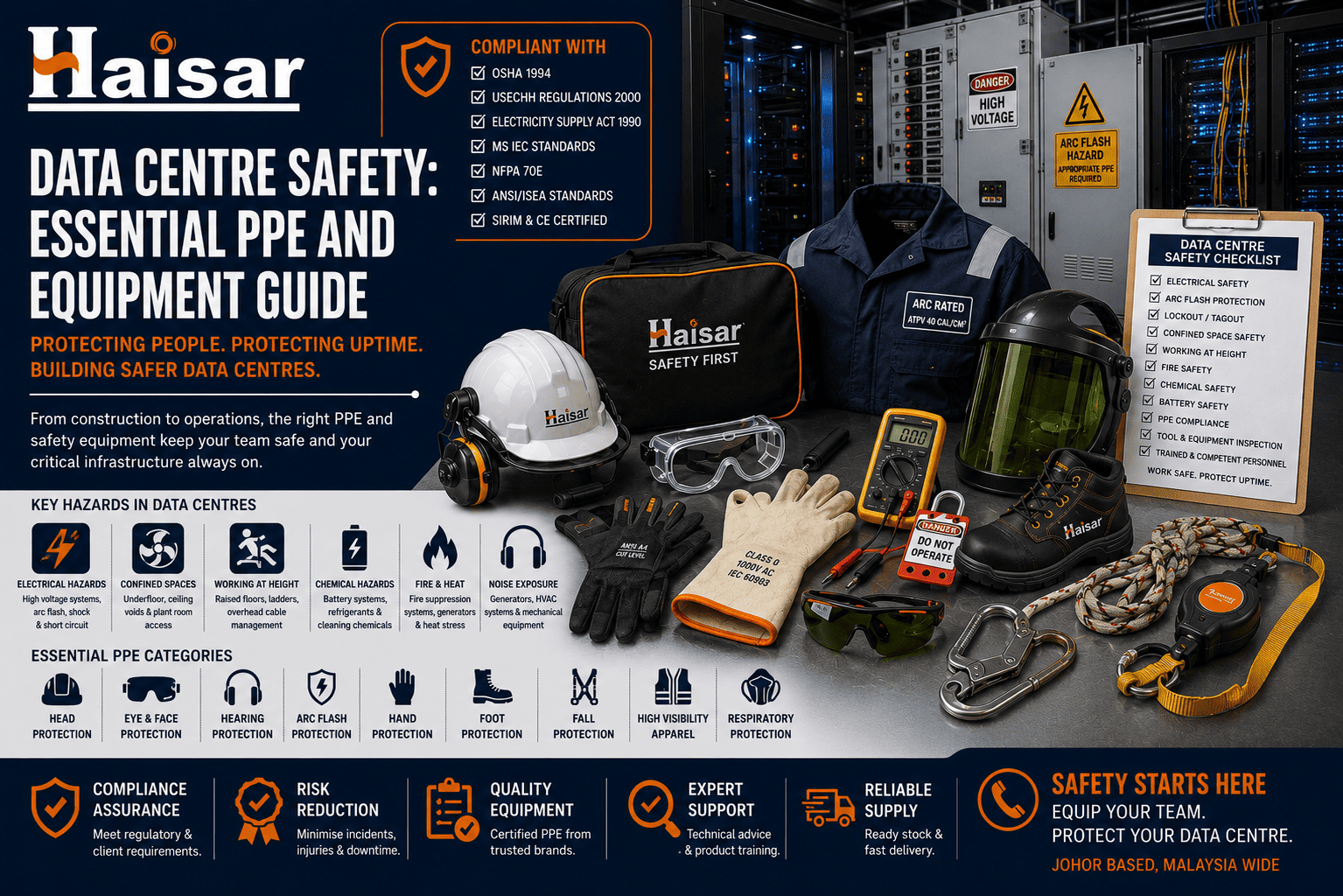
Johor is becoming one of Southeast Asia's most significant data centre corridors. The combination of land availability, competitive power tariffs, proximity to Singapore's hyperscale demand, and strong fibre connectivity has attracted investment from some of the world's largest cloud and colocation operators. Iskandar Puteri, Nusajaya, and the broader Greater Johor Bahru area now host a growing number of hyperscale and enterprise data centre facilities, with further development in the pipeline across multiple sites.

Behind every commissioned data centre rack is a construction and fit-out programme employing hundreds of workers across civil, structural, mechanical, electrical, and low-voltage trades. And behind every operational data centre is an ongoing maintenance and facilities management operation employing engineers, technicians, and service contractors who work in an environment that carries specific and significant safety hazards.

Data centres are not conventional office buildings. They house high-density electrical systems operating at voltages from 230V to 33kV or higher at the grid connection point. They run critical cooling infrastructure including refrigerants under pressure. They contain battery backup systems with chemical and electrical hazards. And they operate under client safety standards that often exceed the Malaysian regulatory baseline in specificity and enforcement rigour.

This guide covers the essential PPE and safety equipment for data centre construction, fit-out, and operations in Malaysia, with particular focus on the electrical safety requirements that define the risk environment.

 WhatsApp us for a quick quote 

The Data Centre Safety Environment in Malaysia

Data centre safety in Malaysia operates within the standard OSHA 1994 and DOSH regulatory framework but is increasingly shaped by the safety standards of the international hyperscale operators who own or lease the facilities. Operators including major cloud providers and colocation companies impose contractor safety requirements that go beyond Malaysian regulatory minimums and that are enforced through mandatory site inductions, permit-to-work systems, and the ability to remove contractors from site for safety violations.

For contractors and fit-out teams working in Johor's data centre sector, this means operating to a higher safety standard than they may be accustomed to on conventional construction projects. The PPE requirements, the documentation expectations, and the behavioural standards on international data centre operator sites reflect global best practice, not just the Malaysian baseline.

The primary hazard categories in data centre environments are electrical hazards from high-density power infrastructure, confined space hazards in underfloor, ceiling void, and plant room environments, working at height on raised floor systems and overhead cable management, chemical hazards from battery systems and refrigerants, and noise and heat stress in plant room and generator hall environments.

Each of these requires specific equipment and specific competency from the workers and contractors operating in the space.

Electrical Safety PPE for Data Centres

Electrical hazards are the defining safety challenge of the data centre environment. Unlike a conventional construction site where electrical work is one of several trades, data centre construction and operations are fundamentally electrical in nature. The density of electrical infrastructure, the scale of the power systems, and the requirement for continuous uptime in operational facilities create an electrical risk environment that demands rigorous PPE selection and management.

Arc flash risk in data centre electrical systems is significant and frequently underestimated by contractors new to the sector. Data centres operate switchgear, UPS systems, distribution boards, and bus bars at power levels and fault current values that produce high incident energy arc flash events. The incident energy at a data centre main switchboard or primary distribution panel can be high enough to be fatal at distances of several metres from the fault point.

Arc flash PPE for data centre electrical work must be based on a site-specific arc flash risk assessment that calculates the incident energy at each work location. PPE selected without reference to this calculation is not compliant with the standards applied by international data centre operators and may not provide adequate protection.

What data centre electrical work requires:

Arc flash rated face shields or switching hoods rated to the incident energy calculated for each work location. Arc flash rated coveralls or two-piece garments with an ATPV in cal/cm² equal to or exceeding the incident energy at the work location. Voltage-rated insulating rubber gloves matched to the system voltage, Class 0 for low voltage work up to 1,000V AC and Class 2 or higher for medium voltage switchgear. Voltage-rated insulating tools to IEC 60900 for all live or near-live work. Non-contact voltage detectors rated for the system voltage for circuit status verification before any contact. Insulating matting at switchboard and distribution board locations.

Lockout/tagout for data centres carries an additional complexity not present in most industrial environments: the requirement to maintain uptime. Live electrical systems in operational data centres cannot always be de-energised for routine maintenance without impacting critical infrastructure. This creates scenarios where work must proceed near live systems with engineering and administrative controls managing the residual risk rather than full isolation. LOTO equipment must be in place for all work where isolation is possible, and where live work is unavoidable, it must be carried out only by authorised competent persons with appropriate arc flash PPE and under a documented safe work procedure approved by the facility operator.

LOTO equipment for data centre environments includes lockout padlocks keyed individually to each authorised worker, hasp lockout devices, circuit breaker lockout devices compatible with the specific breaker configurations in the facility, and tagout tags with durable, moisture-resistant construction appropriate for high-humidity data hall environments.

PPE for Data Centre Construction and Fit-Out

The construction and fit-out phase of a data centre project in Johor involves a broad range of trades working simultaneously in a complex, rapidly evolving environment. The PPE requirements span the full range of construction site hazards with additional data centre-specific considerations.

Head protection. Class B safety helmets providing both impact and electrical protection are the appropriate default specification for all workers on data centre construction sites. The prevalence of overhead electrical work and the continuous presence of live electrical infrastructure in later construction phases makes Class A helmets inadequate. Helmets must be worn in all areas with active overhead work and wherever ceiling voids and cable management systems are being installed.

Eye and face protection. Construction dust from drilling, cutting, and grinding operations in data centre fit-out phases is significant. Safety goggles and face shields are required for all drilling, grinding, and cutting operations. For electrical termination work, arc flash rated face protection must be worn as specified by the site's arc flash assessment.

Respiratory protection. Data centre construction involves significant dust generation from concrete work, raised floor installation, and above-ceiling cabling. P2 or P3 respirators are required for dusty tasks. In areas where fire suppression agents including certain inert gas and clean agent systems have been partially commissioned, workers must be aware of the agent type and the respiratory implications of a system discharge.

Hand protection. Cable pulling, cable management installation, and electrical termination work generate cut risk from sharp cable trays, conduit ends, and cable armour. Cut-resistant gloves rated to ANSI A4 or higher are appropriate for cable management and tray installation work. Electrical insulating rubber gloves must be worn for all live electrical work as specified by the voltage class of the system.

Fall protection. Data centre construction involves working at height on raised floor systems, in ceiling voids, and on elevated platforms for overhead cable management and cooling infrastructure installation. Full-body harnesses with appropriate lanyards or SRLs are required wherever collective fall protection including edge protection and guardrails is not in place. The raised floor systems common in data halls create tripping and fall hazards at ground level that require attention to floor opening covers and clearly marked safe walkways.

Foot protection. Anti-static safety footwear is required in live data hall environments where electrostatic discharge is a risk to sensitive electronic equipment. S3 rated steel-toe safety boots with anti-static specification are the appropriate standard footwear for most data centre construction and operational environments. Standard construction boots without anti-static rating must not be worn in live data hall environments.

High-visibility garments. During active construction phases with plant and vehicle movement, Class 2 or Class 3 hi-vis vests or jackets are required in all areas where mobile plant is operating. In operational data hall environments where forklift and pallet jack movement occurs during fit-out and equipment installation, hi-vis remains a site standard on most major operator sites in Johor.

Confined Space Safety in Data Centres

Data centres contain multiple confined space environments that are routinely entered during construction, fit-out, and maintenance operations. Underfloor plenums on raised floor systems, ceiling void spaces, plant room sumps, cable transit ducts, and generator fuel storage areas all qualify as confined spaces under the DOSH definition.

The atmospheric hazards in data centre confined spaces include oxygen depletion from fire suppression system discharges or from battery off-gassing in UPS rooms, carbon monoxide from generator operation or from fuel system leaks, and refrigerant accumulation from cooling system leaks in plant rooms.

Gas detection is mandatory for confined space entry in data centre environments. A four-gas monitor covering O2, LEL, CO, and H2S provides the baseline detection capability for most data centre confined spaces. In UPS rooms and battery rooms, hydrogen gas detection should be added given the off-gassing potential of VRLA and flooded lead-acid battery systems during charge.

Full confined space entry procedures including pre-entry atmospheric testing, continuous monitoring during entry, ventilation, tripod and retrieval system deployment, and a trained standby person at the entry point are required for all data centre confined space entries.

Battery System Safety

Data centre UPS systems rely on large banks of batteries providing backup power for critical loads. Battery systems in Malaysian data centres range from valve-regulated lead-acid (VRLA) batteries to lithium-ion systems increasingly adopted for their energy density and cycle life. Both present specific safety hazards that require appropriate equipment.

VRLA battery banks off-gas hydrogen during charge and during thermal runaway events. Hydrogen is flammable at concentrations above 4% in air and accumulates in enclosed spaces. Battery rooms and UPS rooms must be ventilated to prevent hydrogen accumulation and gas detection must be in place where hydrogen risk is present.

Lithium-ion battery systems present thermal runaway risk that produces toxic gases including hydrogen fluoride during severe events. The PPE and emergency response requirements for lithium-ion battery incidents are more demanding than for VRLA systems and must be addressed in the site emergency response plan.

Chemical resistant gloves and eye protection are required for all battery maintenance operations involving electrolyte handling. Emergency eye wash stations must be available within 10 seconds of travel from all battery maintenance locations.

Heat Stress Management in Data Centre Environments

Data centre plant rooms, generator halls, and UPS rooms operate at elevated temperatures due to the heat output of the equipment they contain. Workers performing maintenance in these environments are at risk of heat stress, particularly during extended maintenance windows or fault-finding activities.

Work-rest regimes appropriate to the ambient temperature must be implemented for workers in high-temperature plant room environments. Personal cooling equipment including cooling towels and cooling vests can extend the productive work period in hot environments. Hydration must be actively managed, not left to individual discretion.

Generator maintenance environments carry the additional hazard of elevated CO from engine exhaust. Maintenance in generator enclosures must be conducted with adequate ventilation and CO monitoring.

Why Johor's Data Centre Contractors Choose Haisar

Haisar Supply and Services, based in Kulai, Johor, is positioned specifically to serve the data centre construction and operations market growing across Greater Johor Bahru and Iskandar Puteri. We understand the electrical safety standards that international data centre operators apply to their contractor base, the arc flash PPE requirements that ATPV-based assessments generate, and the documentation expectations of principal contractors and facility operators in this sector.

Our data centre safety equipment supply covers arc flash rated PPE across multiple ATPV ratings, voltage-rated insulating gloves and tools, complete LOTO systems compatible with data centre electrical configurations, anti-static safety footwear, confined space gas detection and rescue equipment, battery room safety equipment including eye wash stations and chemical resistant PPE, and the full range of construction phase PPE for data centre fit-out teams.

We supply to project sites across Johor with fast quotation turnaround and the product knowledge to advise on specification for data centre-specific requirements rather than defaulting to generic industrial PPE recommendations.

Get a Quote for Data Centre Safety Equipment

Whether you are equipping a fit-out team for a new data centre project in Johor, managing safety equipment supply for an operational data centre maintenance programme, or reviewing your current PPE arrangements against the standards your principal contractor or facility operator requires, Haisar is ready to help.

Get a Quote from Haisar

Contact our team with your project details and we will respond with equipment recommendations, specifications, and pricing tailored to your data centre safety requirements.

Haisar Supply and Services Sdn Bhd (985158-T) | Kulai, Johor, Malaysia | www.haisar.com