Can't find what you're looking for? Get in touch!



Short answer: Price follows type, and type follows hazard. A portable self-contained eyewash, a plumbed eyewash and a floor-mounted combination eyewash and drench shower are three different products separated by a wide margin - and by whether the risk is to eyes alone or to the whole body. Work out the type from the hazard first; the price question answers itself after that.
We stock well over a dozen eyewash and safety shower variants - portable, wall mounted, bench mounted, pedestal, floor mounted, twin head, combination with drench shower, plus accessories and eye wash solution. That breadth exists because sites genuinely need different things at different points, and the commonest procurement mistake is buying one type and fitting it everywhere.
Our placement guide covers where units go. This page is about which type to buy and what moves the price.
The ten-second rule, and how sites fail it
Almost every non-compliance we see is a routing problem rather than a distance problem. The unit is the correct distance away on the drawing, but the route runs through a self-closing door, up a step, around a pallet stack that lives there permanently, or across a level change. Someone with a caustic in their eyes cannot see, cannot open a door with two hands full of their own face, and will not find a unit they have to navigate to.
For strong acids and caustics the guidance goes further: put the unit immediately adjacent to the hazard rather than at the ten-second limit. Seconds matter more with those than with anything else.
What the unit has to deliver
The tepid water requirement, 16 to 38°C, is the one most often ignored in Malaysia - usually in the opposite direction from cold countries. A line that has been sitting in the sun will deliver its first several litres hot enough to be unusable, and hot water opens the pores and drives chemicals into the tissue rather than flushing them off it. If a plumbed unit is fed by exposed pipework, that needs solving at design stage.
The other figure worth internalising is the fifteen minutes. It is not a target, it is the design duration - and it is why a small bottle of eye wash solution is a first aid item, not an eyewash station. A self-contained unit has to sustain 1.5 L/min for the full quarter of an hour.
Portable, plumbed or combination
What moves the price
| Driver | Effect | What to check |
|---|---|---|
| Type | The dominant factor. Portable, plumbed eyewash and full combination shower are widely separated | Decide from the hazard, not the budget |
| Material | Stainless steel 304 costs more than ABS or coated steel, and lasts far longer in chemical and coastal environments | In Pasir Gudang or any marine-adjacent site, stainless pays for itself |
| Mounting | Wall and bench units are cheaper than pedestal and floor-mounted; floor-mounted needs drainage | Installation and drainage are separate costs from the unit |
| Bowl and head configuration | Twin-head sprayers, dust covers and larger bowls all add cost | Dust covers are worth having — a contaminated head defeats the point |
| Capacity, for portables | Larger reserve costs more but buys the full 15 minutes | Distinguish maximum reserve from working volume — they are not the same number |
| Tepid water provision | Thermostatic mixing or tempering is a separate item and often the largest add-on | Necessary where supply temperature falls outside 16–38°C |
| Installation & commissioning | Pipework, drainage, signage, flow testing | Ask whether a quotation is supply-only or supply-and-install |
What we stock
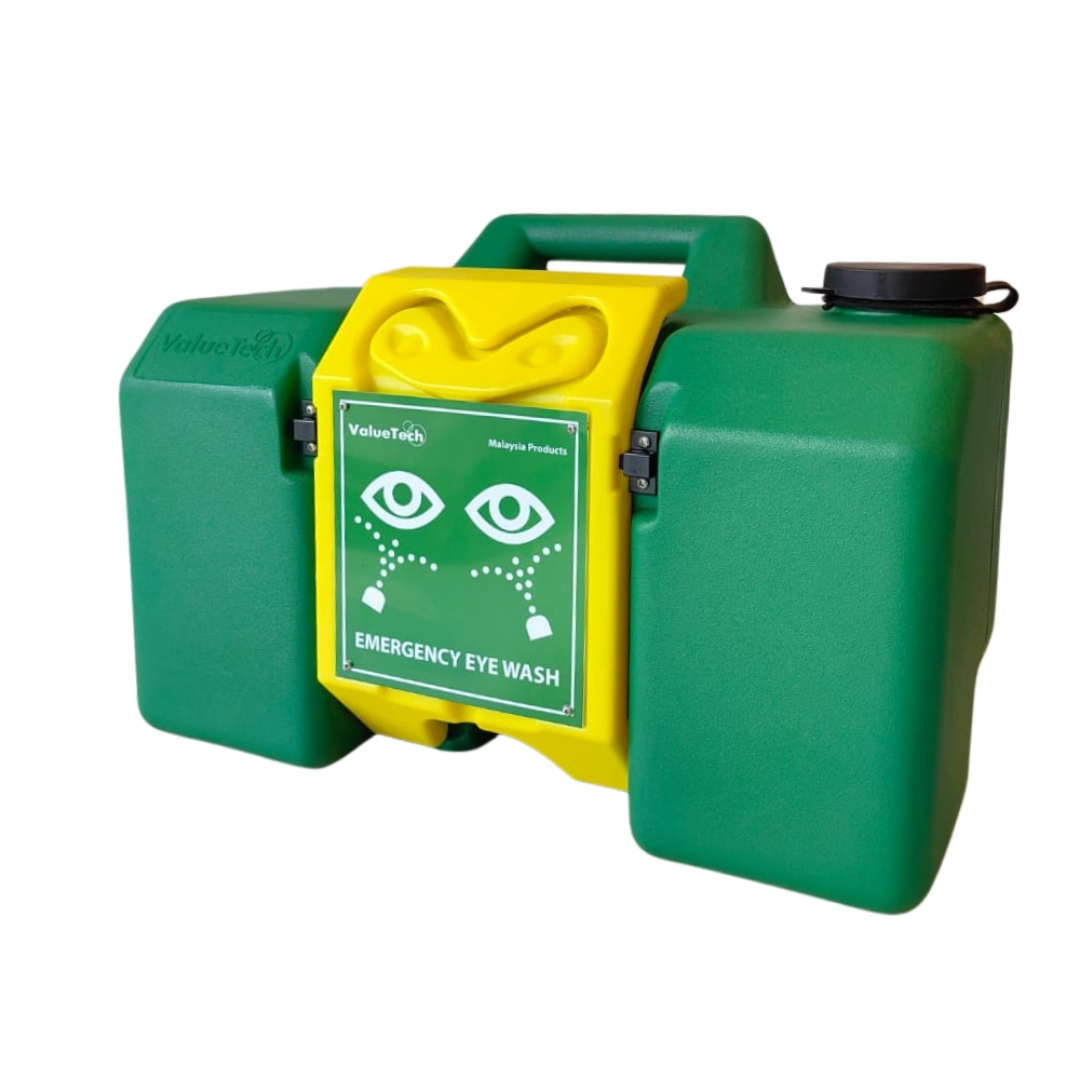
Portable Eyewash — VAL-PE8
Value-Tech, 30 litre / 8 gallon maximum reserve with a 20 litre working volume, flow not lower than 1.5 L/min for the full 15 minutes. High density polyester, green, wide filling hole with dust cover. For jetties, remote manifolds and anywhere plumbing does not reach.

Combination Shower — VAL-SE-S201-V2-BSH
Stainless steel 304 throughout -42 mm pipework, 300 mm shower and eyewash bowls - with a 1" BSP pull-rod shower valve and 1/2" BSP push-board eyewash valve. 640 × 2300 mm, 1" inlet, working pressure 0.2–0.6 MPa.
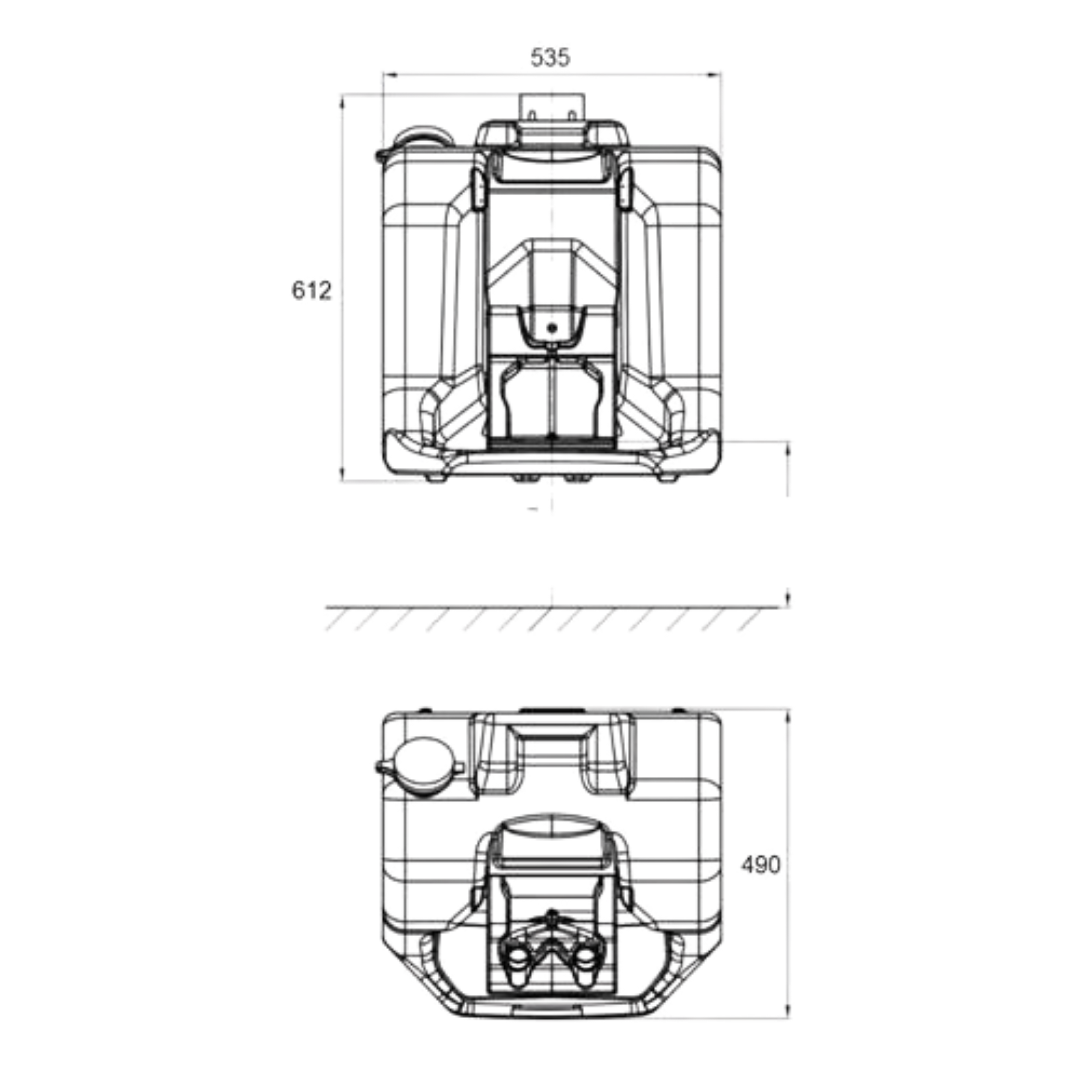
Wall, Bench & Pedestal Units
Wall-mounted ABS and stainless variants, bench-mounted units for laboratories, twin-head sprayers, floor-mounted eyewash and stainless wall showers - plus eyewash solution, spill trays and pegboards to complete the station.
Weekly and annual duties
- Activate plumbed units weekly. Long enough to clear the line of sediment and stagnant water, and to prove the valve still opens in one second and stays open hands-free.
- Full performance test annually. Flow rate, pattern, duration and temperature checked against the standard, with a record kept.
- Portables need a fluid regime. Check the level, and follow the manufacturer's interval for changing the water or preservative solution. A portable unit filled with year-old water is worse than none, because people trust it.
- Keep dust covers on and the path clear. The two failure modes that cost nothing to fix and get found at every audit.
- Sign it and light it. A highly visible sign, and lighting good enough to find the unit with impaired vision.
Fitting out a new area? Send a layout with the chemical points marked and we will tell you how many units, what type and where. Ask for a site recommendation →
Tell us the chemical and the location
What is handled, whether plumbing reaches the point, and how many positions need covering. We will specify the type before we quote a number.
Haisar Supply & Services Sdn Bhd · No. 7501, Jalan Enggang 19, Bandar Putra, 81000 Kulai, Johor · Seremban branch 011-3307 7509 · contact details
Buying questions
How much does an emergency eyewash station cost in Malaysia?
It depends on type more than anything else. A portable self-contained unit, a wall-mounted plumbed eyewash and a stainless steel floor-mounted combination shower are widely separated in price. Tell us the chemical handled and whether plumbing reaches the location and we will specify the right type, then quote it.
Is a portable eyewash acceptable, or do we need plumbed?
A portable unit is the right answer where plumbing genuinely cannot reach — jetties, remote manifolds, temporary works. It is not a cheaper substitute for plumbing that could be run. Whichever you use, it must sustain 1.5 L/min for a full fifteen minutes.
When do we need a drench shower as well as an eyewash?
When a credible splash could reach the body rather than only the eyes — drum decanting, tank farm work, acid and caustic handling. A combination unit lets both be used at once by the same person, which is the point of the configuration.
What is the tepid water requirement?
16 to 38°C. In Malaysia the usual problem is heat rather than cold: exposed pipework in the sun delivers its first litres far too hot, and hot water drives chemicals into tissue instead of flushing them away. If your supply sits outside that range, tempering is a separate item to budget for.
How often does an eyewash station need testing?
Plumbed units are visually inspected and activated weekly, with a full performance test annually. Portable units need their level checked and the fluid changed at the manufacturer's interval. Keep records of both — that is what an auditor asks to see.
What is the difference between maximum reserve and working volume?
They are not the same number. Our VAL-PE8, for example, holds 30 litres maximum reserve with a 20 litre working volume. Compare working volumes rather than tank sizes when you are checking that a unit delivers the full fifteen minutes.
Do you supply installation as well as the unit?
Tell us what you need. Floor-mounted combination units require a water supply and drainage, and quotations can be supply-only or include the associated work — it is worth being explicit about which you are comparing.
