Can't find what you're looking for? Get in touch!



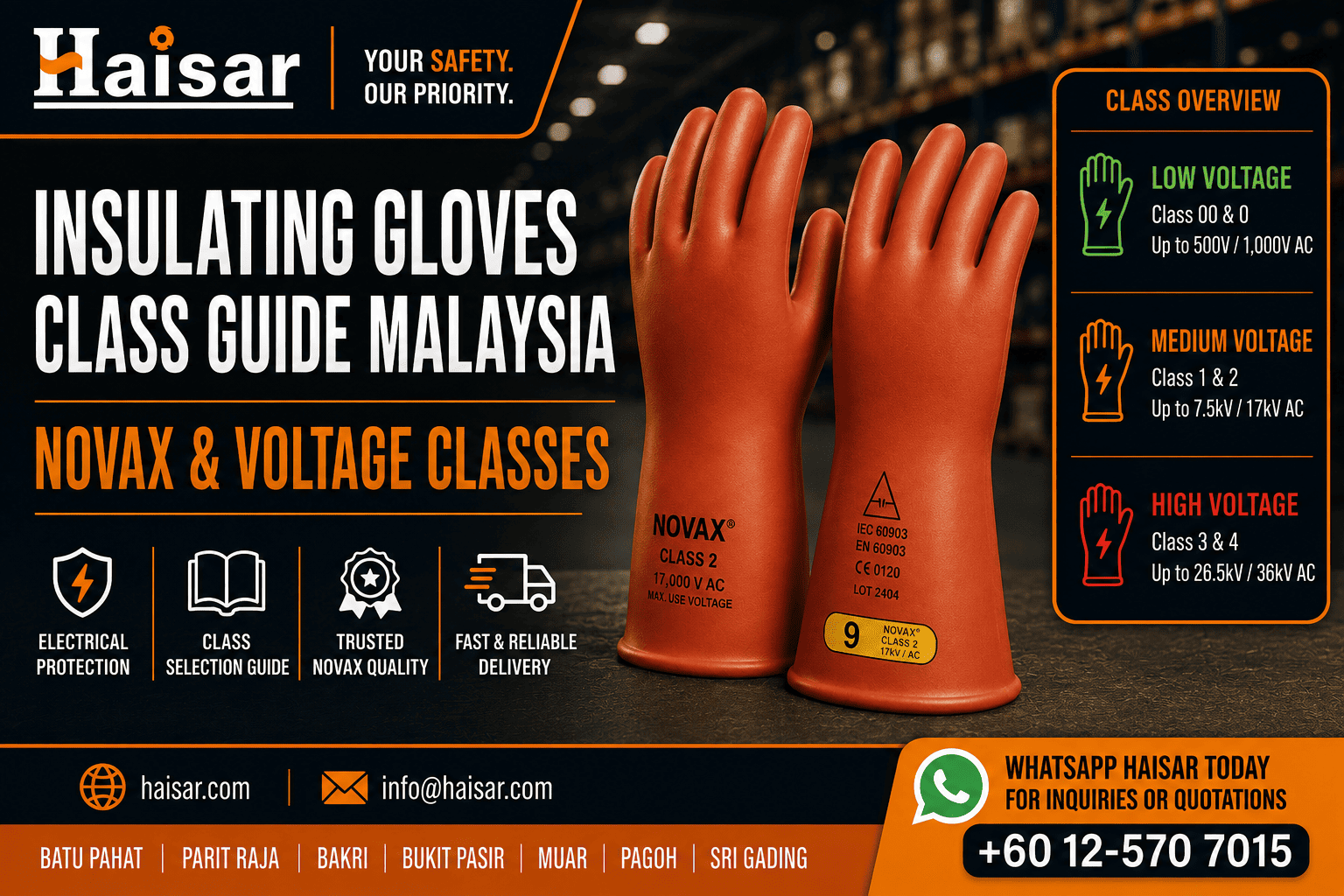
Short answer: The class is decided by the voltage you could contact, not by preference or budget. Class 00 covers up to 500 V, Class 0 to 1,000 V, Class 1 to 7,500 V, Class 2 to 17,000 V, Class 3 to 26,500 V and Class 4 to 36,000 V, all AC maximum use per ASTM D120. Work out your class from the table below, then order by class, length, size and cuff style.
This is an ordering page. If you want the fuller treatment of how to inspect, store and care for insulating gloves, our selection, storage and inspection guide covers that properly. What follows is the part people get wrong at the point of raising a purchase order: which class, how long, what size, and how often it has to go back for test.
Voltage to class: the only table that matters
| Class | Max use, AC | AC proof test | Max use, DC | Typical Malaysian application |
|---|---|---|---|---|
| Class 00 | 500 V | 2,500 V | 750 V | Low voltage panel work, control circuits, instrumentation |
| Class 0 | 1,000 V | 5,000 V | 1,500 V | 415 V LV distribution, MCC and DB work, general maintenance |
| Class 1 | 7,500 V | 10,000 V | 11,250 V | 3.3 kV and 6.6 kV plant distribution |
| Class 2 | 17,000 V | 20,000 V | 25,500 V | 11 kV switchgear - the common chargeman requirement |
| Class 3 | 26,500 V | 30,000 V | 39,750 V | 22 kV networks |
| Class 4 | 36,000 V | 40,000 V | 54,000 V | 33 kV switching and substation work |
Two things follow from that table. First, an 11 kV board needs Class 2 - Class 1 stops at 7,500 V and does not cover it. Second, the proof test voltage is not the working voltage; it is the factory and periodic test level, and it appears on the test certificate rather than being something you work to.
Always specify against the highest voltage the wearer could come into contact with, including the possibility of a fault or a mis-identified circuit. This is not a place to specify against the nominal.
The four things to specify
| Specify | Options | Why it matters |
|---|---|---|
| Class | 00, 0, 1, 2, 3, 4 | Set by voltage. Everything else is preference; this is not. |
| Length | Commonly 280 mm (11"), 360 mm (14"), 410 mm (16"), 460 mm (18") | Longer gives more clearance up the forearm. Higher classes generally want more length. |
| Size | Numbered sizes, typically 7 to 12 | A glove that is too tight will not be worn for a full task; too loose loses dexterity. Order a size set for a team. |
| Cuff style | Straight, bell or contour | Bell cuffs give room over a sleeve; straight is the common default. |
One further option worth asking about: bi-colour construction, where a contrasting inner layer shows through if the outer surface is cut or scratched. It makes damage visible during the pre-use inspection instead of relying on someone spotting a nick in black rubber.
The glove is a three-layer system
The leather protector is the part most often skipped, and skipping it is expensive rather than merely non-compliant. Rubber insulating gloves fail mechanically long before they fail electrically - a snag on a cabinet edge, a scrape against a busbar shroud, contact with a sharp tool. Without a protector, one careless movement takes a certified glove out of service.
Retest intervals and what invalidates a rating
Common practice, and the basis most Malaysian electrical safety programmes work to, is an electrical retest at intervals not exceeding six months for gloves in service, and retest before issue for gloves that have been sitting in storage. A glove is only rated while its test is current, so the date stamp is what an auditor looks for - not the class marking.
- Air test before every use. Roll the cuff to inflate the glove and check for leaks by sight, sound and feel. It takes seconds and it catches the damage that matters.
- Visual inspection every time. Cuts, cracks, embedded debris, ozone checking, swelling or a change in texture all take a glove out of service immediately.
- Never store folded or compressed. Use a glove bag, stored upright, away from heat, sunlight and ozone sources such as motors.
- Keep petroleum products away. Oils, greases and solvents degrade natural rubber. This includes hand creams.
- Retire after any suspected contact or damage. Send it for test, or take it out of service. Do not let it back on the rack "to be checked later".
- Keep the certificates. Test documentation is what makes your programme evidenceable. File it with the glove register.
What we stock
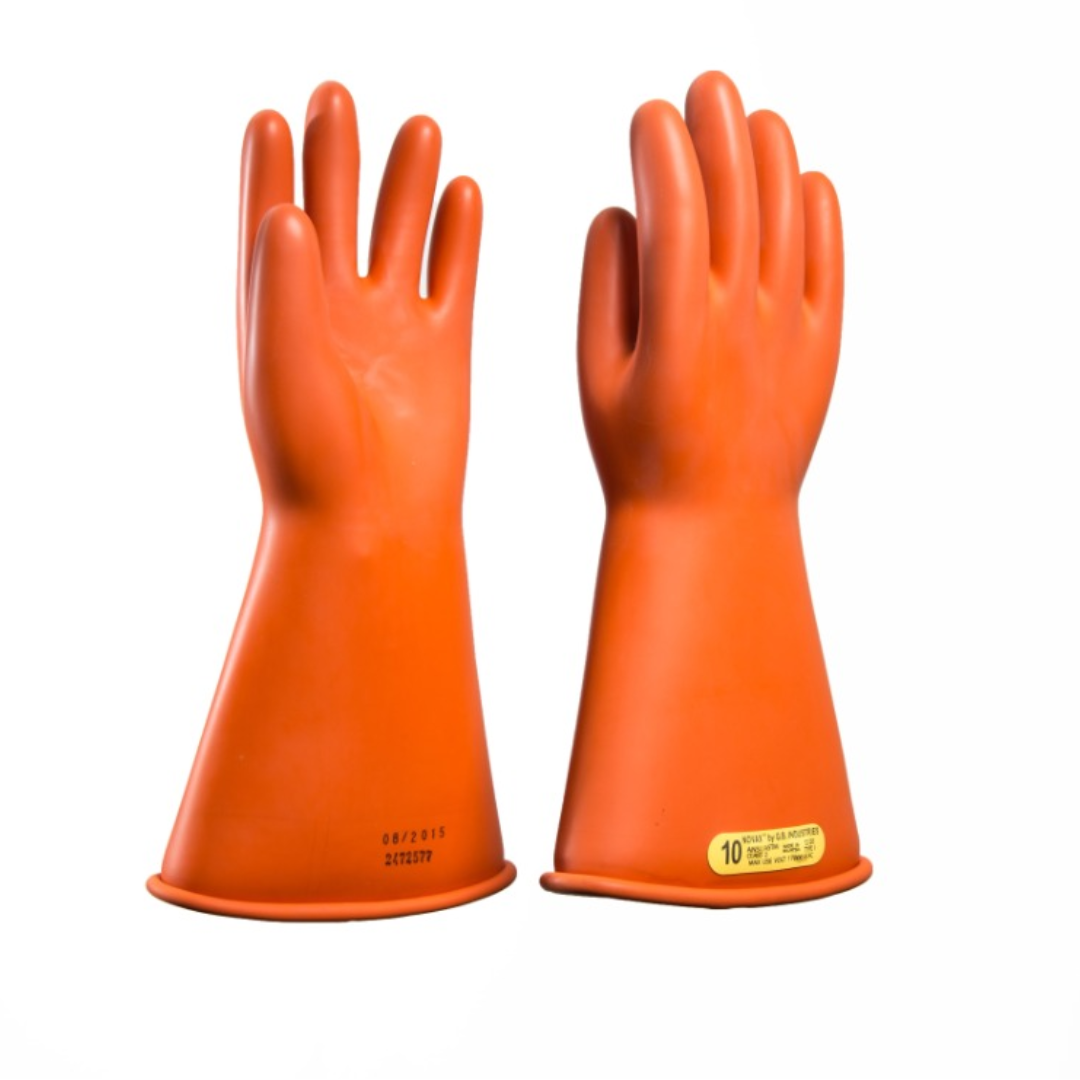
Novax Class 0 — 1,000 V
The workhorse for 415 V distribution, MCC and DB work. Natural latex, EU and UKCA declarations of conformity. Multiple lengths, sizes and cuff styles available, with bi-colour construction as an option for damage detection.
Novax Class 2 — 17,000 V
AC max use 17,000 V, AC proof test 20,000 V, DC max use 25,500 V. Natural latex from an aqueous dip process, 360 mm (14") default length, orange, straight cuff. The class most 11 kV chargeman work calls for.
The rest of the system
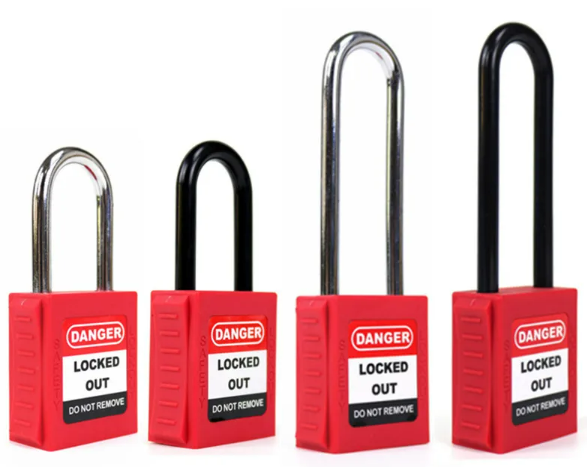
Gloves are one control among several. We supply insulating switchboard mats, insulation stools, fibreglass rescue hooks, dielectric boots, arc flash kits and complete LOTO sets — so the electrical safety package comes from one account.
We hold Class 00, 0, 1 and 2 in the Novax range. Class 3 and Class 4 for 22 kV and 33 kV work are available to order - tell us the class and lead time expectations early, because these are not stock items.
Order by class, not by guesswork
Tell us the system voltage, how many people need kitting out, and their sizes. If leather protectors and a glove bag are not already on your list, we will add them.
Haisar Supply & Services Sdn Bhd · No. 7501, Jalan Enggang 19, Bandar Putra, 81000 Kulai, Johor · Seremban branch 011-3307 7509 · contact details
Ordering questions
Which class do I need for 11 kV work?
Class 2, which has an AC maximum use voltage of 17,000 V. Class 1 stops at 7,500 V and does not cover an 11 kV system. Always specify against the highest voltage that could be contacted, not the nominal you expect.
What is the difference between max use voltage and proof test voltage?
Maximum use voltage is the working limit for the class. Proof test voltage is the higher level the glove is tested at during manufacture and at each periodic retest — it appears on the certificate and is not a voltage you work to. For Class 2 those figures are 17,000 V and 20,000 V respectively.
How often do insulating gloves need retesting?
Common practice is electrical retest at intervals not exceeding six months for gloves in service, plus retest before issue for gloves that have been in storage. A glove is only rated while its test is current, so the date stamp is what matters at audit.
Do we have to use leather protectors?
You should. Rubber insulating gloves fail mechanically far sooner than they fail electrically, and a single snag on a cabinet edge can end a certified glove's service life. Protectors must be compatible with the class and length so that clearances are maintained.
What length should we order?
360 mm (14") is the common default. Longer lengths give more forearm clearance and are generally preferred at higher classes. Tell us the work and we will recommend rather than leaving you to guess.
Do you stock Class 3 and Class 4?
We hold Class 00 through Class 2. Class 3 and Class 4 for 22 kV and 33 kV work are available to order rather than from stock, so raise those early if you have a fixed date.
Can you supply test certificates?
Yes. Ask at quotation stage so documentation is prepared alongside the goods and your glove register is complete from the day they arrive.
