Can't find what you're looking for? Get in touch!



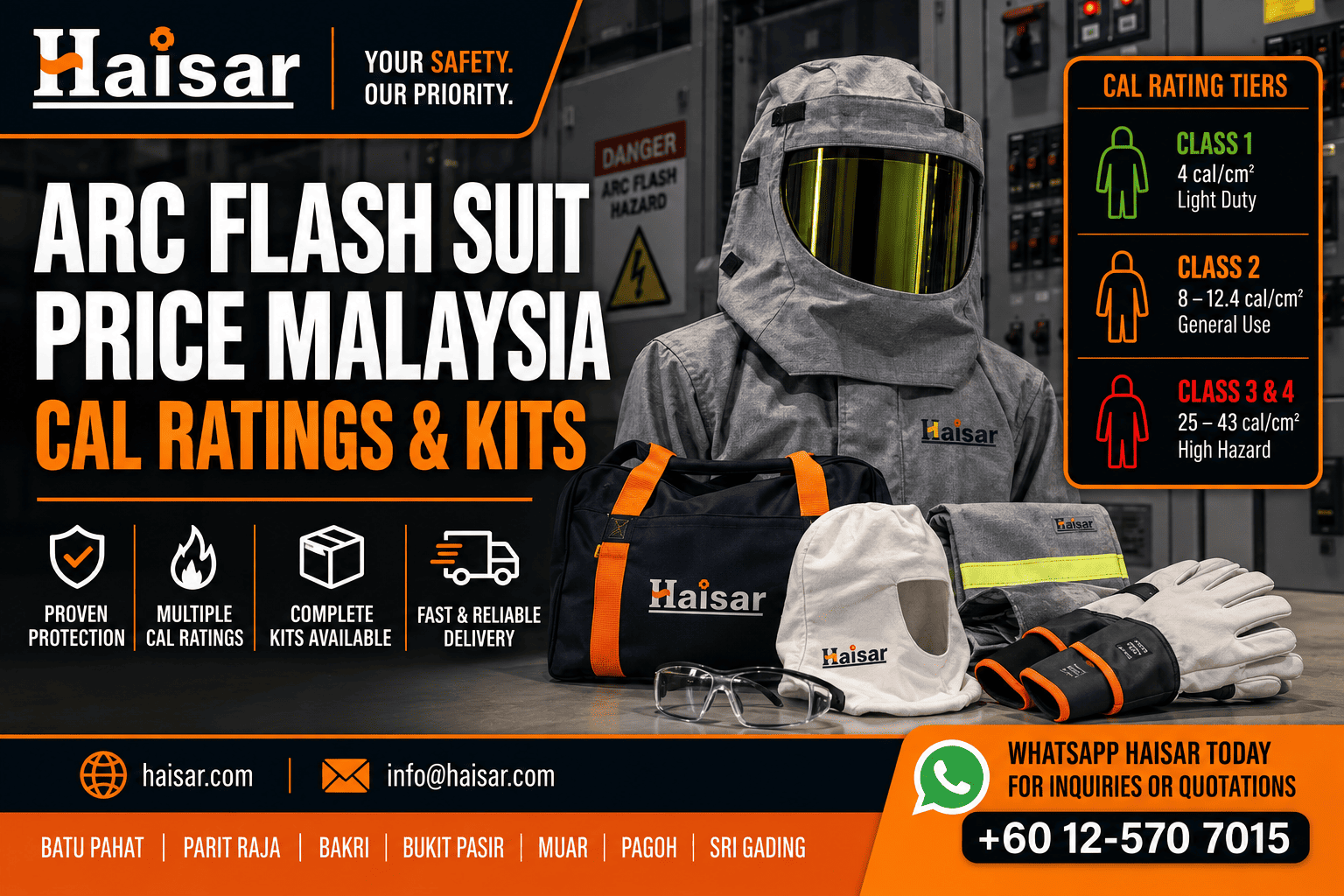
Short answer: Arc flash suit pricing is driven by one number above all others - the arc rating in cal/cm² - and then by whether you are buying a garment or a complete kit. A 12.4 cal Class 2 kit and a 43 cal Class 4 kit are different products for different hazards, and quoting them against each other is meaningless. This page explains what to specify before you compare any prices.
Arc flash is the one PPE category where buying on price is genuinely indefensible, and also the one where buyers are most often quoted numbers that cannot be compared. Two suppliers will send figures that differ by a wide margin, and the difference usually turns out to be the hood, the gloves and the documentation - not the fabric.
Below is what actually determines the cost, in the order you should settle it. As with our helmet pricing page, we have written this without fixed ringgit figures: arc-rated garments move with fabric supply, and a stale published number would mislead you. Ask us for the current figure against a specification.
Start with the incident energy, not the budget
The categories on that scale come from the incident energy at the working distance for the specific board being worked on. That figure is produced by an arc flash study - short circuit analysis, protective device coordination, incident energy calculation and boundary determination — and it is what should appear on the label affixed to the equipment.
If you are shopping for a suit and nobody in the organisation can tell you the cal/cm² figure for the switchboard in question, buying a suit is the wrong first purchase. You may be about to spend money on either too little protection or too much weight and heat stress for the task, and neither will survive an audit that asks how the specification was arrived at.
The other end of the scale matters too. Above 40 cal/cm² the correct answer is not a bigger suit - it is not working on the equipment while it is energised.
What ATPV and EBT actually mean
Every arc-rated fabric is tested two ways, and the number printed on the garment is the lower of the two results. This is worth understanding because it is the most common place for a specification to be misread.
So when a datasheet quotes "ATPV 12.4 cal/cm²", that is the arc rating for that garment. What you must not do is add the ratings of two layers together and assume the sum - layered systems are tested as a system, and the system rating is what counts. If you are wearing an FR base layer under an arc suit, the rating that applies is the one for the tested combination, not either garment alone.
Garment or kit: why two quotes differ so much
This is the single biggest source of confusion in arc flash quotations. A "suit" may mean a jacket and trousers only. A kit typically adds the arc-rated hood or shield with helmet, and may add gloves and a carry bag. Our Class 4 kit, for example, includes the jacket and bib coverall, arc protection gloves rated to the same 43.0 cal/cm², the shield and helmet with hood, and a waterproof carry bag. A cheaper quotation for "a 43 cal suit" may be the coverall alone.
Before you compare anything, write down the six lines in the chart above and ask each supplier to confirm which are included. The exercise usually explains the entire price gap in about two minutes.
The other cost drivers
| Driver | Effect on price | What to watch |
|---|---|---|
| Arc rating (cal/cm²) | The dominant factor. Higher rating means more fabric layers and more cost | Specify from your study, not from what sounds safe |
| Fabric system | Branded engineered fabrics such as Westex Ultrasoft or TenCate Tecasafe cost more than unbranded equivalents | Named fabric on the datasheet is a good sign; "FR treated cotton" with no system named is not |
| Single vs multi-layer | Higher categories need layered construction, which multiplies both cost and heat load | In Malaysian heat, an over-specified suit gets removed. That is a safety issue, not just comfort |
| Hood and visor | A substantial share of a complete kit. Visor arc rating must match the suit | A 40 cal suit with an 8 cal shield protects your body and not your face |
| Sizes and quantity | Size range affects availability; quantity affects unit price | Arc suits are worn over work clothing, so size up. Measure, do not guess |
| Certification & approvals | SIRIM and DOSH approved lines carry documentation cost | Ask for the certificate at quotation stage, not after delivery |
| Laundering and life | Arc protection is inherent to good fabrics, not a coating - but garments still have a service life | Ask about wash care. Improper laundering ruins arc-rated clothing |
The Malaysian compliance picture
Arc flash protection in Malaysia sits at the intersection of two regulators, which is part of why it gets handled inconsistently:
- DOSH, under OSHA 1994. The general duty to provide a safe workplace, which includes electrical safety and appropriate PPE.
- Suruhanjaya Tenaga, under the Electricity Supply Act 1990 and Electricity Regulations 1994. Competent person requirements - the appointment of a chargeman for medium and high voltage installations - and safe work procedures.
- The arc flash study. Incident energy calculated at each working position, arc flash boundary determined, warning labels affixed to equipment showing the energy and the PPE required.
- PPE matched to the category, with documentation retained. This is the part we can supply and evidence; the study itself is separate specialist work.
Practically, if you are buying arc flash PPE for chargeman work on 11kV or 33kV switchgear, the specification conversation should start with the study output. Our electrical safety PPE standards guide and arc flash hazard explainer cover the background; this page is about what it costs and why.
What we stock
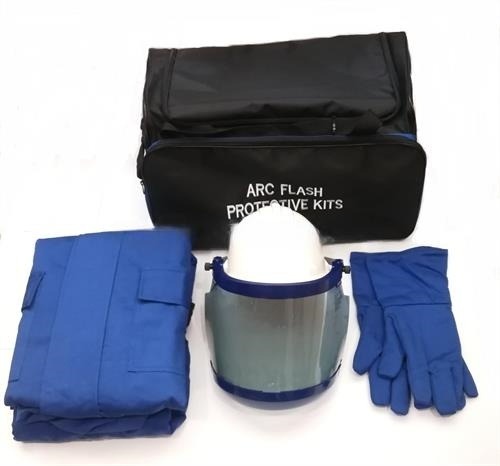
Class II Kit — 12.4 cal/cm²
ATPV 12.4 cal/cm² on jacket, trousers and helmet. Single layer in Westex Ultrasoft by Milliken, 88% cotton / 12% high tenacity nylon, with arc shield and white helmet with UV-coated visor and a rated carry bag. Navy, grey, orange or royal blue.
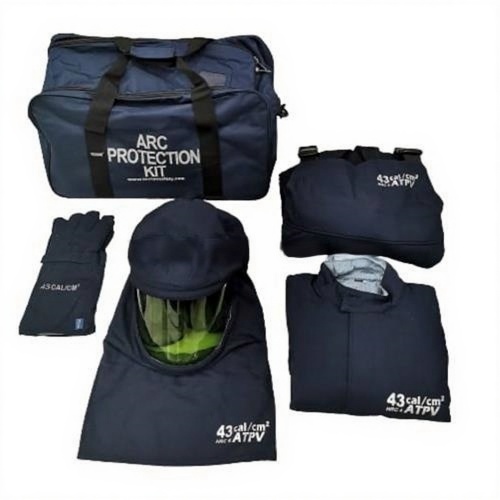
Class 4 Kit — 43.0 cal/cm²
ATPV 43.0 cal/cm², HRC 4. Jacket and bib coverall in TenCate Tecasafe Plus 700A lined with Q8, arc protection gloves rated to the same 43.0 cal, shield and helmet with hood, and a waterproof carry bag. A complete kit, not a garment.
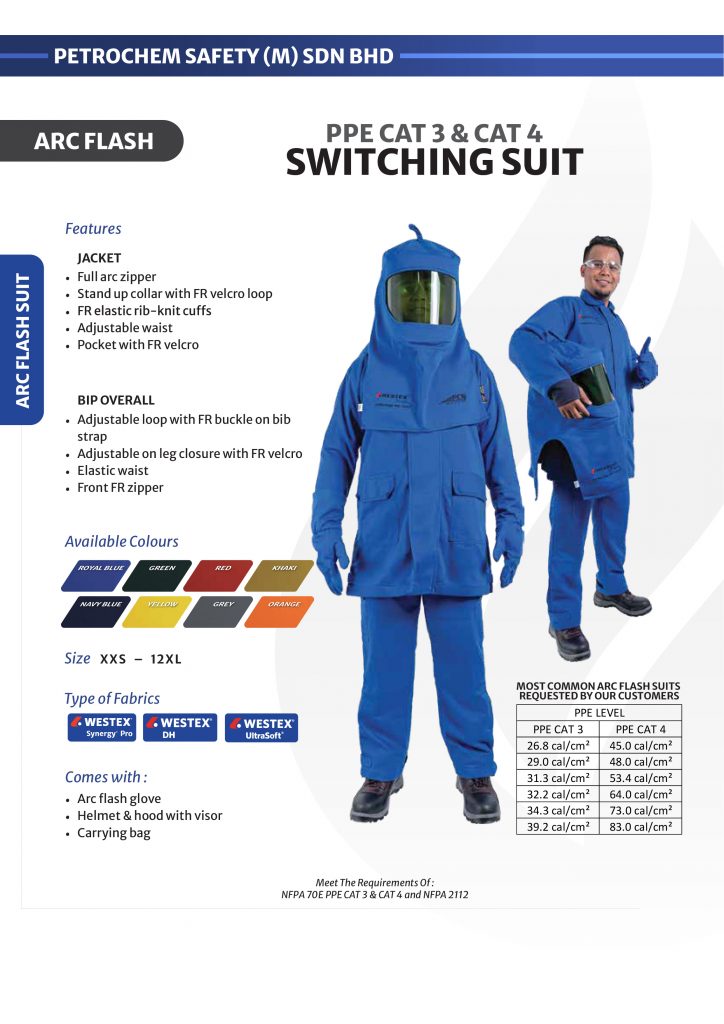
33kV / 45 Cal Chargeman Suit
SIRIM and DOSH approved. Full arc zipper, stand-up collar with FR velcro, elastic ribbed cuffs, adjustable waist and bib overall with adjustable leg closure. Supplied with arc flash gloves, helmet with hood and visor, and carrying bag.
The suit is one part of an electrical safety package. We also supply Novax rubber insulating gloves in Class 00 to Class 2, arc flash face shields, insulating switchboard mats, insulation stools, fibreglass rescue hooks, dielectric boots and complete lockout tagout kits.
Send us the number, not the budget
Tell us the incident energy at the working position, how many people need kitting out, and their sizes. If you do not have a study yet, say so we will tell you what that changes.
Haisar Supply & Services Sdn Bhd · No. 7501, Jalan Enggang 19, Bandar Putra, 81000 Kulai, Johor · Seremban branch 011-3307 7509 · contact details
Arc flash buying questions
How much does an arc flash suit cost in Malaysia?
It depends almost entirely on the arc rating and on whether you are buying a garment or a complete kit. A 12.4 cal Class 2 kit and a 43 cal Class 4 kit are separated by several fabric layers and a great deal of cost. Tell us the incident energy figure and the quantity and we will quote against it.
Why is one quotation so much cheaper than another for the same cal rating?
Almost always because one is a garment and the other is a kit. Check whether the hood or shield with helmet, the arc-rated gloves, the carry bag and the certification documentation are included. Those four lines usually account for the whole difference.
What cal rating do we need?
Whatever your arc flash study says for the equipment being worked on, at the working distance. If nobody can produce that figure, the study is the thing to arrange first - buying a suit before you know the number risks under-protecting or over-specifying, and neither stands up to audit.
What does ATPV mean, and is a higher number always better?
ATPV is the Arc Thermal Performance Value, and the arc rating on a garment is the lower of ATPV and EBT (Energy Breakopen Threshold). Higher is not automatically better: a heavily over-rated suit adds weight and heat load, and in Malaysian conditions a suit that is too hot ends up not being worn.
Can we layer two suits to reach a higher rating?
No. Layered systems are tested and rated as a system; you cannot add two individual ratings together. If you need a layered solution, specify a system that has been tested as one.
Do you supply SIRIM and DOSH approved arc flash suits?
Yes our 33kV / 45 cal chargeman and switchgear suit is SIRIM and DOSH approved, and certification documentation is issued with the delivery order when you request it at quotation stage.
How long does an arc flash suit last?
Arc protection in a properly engineered fabric is inherent rather than a coating, so it does not wash out but garments still have a service life and improper laundering will damage them. Ask about wash care at purchase, and retire any garment that is damaged, contaminated or has been exposed to an arc.
