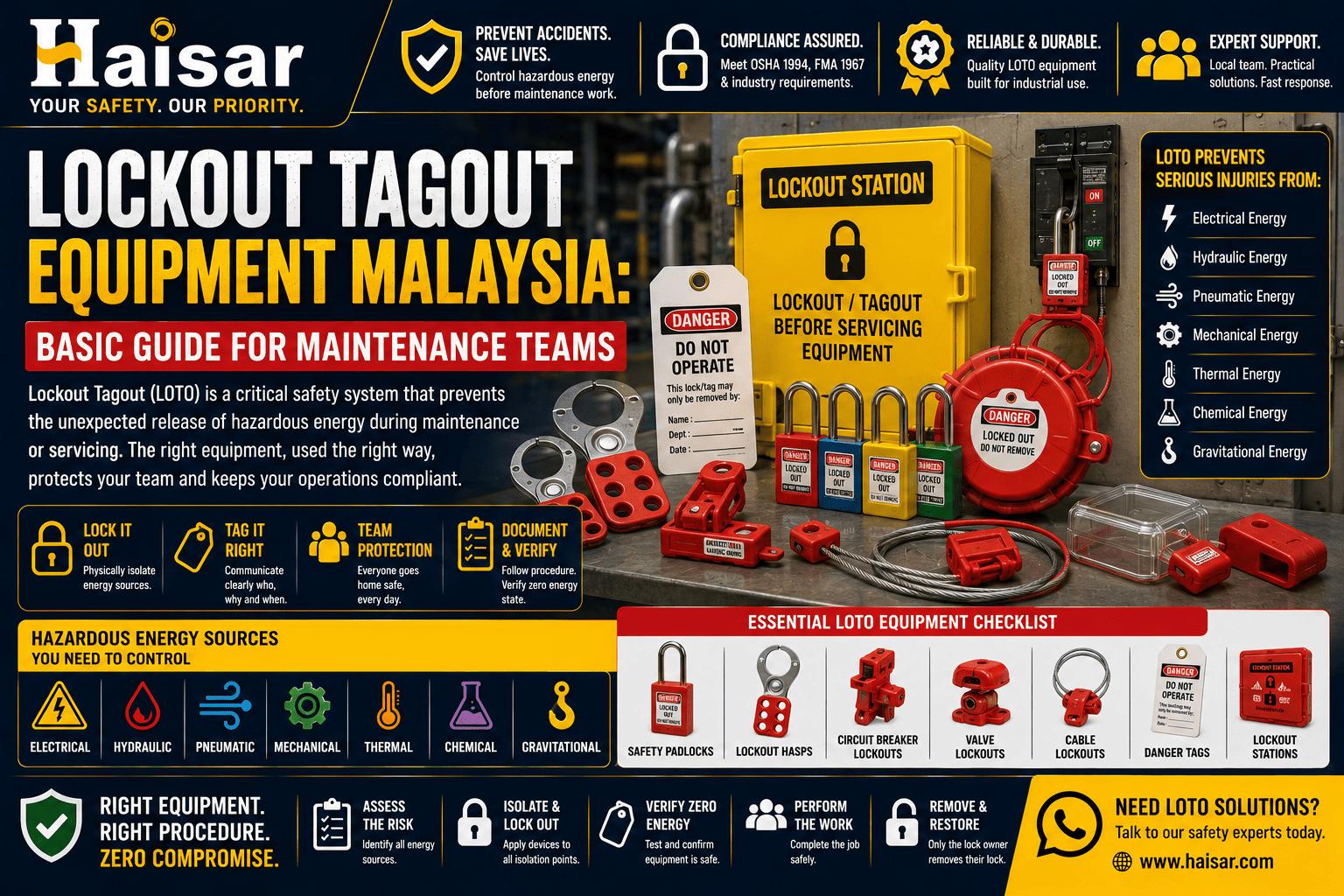
Every year, maintenance workers in Malaysian industrial facilities are injured or killed by machinery and equipment that was not properly isolated before service work began. The mechanism is almost always the same. A maintenance technician is working on a machine that was thought to be de-energised. A colleague, unaware of the ongoing work, restores power. Or the machine has stored hydraulic pressure that nobody verified was released. Or an electrical isolation was made at the wrong point in the system. The machine activates, and the technician is in the way.

Lockout tagout, known in the industry as LOTO, is the procedural and equipment-based system that prevents this. It ensures that hazardous energy is isolated, released or restrained, and cannot be restored until every person working on the equipment has physically removed their own lock and verified that it is safe to re-energise. When implemented correctly, with the right equipment and trained personnel, LOTO eliminates the mechanism of these accidents. When implemented incorrectly, or not at all, the risk remains exactly as it was before any attempt at compliance.

This guide is written for maintenance teams and HSE personnel in Malaysian manufacturing, processing, and industrial facilities. It covers what LOTO actually requires, the equipment components that make up a compliant LOTO programme, how to select the right devices for different energy types and isolation points, and the common failures that turn a paper-based LOTO programme into a liability rather than a protection.

 WhatsApp us for a quick quote 

What Lockout Tagout Is and Why It Exists

Lockout tagout is a hazardous energy control procedure. Its purpose is to protect workers from the unexpected energisation, start-up, or release of stored energy in machinery and equipment during service, maintenance, repair, cleaning, and adjustment work.

The hazardous energies addressed by LOTO include electrical energy at any voltage, hydraulic energy in pressurised fluid systems, pneumatic energy in compressed air systems, mechanical energy stored in springs, flywheels, and counterweights, thermal energy in hot process lines and heated equipment, chemical energy in pressurised process lines containing hazardous substances, and gravitational energy in suspended loads or elevated components.

The reason LOTO requires physical locking rather than just a verbal or procedural isolation is that procedures alone do not prevent re-energisation. A maintenance technician who has isolated a machine at the MCC and communicated this to their supervisor has done nothing that physically prevents someone in the control room from overriding that isolation remotely, or a different shift team from restoring power at changeover because the communication of the ongoing maintenance work did not reach them. A physical lock on the isolation point, to which only the person doing the maintenance work holds the key, prevents re-energisation regardless of any communication failure, procedural gap, or human error elsewhere in the system.

Tagout, the second component, is the warning communication element. A lockout tag attached to the isolation device identifies who placed the lock, when, why, and how to contact them. It serves as a communication tool within the LOTO programme, not as a substitute for the physical lock. A tag alone without a lock is not an adequate energy control in any situation where a lockout device can be applied. Tags can be removed, ignored, or missed. Locks cannot be removed without either the key or a deliberate and documented decision to cut the lock under controlled circumstances.

The Malaysian Regulatory Basis for LOTO

OSHA 1994 and the General Duty Clause. The Occupational Safety and Health Act 1994 places a general duty on employers to provide a safe working environment. Where maintenance work on energised or potentially energised equipment is carried out without an adequate energy control programme, this general duty is not met. DOSH inspectors investigating serious injuries to maintenance workers during servicing operations routinely cite the absence of a LOTO programme as a primary causative factor.

Factories and Machinery Act 1967 (FMA) and Regulations. The FMA and its regulations impose specific requirements for the isolation and de-energisation of machinery before maintenance work. Regulation 11 of the Factories and Machinery (Safety, Health and Welfare) Regulations 1970 requires that machines are effectively stopped and isolated before any maintenance, cleaning, or adjustment work takes place. Effective isolation under the FMA is physical isolation, not procedural isolation.

MS IEC 60204-1 and Electrical Equipment of Machines. For electrical energy specifically, the Malaysian Standard MS IEC 60204-1 on the safety of machinery and electrical equipment of machines provides technical requirements for isolation and energy dissipation that directly inform the LOTO requirements for electrical energy sources. Compliance with MS IEC 60204-1 is a component of compliance with DOSH machinery safety requirements.

OSHA Act Section 15 (Duty of Employees). LOTO is not solely an employer responsibility. Employees have a duty under OSHA 1994 to cooperate with the employer's safety systems and not to intentionally interfere with or misuse safety equipment. This includes not removing a LOTO device placed by another worker, and not re-energising a system that is under LOTO control.

PETRONAS and contractor requirements. For facilities in Johor's oil and gas and petrochemical sector, PETRONAS Technical Standards and contractor HSE requirements impose specific LOTO procedural requirements as conditions of site access and contractor qualification. Contractor maintenance teams working at PETRONAS or Petrochemical Integrated Development (PiChem) sites in Pengerang must maintain LOTO procedures and equipment that meet these requirements in addition to OSHA 1994 obligations.

The practical implication of these frameworks is that a Malaysian industrial employer without a functioning LOTO programme is non-compliant with multiple overlapping regulatory requirements simultaneously, and is exposed to both regulatory enforcement action and civil liability in the event of a maintenance injury.

The Six Steps of a LOTO Procedure

Before examining the equipment components, it is useful to understand the procedural structure that the equipment supports. LOTO equipment without a procedure is hardware without a system. The procedure is where the protection actually lives.

Step one: Prepare for shutdown. The authorised person responsible for the LOTO identifies all energy sources associated with the equipment, the isolation points for each energy source, the type and magnitude of energy at each point, and the sequence in which isolations must be made. A written LOTO procedure for the specific piece of equipment is the correct preparation tool.

Step two: Notify affected workers. All workers who could be affected by the shutdown, including operators, adjacent work area personnel, and supervisors, are informed that the equipment is about to be isolated and must not be re-energised.

Step three: Shut down the equipment. The equipment is stopped using its normal stopping procedure before isolation begins.

Step four: Isolate all energy sources. Each energy source identified in the preparation step is isolated at its isolation point. Electrical circuits are opened at the breaker or disconnect. Pneumatic and hydraulic supply lines are closed and bled. Mechanical energy is restrained or released. Thermal energy sources are closed and allowed to cool to a safe level. Each isolation is made using an appropriate lockout device.

Step five: Apply lockout and tagout devices, and release stored energy. A lockout device is applied at each isolation point by each authorised person performing work on the equipment. Each person applies their own individual lock. Where multiple workers are involved, a hasp allows multiple locks to be applied at a single isolation point. After locking out, all stored energy is released or restrained: electrical capacitors are discharged, pneumatic lines are bled, hydraulic accumulators are vented, springs are released or blocked, and suspended loads are lowered or supported.

Step six: Verify isolation. Before work begins, the authorised person verifies that the isolation is effective. For electrical isolation, this means using a verified-working voltage tester to confirm that the circuit is de-energised at the point of work. For hydraulic and pneumatic isolation, this means verifying that pressure gauges at the work point read zero. Attempting to start the equipment using its normal start controls is a common verification method, provided it is done safely and with all workers clear of any moving parts.

LOTO Equipment Components: What Each Does and When to Use It

A complete LOTO programme requires several categories of hardware. Each serves a distinct function. Substituting one type for another, or omitting components, creates gaps in the energy control.

Safety Padlocks

The safety padlock is the physical lock at the heart of the LOTO system. It is distinguished from a standard padlock by two characteristics. First, it is keyed to a unique key that is held only by the person who applies the lock. No master key exists that could allow a supervisor or manager to remove the lock without the worker's knowledge. Second, it is made from non-conductive or low-conductivity materials to prevent it from becoming part of an electrical circuit at an isolation point.

Safety padlocks are available in several configurations. Standard safety padlocks with a non-conductive shackle are appropriate for most mechanical and non-electrical isolation points. Insulated shackle padlocks, where the shackle is coated with electrical insulating material, are appropriate for electrical isolation points where contact with live conductors is possible during the locking operation. The shackle diameter must be matched to the lockout hasp or device it will engage.

In a multi-worker LOTO scenario, each worker applies their own padlock. The lock stays on the isolation point until that specific worker removes it. No single worker can remove another's lock, and the equipment cannot be re-energised until every lock has been removed by the person who placed it. This is the physical mechanism by which LOTO protects each individual worker independently.

Haisar supplies the Summit 38mm Lockout LOTO Padlock with stainless steel shackle and the standard Safety Padlock as well as the Safety Padlock with Insulation Shackle for electrical isolation applications.

Lockout Hasps

A lockout hasp is a multi-lock device that allows several padlocks to be applied to a single isolation point simultaneously. The hasp body is clamped or looped through the isolation point, and each worker clips their individual padlock through one of the hasp's multiple holes. The isolation point cannot be restored until every padlock on the hasp has been removed, meaning every worker must have finished and cleared.

Hasps are required whenever more than one person is working on the same piece of equipment under the same LOTO isolation. Without a hasp, the system provides no physical mechanism for independent per-worker locking at a single isolation point.

Standard hasps accommodate between three and six padlocks depending on the design. For large maintenance tasks involving multiple work groups simultaneously, extended hasps or group lockout boxes are used to manage the larger number of locks.

LOTO Tags

A LOTO tag is attached to the lockout device at each isolation point. The tag communicates the identity of the person who placed the lock, their contact number, the date and time the lock was placed, the reason for the lockout, and the work being performed. It warns that the isolation must not be removed and that removing it without authorisation is dangerous and a regulatory violation.

LOTO tags must be durable enough to remain legible for the duration of the maintenance work, which may extend over multiple shifts or days. They must be made from materials that resist the environmental conditions at the isolation point, including moisture, chemical exposure, and high temperature. Standard LOTO tags are printed on polypropylene or laminated card with a metal or nylon grommet for attachment.

The information on the tag must be completed by the worker placing the lock before the tag is attached. A blank or partially completed tag reduces the communication value of the tag and creates ambiguity about who is responsible for the lock.

Circuit Breaker Lockout Devices

A padlock alone cannot be applied directly to most circuit breakers because breakers do not have a hasp or loop designed to accept a padlock shackle. A circuit breaker lockout device is a clip or clamp that fits the specific breaker type and size and provides a hasp point to which a padlock can be attached. Applied to a tripped or open breaker, the device prevents the breaker from being switched back to the on position.

Circuit breaker lockout devices are available in configurations for miniature circuit breakers (MCBs), moulded case circuit breakers (MCCBs), and main air circuit breakers (ACBs) across the range of breaker sizes used in Malaysian industrial electrical panels. The correct device must be selected for the specific breaker make, model, and pole configuration. A device that fits loosely or incompletely on the breaker provides less protection than a correctly fitted device.

Plug Lockout Devices

For equipment connected to power through a standard plug and socket, a plug lockout device encases the plug in a lockable housing that prevents it from being inserted into a socket. The plug lockout is appropriate for portable equipment, testing instruments, and smaller machine tools where the isolation point is a standard socket connection rather than a fixed disconnect or breaker.

Valve Lockout Devices

Pneumatic and hydraulic energy sources are isolated at valves. Gate valves, ball valves, and butterfly valves each require different lockout device geometries to secure them in the closed position. A gate valve lockout clamps over the valve handwheel in the closed position and provides a hasp point for a padlock. A ball valve lockout secures the valve handle in the closed position. Butterfly valve lockout devices use a disc or plate fitted to the valve actuator.

The correct valve lockout device is selected based on the valve type, the valve size, and the handle or handwheel geometry. An incorrectly fitted valve lockout device may not securely hold the valve in the closed position, particularly against system pressure that tends to hold a ball valve open.

Lockout Stations and Kits

Where LOTO is implemented across a facility or work area, a lockout station provides a central, organised location for LOTO equipment. The station holds an inventory of hasps, tags, various lockout devices, and spare padlocks immediately available at the point of need. Workers approaching a maintenance task can collect the correct devices from the station before beginning work.

A LOTO kit is a portable set of LOTO equipment assembled for use at a specific task or location. Kits are appropriate for maintenance teams that move between different work areas and equipment, and for contractor teams that must bring their own LOTO equipment to a client site. Haisar supplies the Electrical Lockout Tagout Kit for OSHA-compliant electrical lockout applications, including hasps, universal circuit breaker locks, LOTO tags, and LOTO padlocks.

Selecting LOTO Equipment for Different Energy Types

The diversity of energy sources in Malaysian industrial facilities means that no single lockout device covers every isolation requirement. Selecting the correct device for each energy type is the basis of an effective LOTO equipment inventory.

Electrical energy. The primary isolation points for electrical energy are circuit breakers, disconnect switches, and motor control centre (MCC) starters. Each requires a device appropriate to its physical configuration. MCBs and MCCBs require breaker-specific lockout clips. Disconnect switches with hasp holes in the lever accept padlocks directly. MCC starters require lockout devices fitted to the starter door or isolator handle. Insulated shackle padlocks are appropriate at all electrical isolation points.

For the arc flash risk that exists during switching operations at high-energy electrical panels, arc flash PPE is required during the switching operation itself, before the panel is de-energised and the LOTO lock applied. The LOTO lock prevents re-energisation; the arc flash PPE protects during the switching operation. These are complementary requirements, not alternatives.

Pneumatic energy. Compressed air systems require valve lockout devices at the main supply isolation valve, lockout of any local isolation valves in the circuit, and physical bleeding of the line to verify that trapped pressure has been released before work begins. A line that is locked out at the supply valve but retains stored pressure between the valve and the work point is not adequately isolated.

Hydraulic energy. Hydraulic systems carry the additional complication of accumulator pressure. A hydraulic system that has been isolated at the pump and supply valve may retain significant stored pressure in the accumulator, which can hold cylinders in position or release suddenly if the circuit is opened. The LOTO procedure for hydraulic systems must include specific steps for discharging accumulator pressure and verifying that system pressure has reached zero before work begins.

Mechanical energy. Springs, counterweights, and elevated components store gravitational or mechanical energy that can release without any electrical or fluid energy source being present. Mechanical energy lockout requires physical restraint of the moving part: blocking, cribbing, or pinning the component in a position where it cannot move under stored energy. The restraint device must be capable of withstanding the full stored energy load without failure.

Mixed-energy equipment. Most industrial machinery combines multiple energy types. A production press may have electrical drive motors, a pneumatic die clamp, a hydraulic press cylinder, and mechanically stored energy in the flywheel. A complete LOTO for this machine requires separate isolation and lockout for each energy type, in the sequence specified in the written LOTO procedure for that machine. Isolating one energy source and missing another is partial LOTO, which provides partial protection. Partial protection against a press energisation event is not meaningful protection.

Building a LOTO Programme for a Malaysian Industrial Facility

LOTO equipment alone does not create a LOTO programme. The equipment supports a programme that has four additional components: written procedures, trained personnel, defined responsibilities, and a periodic audit process.

Written LOTO procedures for each piece of equipment. A generic LOTO procedure covering the general steps is not sufficient. Each piece of machinery and equipment must have a specific written procedure that identifies every energy source by type and location, the specific isolation point for each energy source, the lockout device required at each isolation point, the sequence of isolation, the method for verifying isolation, and any special conditions or hazards. These procedures are developed during a hazardous energy survey of the facility.

Authorised and affected worker training. LOTO training distinguishes between authorised workers, those who perform LOTO and work on de-energised equipment, and affected workers, those who operate or work near equipment that may be placed under LOTO. Authorised workers require detailed training in the application of LOTO procedures for the specific equipment they maintain. Affected workers require training sufficient to understand that LOTO is in effect, not to operate the equipment, and not to interfere with LOTO devices. Both training categories must be documented and refreshed when procedures change or a deficiency is identified.

Defined responsibilities. A LOTO programme requires defined roles: who is authorised to perform LOTO for specific equipment, who is responsible for the written procedures, who authorises deviations or complex LOTO scenarios, and who manages the audit process. In a multi-contractor environment, the principal contractor or facility owner must define how contractor LOTO programmes interact with the facility programme.

Periodic audit and inspection. The LOTO programme must be audited regularly to verify that procedures are current, that equipment is in serviceable condition, that training records are complete, and that the programme is being implemented as written. Auditing actual LOTO applications in progress, by observing a maintenance team performing LOTO on equipment against the written procedure, is the most reliable audit method.

Common LOTO Failures in Malaysian Industrial Workplaces

Using tags without locks. The most prevalent LOTO failure in Malaysian facilities is tagout-only programmes where a tag is placed on the isolation point without a physical lock. Tags communicate. They do not physically prevent re-energisation. In any situation where a lockout device can be applied, a lock must be used alongside the tag. A tagout-only approach is only appropriate where the nature of the equipment means that a lockout device physically cannot be applied, which is rare.

One lock for multiple workers. Where a supervisor applies a single lock on behalf of the whole maintenance team and holds the only key, the individual protection that LOTO provides is lost. Any team member who leaves the work area while the supervisor retains the key has lost physical control over their own protection. Each worker must apply their own lock, which only they can remove.

Incomplete energy identification. A LOTO that addresses the electrical isolation but misses the hydraulic accumulator, or isolates the main drive but misses an auxiliary motor, leaves residual energy in the system. The hazardous energy survey that identifies every energy source for every piece of equipment is the foundation of a complete LOTO programme. If the survey is incomplete, the procedure based on it is incomplete, and the LOTO applied under that procedure is incomplete.

LOTO equipment in poor condition. Padlocks with worn or sticky cylinders, hasps with cracked or deformed bodies, and tags that are illegible or missing identification fields degrade the reliability of the LOTO programme. LOTO equipment must be inspected regularly and replaced when defective. A maintenance programme that depends on worn-out equipment is not a credible safety system.

Verbal shortcuts at shift change. When maintenance work extends across a shift change, the outgoing shift's locks must remain on the isolation point and the incoming shift's authorised workers must apply their own locks before the outgoing shift's locks are removed. The transfer of a single lock between shifts, rather than a proper shift-change LOTO process, creates a window during which the equipment is not under physical lock control. Some facilities address this by using a group lockout box at shift change, but the procedural requirement is always that there is no moment when the isolation point is unprotected.

Contractor LOTO gaps. Maintenance contractors who bring their own equipment and procedures to a Malaysian facility may have LOTO practices that do not align with the facility's requirements. The facility owner or principal contractor is responsible for verifying that contractor LOTO programmes are compatible with the facility programme and that contractors are briefed on facility-specific LOTO requirements before work begins. A contractor team operating under a different LOTO standard creates an interface hazard.

LOTO Equipment by Industry: Malaysian Applications

Manufacturing and production facilities. Production machinery across Johor's manufacturing sector ranges from injection moulding presses and CNC machine tools to packaging lines and automated assembly equipment. Each presents multiple electrical, pneumatic, and in some cases hydraulic energy sources. A complete inventory of circuit breaker lockout devices, valve lockout devices, hasps, padlocks, and tags is required at each maintenance area, supported by machine-specific written procedures.

Oil and gas and petrochemical facilities (Pasir Gudang and Pengerang). LOTO in petrochemical environments must address not only electrical and mechanical energy but also pressurised process lines carrying hydrocarbons, hazardous chemicals, and high-temperature process fluids. The LOTO requirements at PETRONAS and contractor facilities in Pengerang's PiChem complex are among the most stringent in Malaysian industry, and contractor maintenance teams must be equipped and trained to this standard before site access is granted.

Data centres. UPS systems, generator sets, cooling plant, and high-density electrical infrastructure in Malaysian data centres require LOTO for any maintenance work on energised systems. The stored energy in UPS battery banks and capacitor banks is a significant hazard that is frequently underestimated by maintenance teams unfamiliar with data centre electrical systems.

Water treatment and utility facilities. High-power pump motors, valve actuators, chemical dosing systems, and high-voltage distribution equipment in Malaysian water treatment plants and utility facilities present complex multi-energy LOTO requirements. Motor control systems at water treatment facilities frequently involve both local and remote control capability; LOTO procedures must address both control paths.

Construction sites. Temporary electrical distribution on Malaysian construction sites, including generator sets, temporary switchboards, and power tools, requires LOTO for any maintenance or modification work. The temporary and evolving nature of site electrical systems makes clear written procedures and trained electrical personnel particularly important.

Haisar Supply and Services: LOTO Equipment Supplier in Malaysia

Haisar Supply and Services supplies lockout tagout equipment for maintenance teams across Johor and peninsular Malaysia. Our LOTO range includes safety padlocks including standard and insulated shackle variants, lockout tagout kits with hasps, breaker locks, tags, and padlocks for complete LOTO deployment, and individual LOTO components for kit restocking and programme expansion.

Our LOTO equipment supports maintenance teams in manufacturing, oil and gas, utilities, and project environments who need reliable, correctly specified hardware for their energy control programmes. We can advise on device selection for specific isolation point types and help you build a LOTO equipment inventory that covers the energy sources in your facility.

Beyond LOTO, our electrical safety range covers arc flash protection suits and kits, insulating rubber gloves, dielectric safety boots, and insulation matting for electrical work areas. For maintenance teams managing broader project requirements, our project supplies and equipment range covers the hardware, consumables, and site safety equipment needed to support planned and shutdown maintenance work.

WhatsApp us now to discuss your LOTO equipment requirements. Our team will respond with product recommendations and advice for your facility in Johor and across Malaysia.

Browse Electrical Safety and LOTO Equipment at haisar.com

Haisar Supply and Services Sdn Bhd (985158-T) | Kulai, Johor, Malaysia | www.haisar.com