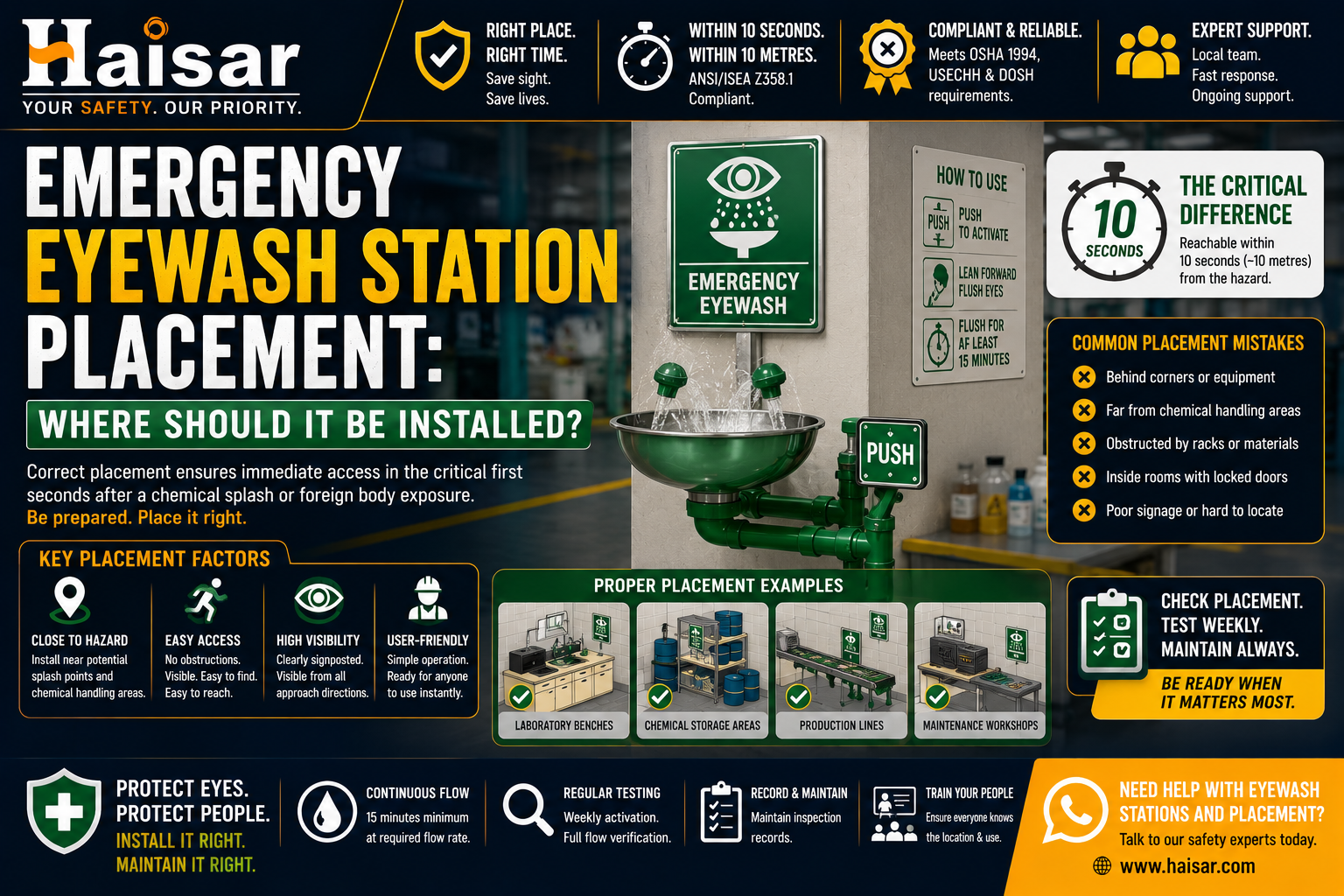
An emergency eyewash station does one thing. It delivers a continuous, controlled flow of clean water to an injured worker's eyes within the first critical seconds after a chemical splash or foreign body exposure. Whether it does that job depends almost entirely on where it is installed.

This is not a complicated point in theory. In practice, Malaysian industrial workplaces get it wrong more often than they should. The eyewash station is bought, mounted on a wall somewhere in the vicinity of the chemical handling area, and the requirement is considered met. Then a worker gets hydrochloric acid in their eyes at a dispensing bench, turns to find the station, and discovers it is behind a storage rack, around a corner, and twelve seconds away. Those twelve seconds matter. At that point, the eyewash station is not a first-aid provision. It is furniture.

This guide covers the correct placement principles for emergency eyewash stations in Malaysian industrial workplaces, the regulatory basis that makes placement a compliance requirement rather than a recommendation, the maintenance routine that keeps a station ready to operate when it is needed, the mistakes that make eyewash stations non-functional despite being physically present, and the selection considerations for different workplace environments.

 WhatsApp us for a quick quote 

Why Placement Is the Primary Variable in Eyewash Station Effectiveness

The science behind eyewash station placement is simple. When a chemical splashes into a worker's eyes, the clock starts immediately. Concentrated acids, alkalis, and oxidising agents begin damaging eye tissue on contact. The damage is not linear: the first fifteen seconds of irrigation are more important than the following fifteen minutes, because the initial flush removes the bulk of the chemical before it penetrates the corneal tissue.

ANSI/ISEA Z358.1, the internationally referenced standard for emergency eyewash and shower equipment, specifies that an eyewash station must be reachable within ten seconds from the hazard point. Ten seconds is approximately ten metres on a clear, unobstructed walking path. The emphasis is on both the distance and the path: ten metres through an obstructed aisle, around equipment, or across a production floor is not ten seconds. In chemical environments where a worker's eyes may be partially or fully closed due to pain and reflex closure, the path to the eyewash station must be navigable without sight.

This is why placement is not a secondary consideration after purchasing the correct equipment. Placement is the primary variable. A correctly specified eyewash station installed in the wrong location provides less protection than an adequate station installed correctly.

The Regulatory Basis for Emergency Eyewash Provision in Malaysia

Several regulatory frameworks in Malaysia address emergency eyewash provision directly or by implication. Together they create a compliance requirement that DOSH inspectors and DOE auditors treat as substantive, not administrative.

OSHA 1994 and the General Duty Clause. The Occupational Safety and Health Act 1994 imposes a general duty on employers to provide and maintain a safe working environment. Where chemicals capable of causing eye injury are used or handled, this duty extends to providing the means for immediate first aid. An emergency eyewash station that cannot be reached within ten seconds does not satisfy this duty because the response capability it provides is materially degraded by the delay.

USECHH Regulations 2000. The Occupational Safety and Health (Use and Standards of Exposure of Chemicals Hazardous to Health) Regulations 2000 require employers to implement control measures for chemicals hazardous to health. The Chemical Health Risk Assessment (CHRA) for each workplace identifies the hazards present and specifies the controls required. Where chemicals with eye corrosion or serious eye damage classifications under GHS are identified in the CHRA, emergency eyewash provision at the point of use is a control measure that flows directly from the risk assessment.

Factory and Machinery Act 1967 (FMA). For registered factories under the FMA, DOSH inspectors assess first-aid provisions as part of routine and audit inspections. Emergency eyewash stations that are incorrectly located, not maintained, or not accessible are cited as inadequate first-aid provisions under the FMA requirements.

ANSI/ISEA Z358.1 as a reference standard. Malaysia does not have a national standard equivalent to ANSI/ISEA Z358.1 that specifies emergency eyewash performance and placement requirements in detail. In the absence of a Malaysian standard, ANSI/ISEA Z358.1 is the recognised reference for eyewash station specification and placement, and is cited by DOSH and qualified industrial hygienists in CHRA documentation. Compliance with ANSI/ISEA Z358.1 placement requirements is the practical benchmark for eyewash provision in Malaysian industrial workplaces.

Placement Principles: The Ten-Second Rule and What It Actually Means

Distance from the hazard. The eyewash station must be within ten seconds of walking from the point where the chemical exposure could occur. For bench-scale chemical work, this means within ten metres of the workbench. For dispensing areas, within ten metres of the dispensing point. For chemical storage areas with tapping or transfer operations, within ten metres of the transfer location.

Ten seconds means ten metres on an unobstructed, level path. If the path between the hazard point and the eyewash station is obstructed by equipment, has a change in floor level, involves a door that must be opened, or passes through a congested aisle, the effective distance is shorter than ten metres. In practice, five to seven metres is a more realistic working distance for obstructed industrial environments.

Direct line of travel. The path from the hazard to the eyewash station must be on the same level and free from obstructions that a partially-sighted or unsighted worker could not navigate. Steps, raised kerbs, and narrow passages between equipment are all disqualifying. The injured worker may be operating with eyes closed or with severely degraded vision. The route must be walkable by feel and memory.

Same room, same area. An eyewash station located outside the chemical handling room does not meet the ten-second requirement for operations inside the room. The station must be in the room where the hazard exists, or immediately at the exit if the exit is within ten seconds and the path to it is unobstructed. Placing the station in a corridor outside a chemical storage room and describing it as the provision for that room is a common compliance error.

Avoiding the spill zone. The eyewash station must not be located in an area where a spill could contaminate it or block access to it. If a drum failure or large-volume chemical spill would flood the floor between the worker and the eyewash station, the station placement is inadequate. Position the station at the edge of the containment zone or in a location that remains accessible even if the primary chemical storage area is contaminated.

Height and accessibility. The eyewash nozzles must be between 83.8 centimetres and 134.6 centimetres above the floor, the range specified by ANSI/ISEA Z358.1. The activation mechanism must be operable with a single downward push, hold-open, or automatic activation that can be operated by a worker wearing chemical-resistant gloves and with impaired vision. The station must not require a worker to remove PPE to operate it.

Lighting. The eyewash station must be in an area with adequate lighting to locate and use it. In chemical storage areas that may lose power during an incident, emergency lighting covering the eyewash station location ensures it remains accessible.

Signage. The eyewash station location must be identified by a clearly visible sign that can be read from the approach to the chemical handling area. Green cross or eye irrigation symbols on a contrasting background at the station and directional signage pointing toward it from the chemical work area are both appropriate. A worker unfamiliar with the facility must be able to locate the station from the chemical area without asking for directions.

Types of Emergency Eyewash Stations and When to Use Each

Selecting the right type of eyewash station for the location is as important as placing it correctly. The type determines whether the station provides an adequate fifteen-minute flush, which is the minimum duration required by ANSI/ISEA Z358.1 for irrigating a chemical-exposed eye.

Plumbed eyewash stations. Connected directly to the facility's potable water supply, plumbed stations provide an unlimited supply of clean water for the full fifteen-minute minimum flush duration. They are the preferred type for permanent chemical handling areas, laboratories, and production facilities where chemicals are used on a regular basis. The requirement for a plumbed station is that the water supply provides a minimum flow rate of 1.5 litres per minute per nozzle at a temperature between 16°C and 38°C. Water that is too cold can cause injured workers to stop using the station before the fifteen-minute period is complete; tepid water encourages the full flush.

In Malaysian industrial facilities with high ambient temperatures, water supplied directly from an uninsulated supply line can be significantly warmer than 38°C. A thermostatic mixing valve that blends the supply with cooler water to maintain the tepid temperature range is required where supply temperatures exceed the upper limit.

Self-contained portable eyewash stations. Sealed units containing a pre-charged volume of preserved clean water, portable stations do not require a plumbed connection. They are appropriate for locations where plumbing is not available, for temporary work sites, for outdoor chemical work areas, and as a supplementary station where the fixed plumbed station is at the limit of the ten-second travel distance. The limitation of a portable station is that the pre-charged volume determines the flush duration. A correctly sized portable station for chemical environments must contain sufficient volume for a full fifteen-minute flush at the specified flow rate: typically a minimum of 13.2 litres for a personal unit and significantly more for a full eyewash station.

After use, a portable station is depleted and must be replaced or recharged before it can be used again. This creates a maintenance requirement that is critical: a portable station that has been used and not restocked provides no protection for the next incident. For locations where portable stations are the primary eyewash provision, a resupply protocol must be in place with defined responsibility and timeline.

Personal eyewash bottles. Small squeeze bottles of saline or preserved water used for immediate first-flush before reaching a fixed station. Personal eyewash bottles are a supplement to, not a substitute for, a compliant fixed eyewash station. Their role is to begin irrigation in the first few seconds while the worker moves to the primary station. They do not provide the flow rate or flush duration required for a compliant fifteen-minute eye irrigation. Placing a personal eyewash bottle in the chemical handling area and describing it as the eyewash provision is a compliance failure.

Combination eyewash and safety shower units. For chemical environments where the exposure risk extends beyond the eyes to the full body, including large-volume acid or alkali handling, chemical immersion risk, and highly toxic chemical work, a combination unit provides both an eyewash station and an overhead emergency shower at the same location. The placement requirements for the shower component include a minimum clearance of 2.1 metres around the shower head and a floor drain to manage the volume of water discharged.

Placement by Work Environment: Malaysian Industrial Applications

Chemical storage and drum dispensing areas. The most common high-risk location for eye chemical exposure in Malaysian industrial workplaces. Drums of acids, alkalis, solvents, and process chemicals are tapped, transferred, and dispensed in these areas regularly. A plumbed eyewash station positioned at the primary dispensing point, within five metres on an unobstructed path, with a combination shower unit if full-body exposure is credible, is the minimum provision.

Metal finishing and surface treatment. Electroplating, acid pickling, anodising, and chemical etching operations in Johor's manufacturing sector involve regular handling of concentrated acids and alkali cleaning solutions. These are among the highest eye injury risk environments in Malaysian industry. Eyewash stations must be at every work position where chemical contact is possible, not one station for the whole room.

Battery maintenance areas. Sulphuric acid electrolyte from lead-acid batteries is a significant eye hazard in facilities with large battery banks: data centres, UPS rooms, telecoms installations, and heavy equipment maintenance workshops. A plumbed eyewash station is required in every battery maintenance area. For unmanned battery rooms, a portable station immediately outside the room with a plumbed station at the service point is the appropriate configuration.

Laboratories. Chemical laboratories in Malaysian universities, research facilities, pharmaceutical manufacturers, and analytical testing operations handle a wide range of corrosive chemicals at bench scale. ANSI/ISEA Z358.1 requires an eyewash station within the laboratory space, not in a corridor. For multi-bench laboratories, a central station may be adequate if every bench is within ten seconds; for larger laboratory spaces, multiple stations may be required.

Construction sites. Chemical exposure risks on Malaysian construction sites include concrete admixtures and accelerators, waterproofing chemicals, epoxy resins, and battery maintenance at site facilities. A portable eyewash station at the chemical handling area, moved with the work as the site develops, provides the required provision where plumbing is not available. For permanent site offices and welfare facilities, a plumbed station in the first-aid room is appropriate.

Food and beverage processing. Caustic cleaning solutions, phosphoric acid-based sanitisers, and chlorine-based disinfectants are standard cleaning chemicals in Malaysian food processing facilities. They represent a significant eye injury risk during preparation, dilution, and application. Eyewash stations must be provided in chemical preparation areas, not only in production areas.

Semiconductor and electronics manufacturing. The processes used in semiconductor fabrication and PCB manufacturing in Johor's electronics sector involve hydrofluoric acid, sulphuric acid, hydrogen peroxide, sodium hydroxide, and solvents. Hydrofluoric acid deserves specific attention: it penetrates tissue rapidly and causes damage beyond the initial contact area, requiring immediate and prolonged irrigation alongside specific first-aid treatment. Eyewash stations in HF handling areas must be positioned for immediate access and the facility emergency response plan must address the additional treatment requirements for HF exposure.

Emergency Eyewash Station Maintenance Checklist

An eyewash station that is installed correctly but not maintained is a compliance risk and a safety failure. The most common finding during DOSH inspections of chemical workplaces is not the absence of eyewash stations but the presence of stations that are non-functional, contaminated, or obstructed.

Weekly activation check. Activate the eyewash station weekly to flush the supply line and verify that water flows from both nozzles simultaneously at adequate pressure and flow rate. Stagnant water in plumbed supply lines can support microbial growth including Legionella; the weekly flush prevents stagnant water accumulating in the branch line. Run the station for a minimum of three minutes during the weekly check. Record the date and result in the maintenance log.

Monthly inspection. Each month, verify that the eyewash station is unobstructed with clear access from the chemical work area, the dust covers on the nozzles are in place and intact, the activation mechanism operates correctly and stays open without requiring the worker to hold it, there is no visible corrosion, damage, or leakage at the station or supply connections, the station signage is visible and undamaged, and the area around the station is clear of stored materials, equipment, or any obstruction that reduces the accessible footprint around the unit.

Portable station inspection. For self-contained portable stations, verify the charge level indicator shows a full charge, the seal is intact, the expiry date of the preservative solution has not been passed, and the unit is mounted at the correct height and accessible. Replace the unit immediately if it has been used or if the expiry date is within the next inspection period.

Annual inspection and service. Have the eyewash station and its supply system inspected annually by a competent person. The annual inspection should verify water temperature at the nozzle under flow conditions, flow rate at both nozzles simultaneously, condition of internal nozzle components, function of any thermostatic mixing valve, and compliance of the installation with current ANSI/ISEA Z358.1 requirements.

Post-incident procedure. After any use of the eyewash station in a genuine eye exposure incident, inspect the station before returning it to service. Verify no chemical contamination from the incident has entered the station, replace nozzle dust covers, flush the supply line, and record the incident and inspection in the maintenance log.

Record keeping. A maintenance log for each eyewash station is both a compliance record and an operational management tool. The log should include the station location identifier, date and result of each weekly flush, date and findings of each monthly inspection, date of any repairs or component replacements, date and result of any annual service, and date and description of any incident use. In a DOSH audit, the maintenance log demonstrates that the eyewash provision is actively managed rather than passively installed.

Common Eyewash Station Placement and Maintenance Mistakes

Locating the station outside the chemical handling area. The station is in the corridor, the stairwell, or the general first-aid room rather than in the room where the chemical is handled. By the time a worker with acid in their eyes exits the chemical area, locates the station, and begins irrigation, the ten-second window has closed. This is the single most common placement error in Malaysian chemical workplaces.

Blocking access with stored materials. The area in front of the eyewash station is used for temporary storage of drums, equipment, or materials. The station is physically present but not immediately accessible. This is a common finding in facilities where the eyewash station was installed before the storage layout was finalised and subsequent operational use has encroached on the access path.

Using a personal eyewash bottle as the sole provision. A squeeze bottle of saline is not a compliant eyewash station. It does not provide the flow rate, flush duration, or hands-free operation required by ANSI/ISEA Z358.1. It is appropriate as a first-flush supplement at a workbench, positioned alongside the primary compliant station. It is not appropriate as a standalone provision.

Failing to flush plumbed stations weekly. Stagnant water in supply lines serving infrequently used eyewash stations accumulates sediment and supports microbial growth. The first water to flow from a station that has not been flushed for weeks may be discoloured or contaminated. Weekly flushing is a non-negotiable maintenance requirement, not a recommended optional.

Exceeding the portable station expiry without replacement. The preservatives in self-contained portable eyewash solutions have a defined shelf life. Using an expired portable station means irrigating an injured eye with potentially contaminated water. Monthly inspection of portable stations must include a check against the expiry date.

Not training workers to locate and use the station. Workers must know where the eyewash station is, how to activate it, and how to use it before an incident occurs. Emergency drills that include eyewash station activation familiarise workers with the station under non-emergency conditions. A worker who has never used the station before is slower and less effective in an emergency.

Installing above or below the correct height range. A station installed too low requires a worker to crouch during irrigation. A station installed too high cannot be reached by shorter workers or by workers in pain. The 83.8 to 134.6 centimetre nozzle height range in ANSI/ISEA Z358.1 is not arbitrary; it ensures the station is usable by the full range of workers who may need it.

Haisar Supply and Services: Emergency Eyewash Stations in Malaysia

Haisar Supply and Services supplies emergency eyewash stations for chemical handling areas, laboratories, battery rooms, and industrial facilities across Johor and peninsular Malaysia. Our range includes plumbed eyewash stations for permanent chemical work areas, self-contained portable eyewash stations for temporary sites and locations without plumbed supply, combination eyewash and safety shower units for full-body chemical exposure risk areas, and personal eyewash bottles as a first-flush supplement.

We supply eyewash stations that meet ANSI/ISEA Z358.1 performance requirements and can advise on correct placement, installation height, and maintenance procedures for your specific chemical work environment. Where your CHRA identifies chemical hazards requiring eyewash provision, we can help you specify the correct station type and capacity for each location.

We also supply the chemical safety and emergency response equipment that complements your eyewash provision, including chemical spill kits, chemical-resistant PPE, and chemical storage solutions. For facilities managing broader emergency response requirements, our emergency responder range covers the equipment needed to build a complete first-response capability.

WhatsApp us now to discuss your eyewash station requirements. Our team will respond with product recommendations and placement advice for your facility in Johor and across Malaysia.

Browse Chemical Safety and Emergency Response Products at haisar.com

Haisar Supply and Services Sdn Bhd (985158-T) | Kulai, Johor, Malaysia | www.haisar.com