Can't find what you're looking for? Get in touch!



Offshore oil and gas operations in Malaysia represent some of the most hazardous working environments in the country. Platforms in the South China Sea, the Malacca Strait, and Sabah and Sarawak waters expose workers to a combination of hazards that no onshore industrial environment replicates simultaneously: remote location, helicopter and vessel access, living accommodation on the asset, continuous process operations running 24 hours a day, flammable and toxic hydrocarbon handling, working over open water, and the physical demands of a marine environment including wave action, corrosive saltwater, and restricted deck space.
The safety equipment requirements for Malaysian offshore oil and gas operations reflect this complexity. They are more extensive, more specifically specified, and more rigorously enforced than the requirements for comparable onshore operations. PETRONAS technical standards, PCSB contractor safety requirements, the Petroleum Safety Measures Act 1984, international standards including IOGP and SOLAS, and the safety management systems of the platform operators themselves all impose requirements that procurement teams and HSE managers must navigate simultaneously.
This guide covers the essential offshore safety equipment required at Malaysian O&G sites, the standards that govern each category, and what to look for in a supplier equipped to support offshore procurement requirements in Malaysia.
The Regulatory and Standards Framework for Offshore Safety Equipment in Malaysia
Understanding the layered compliance framework that governs offshore safety equipment is essential before reviewing the equipment categories themselves. Procurement that does not account for all applicable standards will produce gaps that offshore safety audits will find.
Petroleum (Safety Measures) Act 1984. The primary legislation governing safety in Malaysian petroleum operations. It establishes the legal obligations of operators, contractors, and personnel on offshore petroleum installations and provides the framework for DOSH enforcement in the upstream sector.
DOSH Offshore Safety Regulations. DOSH enforces occupational safety requirements on Malaysian offshore installations and inspects platforms and their safety management systems. Offshore safety equipment must meet DOSH standards as a baseline alongside any additional requirements imposed by the operator.
PETRONAS Technical Standards (PTS). PETRONAS operates an extensive suite of technical standards covering safety, engineering, and operational requirements on its assets. PPE and safety equipment used by contractors at PETRONAS-operated offshore facilities must meet applicable PTS specifications. PETRONAS also maintains approved vendor lists and product approval requirements that directly affect offshore safety equipment procurement decisions.
PCSB Contractor Safety Requirements. For contractors working on PCSB-operated assets, documented contractor safety management obligations apply including specific PPE standards, offshore safety induction requirements, and permit-to-work system compliance.
IOGP Standards. The International Association of Oil and Gas Producers publishes technical guidance widely referenced in the Malaysian offshore sector. IOGP Life Saving Rules, which have been adopted by most major operators in Malaysia, include specific requirements relating to working at heights, confined space entry, bypassing safety controls, and driving that have equipment and procedural implications.
SOLAS (Safety of Life at Sea). The International Convention for the Safety of Life at Sea governs safety requirements for vessels involved in offshore support operations, crew transfers, and supply runs. Equipment carried on offshore support vessels and used during offshore marine operations must meet SOLAS requirements.
DNV, ABS, and Classification Society Standards. Offshore installation equipment including lifting equipment, pressure vessels, and certain safety systems must meet classification society requirements. Safety equipment suppliers working with offshore operators must be familiar with documentation requirements that align with classification society audits.
Offshore Safety Equipment: Category by Category
1. Personal Gas Detection
Gas detection is the non-negotiable first line of protection on any offshore installation. Hydrocarbon gas, H2S, CO, and oxygen deficiency are all credible hazards across different zones of a Malaysian offshore platform, from the process deck to the accommodation module. A worker entering any classified hazardous area without a functioning, calibrated personal gas monitor is in violation of PETRONAS requirements, PCSB contractor standards, and basic offshore safety practice.
Four-gas personal monitors covering O2, LEL (combustible gases), H2S, and CO are the minimum configuration for offshore operations. At platforms where specific process gases or chemical injection chemicals present additional hazards, extended sensor configurations are required.
H2S personal monitors with both audible and vibrating alarms are required across all areas of H2S risk. Vibrating alarms are particularly important in high-noise offshore environments where an audible alarm alone may not be detected.
Pre-entry sampling equipment including sampling pumps and remote probes for testing confined space atmospheres on the platform before entry without requiring personnel to approach the entry point.
Intrinsically safe gas detectors certified for use in Zone 1 and Zone 2 classified hazardous areas. Gas detectors used in classified zones on Malaysian offshore platforms must carry ATEX, IECEx, or equivalent certification appropriate to the zone classification. Standard industrial gas detectors without hazardous area certification cannot be used in classified offshore zones.
Calibration gas and docking stations for managing the calibration and bump test programme for the fleet of gas detectors deployed on the platform. Calibration records must be maintained and available for audit by PETRONAS, DOSH, or the platform operator's safety team.
Checklist requirement: Every personal gas monitor used offshore must be bump tested against calibration gas before each shift. The bump test must be documented. A gas monitor that has not been bump tested is not acceptable for use on a PETRONAS or PCSB-operated platform regardless of its calibration status.
2. Personal Flotation Devices and Overboard Protection
Falls overboard on Malaysian offshore platforms are a fatality-level event. The distance from platform deck to water surface, the sea state conditions, and the time required to initiate and complete a man overboard recovery in offshore Malaysian waters create an extremely narrow survival window. Personal flotation equipment is a life-critical requirement for any work near the platform edge, during vessel transfers, and during helicopter operations.
Automatic inflatable lifejackets rated to 150N or 275N are required for all personnel working in areas where a fall overboard is possible. Automatic inflation activates on water immersion without requiring the wearer to pull a cord, which is critical for an incapacitated casualty. The 275N rating is the offshore standard for full work vest configuration.
SOLAS-approved lifejackets for vessel crew and personnel involved in marine operations. SOLAS approval is a different certification standard to standard industrial lifejacket ratings and is specifically required for vessel operations under the Maritime Department Malaysia.
Lifejacket crotch straps and sprayhoods as standard offshore accessories that prevent the lifejacket riding up on an unconscious wearer and that provide basic face protection in rough sea conditions.
Personal locator beacons (PLBs) for personnel working away from the main platform structure, during inspection operations, and for any work where rapid location of a person in the water is critical to recovery.
EPIRB and SART devices for vessels involved in offshore support operations under SOLAS requirements.
Man overboard equipment including SOLAS-rated lifebuoys, safety lines, and marker lights positioned at all deck edges and water-adjacent working locations.
Servicing requirement: Automatic inflatable lifejackets must be inspected and re-armed at manufacturer-specified intervals, typically annually. An uninspected inflatable lifejacket may not inflate when needed. Offshore operators in Malaysia typically require evidence of valid service inspection for all lifejackets before they are approved for use on the installation.
3. Fall Protection and Working at Height Equipment
Offshore platforms have significant working at heights exposure. Process structure maintenance, flare stack inspection, crane operations, scaffold erection and dismantling on the platform structure, and gangway operations during vessel transfers all require fall protection management.
Full-body harnesses rated to EN 361 correctly fitted to each individual worker. Harness inspection frequency on offshore installations must be increased relative to onshore environments because of the accelerated degradation caused by continuous saltwater exposure and UV radiation.
Self-retracting lifelines (SRLs) for freedom of movement on process decks and elevated structures where a fixed lanyard would create trip hazards on congested offshore deck areas.
Stainless steel hardware for snap hooks, D-rings, and connecting components used in offshore environments. Standard zinc-plated steel hardware corrodes rapidly in the saltwater marine environment and must not be used for long-term offshore deployment.
Twin-leg lanyards for continuous connection during movement between anchor points on elevated offshore structures.
Rope access equipment for inspection and maintenance of platform legs, risers, and subsea structures where conventional scaffold access is not practicable. Rope access contractors working on Malaysian offshore installations must be IRATA or equivalent certified.
Scaffold systems designed for offshore use with tube and fitting systems that provide the structural adequacy required for the loads imposed by offshore maintenance operations. Scaffold erected on offshore platforms must be inspected by a competent scaffolder at required intervals and must account for the dynamic loads imposed by platform motion in rough sea conditions.
Rescue plan requirement: IOGP guidelines and PETRONAS requirements mandate that a rescue plan be in place before any working at heights operation on an offshore installation. Offshore rescue from elevated positions requires specific planning given the restricted access, the distance to emergency services, and the potential for a suspended worker to be over open water.
4. Survival and Emergency Equipment
Offshore survival and emergency equipment requirements reflect the remote location of Malaysian offshore platforms and the extended response time for external emergency services. The platform must be able to manage a major emergency for a significant period before external support arrives.
Immersion suits and survival suits for all personnel on the installation, providing thermal protection following a fall overboard and during survival craft boarding. Immersion suits for Malaysian offshore waters must be appropriate for the water temperatures encountered, with the thermal protection rating selected to provide survival time until rescue can be achieved.
Survival craft and life rafts in sufficient capacity for all persons on board, maintained in compliance with SOLAS and classification society requirements. Life raft inspection and certification must be current and available for audit.
Fire suits and proximity suits for the offshore emergency response team, providing thermal protection during structural fire response and rescue operations.
SCBA sets for emergency response in sufficient number for the platform's emergency response team requirements, maintained in full readiness condition with charged cylinders and tested face pieces.
Escape sets and EEBD for all platform personnel providing emergency egress capability from areas with toxic or oxygen-deficient atmospheres during an emergency.
Muster station equipment including roll call boards, headlamp torches rated for marine environments, and communication equipment at each designated muster station.
5. Confined Space Equipment for Offshore
Confined space entry is routine on offshore platforms. Vessel internals, ballast tanks, cofferdams, J-tubes, caissons, storage tanks, and pump rooms all present confined space hazard profiles that combine oxygen deficiency, toxic gas, and flammable atmosphere risk with the additional complexity of remote location and restricted rescue access.
Four-gas pre-entry monitors with remote sampling capability to test the atmosphere at depth within a confined space on the platform before any person approaches the entry point.
Intrinsically safe ventilation blowers and ducting for forced air ventilation of offshore confined spaces. Blowers used in classified zones must carry appropriate hazardous area certification.
Tripod and davit rescue systems rated for the combined weight of a fully equipped worker, positioned at each confined space entry point for the duration of the entry operation.
Man-rated retrieval winches with controlled lowering capability for rescue of an incapacitated entrant from a vertical access confined space.
Full-body harnesses with dorsal rescue D-ring for all confined space entrants on the platform.
Intrinsically safe two-way radios for communication between the entrant and the standby person. Standard radios without hazardous area certification cannot be used in the classified zones common around offshore confined space entry points.
Confined space entry permit system with physical signage and barriers at all access points for the duration of every entry operation.
6. Fire Safety and Explosion Prevention
Fire and explosion prevention is an integral element of offshore safety management in Malaysia. Hydrocarbon process streams, flare systems, gas compression equipment, and fuel storage all present ignition risk that must be managed through equipment, engineering controls, and rigorous hot work permit procedures.
FR coveralls to NFPA 2112 or equivalent for all personnel working in process areas and classified zones on Malaysian offshore platforms. Standard polycotton coveralls are not acceptable in offshore hydrocarbon process environments. The calorie rating of the FR garment must be appropriate for the flash fire hazard level at the specific platform.
Anti-static workwear and footwear for classified hazardous area work. Static electricity is an ignition source in flammable atmospheres and all workwear worn in classified zones must meet anti-static requirements.
Intrinsically safe torches and hand lamps for work in classified zones. Standard battery-powered torches are ignition sources in flammable atmospheres and must not be used in Zone 1 and Zone 2 areas.
Hot work permits and associated equipment including fire watches, fire extinguishers at the work location, fire blankets, and gas detection monitoring at the work location during hot work operations.
BOMBA-rated and offshore-specification fire extinguishers at all required locations on the platform, maintained in compliance with the platform's fire safety management plan and classification society requirements.
7. Offshore PPE for the Marine Environment
Standard industrial PPE does not perform as well in the offshore marine environment as it does onshore. Saltwater exposure, continuous UV radiation, physical abrasion on steel deck surfaces, and the humidity of the marine atmosphere all accelerate PPE degradation and require more frequent inspection and replacement.
Class B safety helmets with chin straps for all areas of the offshore installation. Chin straps are mandatory in marine environments where wind and platform motion could dislodge an unsecured helmet. The dislodged helmet then becomes a dropped object hazard to workers on lower decks.
Maritime non-slip safety footwear with outsoles designed for traction on wet steel deck surfaces. Standard construction safety boots with smooth rubber outsoles are dangerous on wet offshore deck surfaces. Maritime-rated outsoles use specifically formulated rubber compounds and tread patterns that maintain grip on steel decks in wet and oily conditions.
Anti-static safety footwear for classified hazardous area work throughout the process areas of the platform.
Chemical resistant gloves for handling process chemicals, chemical injection products, and corrosion inhibitors used in platform maintenance. Chemical resistance selection must be based on the specific chemicals used at the platform, not on a generic assumption that any nitrile glove is adequate.
UV-rated eye protection for outdoor deck work under Malaysia's equatorial sun. Workers on offshore platforms in Malaysian waters are exposed to very high UV index levels throughout the working day and require UV400-rated lenses as standard.
Hearing protection rated to the noise levels in the areas of the platform where it is required. Engine rooms, compressor modules, and generator halls on offshore platforms typically exceed 85 dB(A) and require hearing protection rated to provide adequate attenuation in these environments.
8. Dropped Object Prevention
Dropped objects are one of the most consistent causes of fatalities and serious injuries in the offshore oil and gas sector globally and in Malaysia specifically. On a platform where workers are present at multiple levels simultaneously, a tool or component dropped from an elevated work area can be fatal to a worker on a lower deck.
Tethered tools and tool lanyards for all hand tools used at height or in elevated work areas. Tool tethering programmes require tools to be physically connected to the worker or the work area so that a dropped tool is arrested before reaching the level below.
Soft tool bags and tool pouches for carrying multiple tools at height, with closures that prevent tools falling out during movement.
Dropped object netting installed below elevated work areas to catch tools and materials that are not individually tethered.
Toe boards and edge protection on all elevated platforms and work areas to prevent tools and materials rolling off edges.
Checklist requirement: Most offshore operators in Malaysia require a documented dropped object prevention plan for all working at heights operations on the installation. The plan must identify all tools and materials to be used at height, the tethering method for each, and the exclusion zone below the work area.
What to Look for in an Offshore Safety Equipment Supplier in Malaysia
Supplying safety equipment for offshore operations in Malaysia is a more demanding proposition than supplying for onshore industrial sites. The documentation requirements are more extensive, the product specifications are more stringent, the compliance framework is more layered, and the consequences of supply failures are more serious given the remote operating environment.
PETRONAS and PCSB product compliance capability. Your supplier must understand how PETRONAS approved vendor list requirements apply to the specific equipment categories you need and must be able to provide documentation that supports approved vendor submission where required.
Hazardous area certified equipment. Gas detectors, communication equipment, torches, and ventilation equipment for use in classified zones on offshore platforms must carry ATEX, IECEx, or equivalent certification. A supplier who cannot confirm the hazardous area certification of their gas detection products is not equipped for offshore procurement.
FR garment expertise. FR coveralls for offshore use must meet NFPA 2112 or equivalent and must carry test certificates confirming the calorie rating. The customisation process for branded FR garments must preserve the FR rating. A supplier working with offshore operators in Malaysia must be able to confirm both the base garment specification and the compliance of the customisation process.
Offshore-rated lifejacket service capability. Automatic inflatable lifejackets require annual inspection and re-arming. Your supplier should either provide this service directly or be able to direct you to an authorised service facility that can support the lifejacket programme for your offshore installation.
Documentation management. Offshore procurement requires calibration certificates for gas detection instruments, test certificates for FR garments, ATEX or IECEx certificates for hazardous area equipment, and SIRIM or equivalent certification references for PPE. A supplier who cannot produce this documentation promptly on request is not the right partner for offshore operations in Malaysia.
Haisar Supply and Services: Offshore Safety Equipment in Malaysia
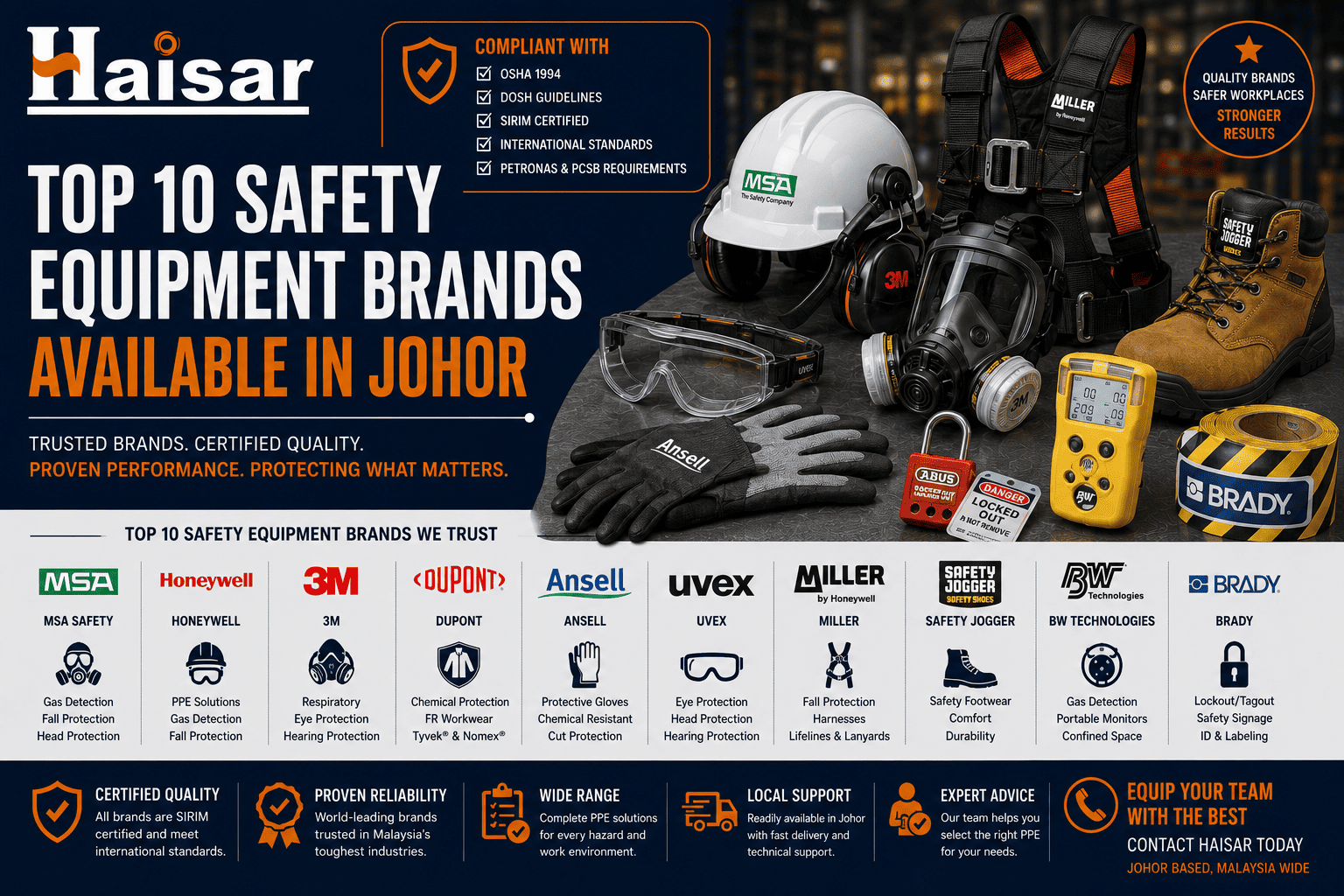
Haisar Supply and Services Sdn Bhd, based in Kulai, Johor, supplies the full range of offshore safety equipment for O&G operations across Malaysia. We work with PETRONAS contractors, offshore support operators, platform maintenance contractors, and shutdown teams who need safety equipment specified and documented to the standards that Malaysian offshore operations demand.
Our offshore supply range covers ATEX and IECEx certified gas detection equipment and calibration gas, automatic inflatable lifejackets and SOLAS equipment, fall protection with stainless steel offshore-specification hardware, FR coveralls with NFPA 2112 certification, anti-static footwear and maritime deck footwear, confined space rescue systems including intrinsically safe communication equipment, dropped object prevention tools and tethering equipment, and the full range of offshore-rated PPE across all categories.
We understand the PETRONAS and PCSB compliance framework and we supply with the documentation that offshore audits and safety management system reviews require.
Download the Haisar Offshore Safety Equipment Catalogue
Download the Offshore Safety Equipment Catalogue
Contact our team with your platform, project, or contractor requirements and we will respond with product specifications, compliance documentation, and pricing tailored to your offshore operations in Malaysia.
Haisar Supply and Services Sdn Bhd (985158-T) | Kulai, Johor, Malaysia | www.haisar.com
