Can't find what you're looking for? Get in touch!



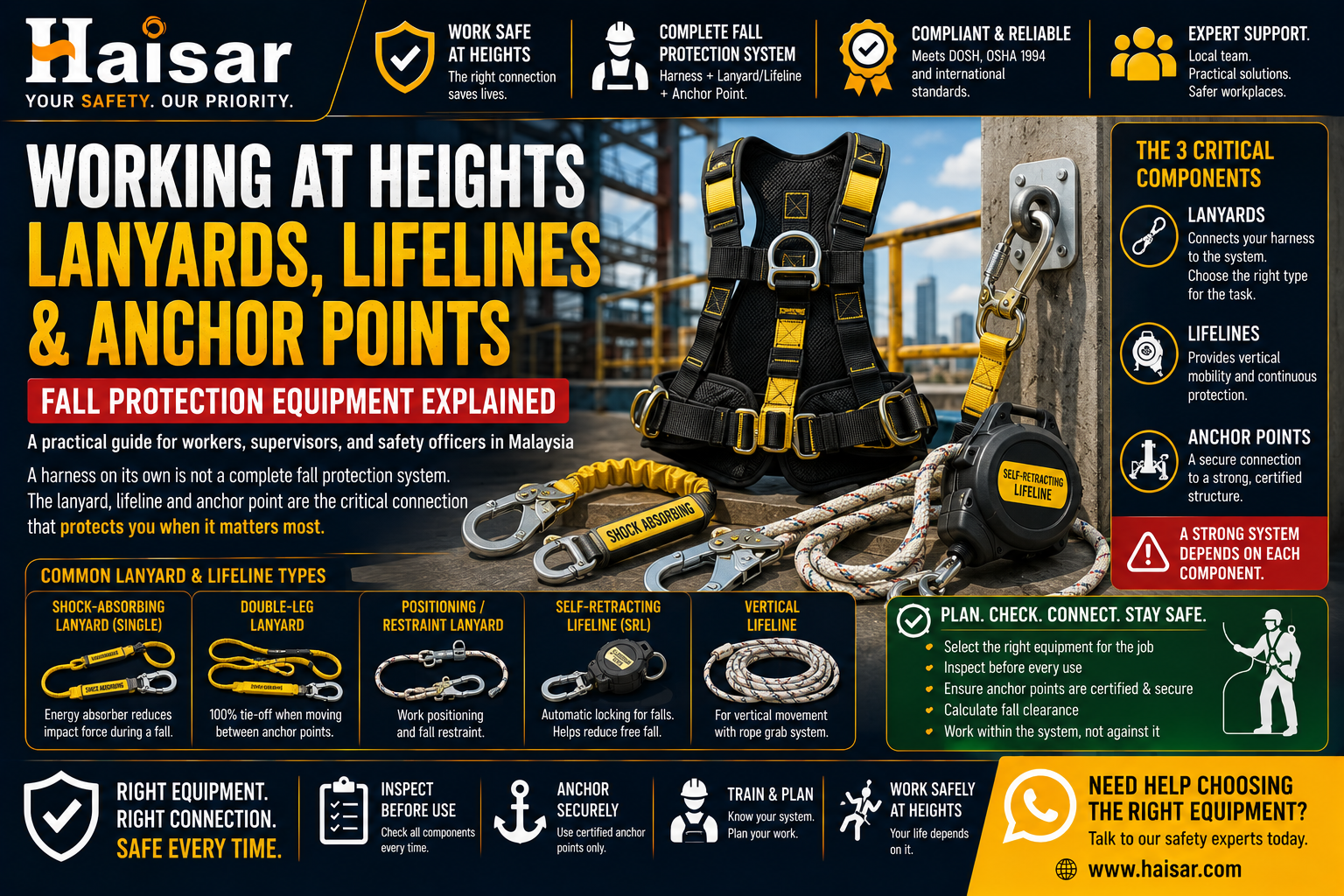
Fall Protection Equipment Explained
A practical guide for workers, supervisors, and safety officers in Malaysia
A safety harness keeps a worker attached to a fall protection system. But a harness on its own is not a complete fall protection system. The harness is only as effective as the components connecting it to a fixed structure - the lanyard, the lifeline, and the anchor point. This is where many working-at-heights programmes in Malaysia fall short. Teams invest in quality harnesses, tick the box on harness inspection, and then give insufficient attention to the connection between the worker and the structure. A worn snap hook, an incorrectly installed anchor, a shock-absorber pack that has already deployed, or a self-retracting lifeline used on the wrong type of fall - any one of these failures can result in a fall that the harness alone cannot prevent.
This guide explains lanyards, lifelines, and anchor points in plain language: what each component does, how the different types compare, how to select the right equipment for your work at height in Malaysia, and the inspection standards that apply to each. It is intended for workers, supervisors, safety officers, and procurement teams responsible for fall protection equipment across Malaysian construction sites, industrial facilities, and infrastructure projects.
Why the Connection Between Worker and Structure Is
Critical
When a person falls from height, the sequence of events that determines whether they survive - and in what condition - depends entirely on what happens between the moment they leave the surface and the moment the system arrests the fall.
Three things happen in that sequence. First, the worker falls freely until the slack in the connecting system is used up. Second, the energy-absorbing components in the system - typically the shock absorber in the lanyard or the braking mechanism in a self-retracting lifeline - begin to decelerate the fall. Third, the fall is arrested, ideally with the worker still above any lower level or obstruction.
The lanyard, lifeline, and anchor point govern all three stages. They determine how much free fall occurs, how efficiently the fall energy is absorbed, and whether the system holds. Selecting the wrong component for the application, or using a component in poor condition, does not just reduce the margin of safety. It can cause the system to fail entirely.
Falls from height remain the leading cause of workplace fatalities in Malaysia's construction sector, and a significant cause in oil and gas, utilities, and manufacturing maintenance work. The Department of Occupational Safety and Health (DOSH) under the Occupational Safety and Health Act 1994 requires employers to provide adequate fall protection systems for any work at height where a fall risk exists. Having the right connecting equipment - correctly selected, correctly inspected, and correctly installed - is not optional.
Lanyards: The Primary Connecting Component
A lanyard is the component that connects the dorsal D-ring on a worker's harness to an anchor point or lifeline. It is the most commonly used fall protection connecting component and comes in several configurations with significantly different performance characteristics.
Shock-Absorbing Lanyards
What they are: A shock-absorbing lanyard incorporates an energy absorber - typically a folded, tear-stitch pack sewn into the webbing - that deploys during a fall to reduce the peak arresting force transmitted to the worker's body.
How they work: When a fall is arrested, the shock absorber tears open in a controlled manner, extending the stopping distance and reducing the deceleration force. Without this, the sudden arrest of a fall can itself cause serious spinal and harness-induced suspension injuries even when the worker is caught before hitting a lower level.
Standard lanyard length: The most common shock-absorbing lanyard length in Malaysian site use is 1.8 metres. This is the maximum free fall distance that must be accounted for in the fall clearance calculation below the anchor point.
The clearance calculation: This is the most frequently misunderstood aspect of lanyard selection. Before using a 1.8m lanyard, calculate the total clearance required below the anchor point: 1.8m (lanyard length) + up to 1.75m (shock absorber deployment) + 2m (safety clearance) + the worker's height from D-ring to feet (approximately 1.5m). The total minimum clearance required below the anchor for a standard 1.8m lanyard is approximately 6–7 metres. On many Malaysian construction and maintenance tasks, this clearance does not exist, making a shorter lanyard, a self-retracting lifeline, or a repositioning lanyard the correct choice.
Double-Leg (Twin-Leg) Lanyards
What they are: A twin-leg lanyard has two legs, each with its own snap hook, connected to a single harness attachment point. One leg connects to the anchor while the other is free, allowing the worker to always have one leg connected while moving between anchor points - maintaining 100% tie-off at all times.
When they are required: Any task requiring movement along a structure where the worker must disconnect from one anchor to connect to the next - tower climbing, structural steel erection, and traversing walkways with multiple tie-off points - requires a twin-leg lanyard. A single-leg lanyard creates unprotected intervals during transitions.
Positioning and Restraint Lanyards
What they are: A positioning lanyard is an adjustable-length lanyard designed to hold a worker in a fixed position at height, typically with the lanyard under tension, freeing both hands for work. Restraint lanyards are used to prevent a worker from reaching a fall edge, rather than to arrest a fall.
Critical distinction: Positioning and restraint lanyards are not fall arrest devices. They are not rated for the full fall arrest load of a 1.8m free fall. Using a positioning lanyard in a configuration where a free fall is possible is a serious specification error that could result in lanyard failure during fall arrest.
|
Lanyard Type |
Primary Function |
Typical Length |
Suitable for Free Fall? |
Common Malaysian Application |
|
Shock-absorbing (single leg) |
Fall arrest |
1.8m |
Yes — if clearance permits |
General construction, industrial maintenance |
|
Twin-leg shock-absorbing |
Fall arrest + 100% tie-off |
1.8m per leg |
Yes — if clearance permits |
Tower work, structural steel, column climbing |
|
Positioning lanyard |
Work positioning (hands-free) |
Adjustable |
No |
Pole work, structural steel positioning |
|
Restraint lanyard |
Prevent reaching fall edge |
Fixed or adjustable |
No |
Roof edge restraint, platform perimeter work |
|
Self-retracting lifeline (SRL) |
Fall arrest with minimal free fall |
4m to 30m+ |
Yes — very short free fall |
All height work where clearance is limited |
Self-Retracting Lifelines (SRLs): When Lanyards Are Not
Enough
A self-retracting lifeline - sometimes called a retractable lanyard or fall arrester - is a fall protection device that automatically pays out and retracts a cable or webbing line as the worker moves, while locking instantly in the event of a fall. The braking mechanism engages in response to the speed of line extraction, not to a predetermined fall distance.
This has a crucial practical advantage over a fixed-length lanyard: the free fall distance before arrest is typically only centimetres rather than the full lanyard length. This dramatically reduces the clearance required below the work position and the peak arrest force on the worker's body.
SRL Types and Their Differences
Standard SRLs (leading edge rated): Designed for overhead anchor use where the SRL is positioned above the worker. Standard SRLs assume a relatively short, clean fall path. They are the most common type on Malaysian construction sites and industrial facilities.
Leading edge SRLs: Designed for use where the SRL cable may contact a structural edge during a fall - such as when working at floor level with the anchor at the same level or below. Standard SRLs can fail if the cable is cut by a sharp edge during fall arrest. Leading edge-rated SRLs have cable and casing construction designed to withstand this loading.
Personal SRLs: Smaller, lighter devices designed to be worn by the worker or kept at belt level. They offer good mobility for work requiring frequent repositioning. Personal SRLs are typically rated for shorter fall distances and lower loads than larger structural SRLs.
SRL Selection Checklist
|
☑ BEFORE SELECTING AN SRL, CONFIRM: |
|
✓ Anchor position - is the anchor directly above the worker? If not, a leading edge-rated SRL may be required |
|
✓ Fall clearance - confirm adequate clearance exists below the work position for the SRL's stated fall distance |
|
✓ Line length - select an SRL with sufficient line for the full working range without forcing the worker to over-extend |
|
✓ Load rating - confirm the SRL is rated for the worker's weight including tools and equipment |
|
✓ Environment - stainless cable SRLs for marine, chemical, or high-humidity environments; galvanised for general use |
|
✓ DOSH/SIRIM compliance - confirm the SRL is certified to EN 360, ANSI Z359.14, or equivalent standard |
Anchor Points: The Foundation of the Entire System
The anchor point is the fixed point on the structure to which the lanyard or lifeline is attached. Every component below the anchor - the SRL, the lanyard, the energy absorber, the harness - can only perform correctly if the anchor point itself holds.
Anchor point failure is one of the most catastrophic outcomes in a fall event, because it typically means the worker falls the full distance to the lower level with no arrest whatsoever. A failed snap hook can be survived. A failed anchor cannot.
Anchor Point Load Ratings
Under DOSH requirements and the relevant standards - including EN 795 and ANSI Z359.15 - anchor points used for fall arrest must be capable of sustaining a minimum static load of 15 kN (approximately 1,500 kg or 3,360 lbf) per worker connected. This rating accounts for the dynamic loads generated during fall arrest, which are significantly higher than the worker's static body weight.
This 15 kN minimum rating must be confirmed through engineering verification of the anchor and its attachment to the structure - not assumed based on the apparent robustness of the structure. A concrete roof slab that looks solid may have inadequate reinforcement at the anchor fixing point. A steel beam that could support many tonnes of structural load may be bolted to secondary steel not rated for point loads of 15 kN.
Types of Anchor Points
Permanent fixed anchors: Installed by a structural engineer as part of the building or facility design, rated and certified for fall arrest loads. Common on rooftops of commercial buildings in Kuala Lumpur, Johor Bahru, and major Malaysian industrial facilities. Permanent anchors must carry manufacturer certification and should be inspected and recertified periodically.
Temporary portable anchors: Devices that clamp, strap, or hook onto existing structural elements to create a rated anchor point where no permanent anchor exists. Beam clamps, roof anchors that hook over ridge beams, and strap anchors that wrap around columns are common types. Temporary anchors must still meet the 15 kN rating requirement and must be rated for the specific structural element they are being attached to.
Horizontal lifeline systems: A tensioned cable or webbing line running horizontally between two anchor points, allowing a worker to move laterally along a structure while maintaining continuous connection. Horizontal lifelines must be engineered - the end anchor forces in a horizontal lifeline under fall arrest loads can be several times the 15 kN rated load due to the geometry of the cable angle. Improvised horizontal lifelines rigged on site without engineering input are one of the most dangerous fall protection configurations in common site use.
Structural elements used as anchors: In practice, particularly in construction and maintenance, workers frequently clip to structural steel beams, scaffold tubes, or other existing elements. The load rating of the element may be adequate, but the connection method matters equally. A scaffold tube is not a rated anchor point unless it is part of a system that has been verified to hold the required load in the direction of the potential fall.
|
Anchor Type |
Load Rating Verification |
Installation |
Mobility |
Typical Use in Malaysia |
|
Permanent fixed anchor |
Engineer-certified at installation |
Permanent |
Single fixed point |
Building rooftops, towers, plant structures |
|
Portable beam clamp |
Rated by manufacturer for beam size |
Temporary, manual |
Relocatable |
Industrial maintenance, steel structures |
|
Roof ridge anchor |
Manufacturer rated for roof pitch/type |
Temporary, strap |
Relocatable |
Residential and commercial roofing work |
|
Horizontal lifeline |
Requires engineering design |
Temporary or permanent |
Full line length |
Scaffold work, rooftop walkways, bridge maintenance |
|
Structural steel (beam) |
Structural calculation required |
Improvised/clip-on |
Single point |
Construction steel work — verify before use |
Inspection Requirements: Lanyards, SRLs, and Anchor
Points
The inspection requirements for connecting components are just as rigorous as for the harness itself. A lanyard that has been involved in a fall arrest event, or an SRL that does not retract smoothly, must be removed from service regardless of visual appearance.
Lanyard Inspection — Before Every Use
|
☑ LANYARD VISUAL AND FUNCTIONAL INSPECTION: |
|
✓ Webbing - check for cuts, fraying, abrasion, burns, chemical damage, and UV degradation along the full length |
|
✓ Stitching - inspect all seams and bar tacks; broken or loose stitching is an immediate retirement trigger |
|
✓ Shock absorber pack - must be intact with the deployment cover sealed; any opening or tearing means the lanyard has been involved in a fall and must be retired |
|
✓ Snap hooks - gate must open cleanly, close positively, and lock automatically on locking snap hooks |
|
✓ Gate keeper function - the double-action or triple-action gate mechanism must require deliberate sequential movement to open; it must not open with a single casual motion |
|
✓ Carabiners - check for corrosion, distortion, and that screw gates are fully closed and seated |
|
✓ Connection hardware - no cracks, burrs, or distortion on any metal component |
|
✓ Labels - test date, standard compliance, and manufacturer information must be legible |
|
❌ REMOVE FROM SERVICE IMMEDIATELY IF: |
|
Shock absorber pack is open, torn, or has partially deployed - this lanyard has been in a fall |
|
Any snap hook gate does not lock positively and require deliberate release to open |
|
Webbing shows cuts, chemical damage, or significant abrasion |
|
The lanyard has been used to arrest a fall, regardless of visual condition |
SRL Inspection — Before Every Use
|
☑ SRL FUNCTIONAL INSPECTION: |
|
✓ Pull test - pull the line out to its full extent and allow it to retract; retraction should be smooth and consistent under even tension throughout the full length |
|
✓ Lock test - pull the line out sharply and quickly; the braking mechanism should engage and lock immediately, then release when line tension is reduced |
|
✓ Line condition - inspect the cable or webbing line along its full length for kinks, birdcaging (wire rope distortion), cuts, or fraying |
|
✓ Housing - check for cracks, impact damage, or deformation to the SRL casing |
|
✓ Swivel - the top connecting swivel should rotate freely without grinding or catching |
|
✓ Connection hardware - snap hook or carabiner at the worker end must function correctly as per lanyard hook inspection above |
|
✓ Indicator - some SRLs incorporate a fall indicator that changes colour or displays a marker after a fall; check this against the manufacturer's guidance |
|
✓ Labels and certifications - confirm the SRL is within its periodic inspection interval per manufacturer's requirements |
Anchor Point Inspection — Before Every Use
|
☑ ANCHOR POINT INSPECTION: |
|
✓ Certification - confirm the anchor is certified or engineered for fall arrest at the required load rating; do not use uncertified anchors for fall arrest |
|
✓ Physical condition - check for corrosion, distortion, cracking, or impact damage on the anchor body and all fixings |
|
✓ Attachment to structure - confirm the anchor is correctly and fully attached to the structural element it is fixed to; check all bolts, clamps, or straps |
|
✓ Orientation - confirm the anchor is oriented correctly for the direction of the potential fall load |
|
✓ Clearance - confirm adequate clearance exists below the anchor for the total fall distance of the system being used |
|
✓ Rated capacity - confirm the anchor's rated load is sufficient for the number of workers connected |
|
✓ Horizontal lifelines - inspect tensioners, end terminations, and intermediate supports; confirm the system is within its engineered load capacity |
Common Fall Protection Errors in Malaysian Site Practice
The following errors appear regularly in DOSH incident investigations and site safety audits across Malaysian construction and industrial projects. Each represents a configuration or selection mistake that can result in system failure during a fall.
|
Common Error |
Why It Is Dangerous |
Correct Practice |
|
Using a 1.8m lanyard where clearance below the anchor is less than 6–7 metres |
Worker will strike lower level or obstruction before fall is arrested |
Use an SRL or calculate clearance before selecting lanyard length |
|
Clipping snap hook to the back of the lanyard's own D-ring (back-hooking) |
Reduces rated gate strength; hook can roll and gate can open under load |
Always connect snap hook to a rated anchor or D-ring only |
|
Using a standard SRL in a leading edge application |
Cable can be cut on structural edge during fall, causing complete system failure |
Use only leading edge-rated SRLs where cable may contact a structural edge |
|
Rigging a horizontal lifeline between two anchor points without engineering input |
End anchor forces can be 10x or more the fall arrest load; anchors fail |
All horizontal lifelines must be designed by a competent engineer |
|
Continuing to use a lanyard after a fall arrest event |
Shock absorber has deployed and can no longer absorb energy; the lanyard is no longer rated for fall arrest |
Retire any lanyard involved in a fall immediately, regardless of appearance |
|
Connecting lanyard to an unverified structural element |
Structural element may not be rated for 15 kN fall arrest load in the fall direction |
Only connect to certified or engineered anchors; verify before clipping in |
Selecting the Right Fall Protection System for Your Task
No single connecting system suits every working-at-heights task. The correct selection depends on the work environment, the available clearance below the work position, the mobility requirements of the task, and the available anchor infrastructure.
|
Work Scenario |
Recommended System |
Key Consideration |
|
General construction - overhead anchor available, ≥7m clearance below |
1.8m shock-absorbing lanyard |
Verify clearance calculation before use |
|
Tower climbing or structural steel - moving between anchor points |
Twin-leg shock-absorbing lanyard |
Maintain 100% tie-off during anchor transitions |
|
Roof work - limited clearance below work level |
Self-retracting lifeline (SRL) |
Confirm anchor is directly above worker; use leading edge SRL at floor level |
|
Working on leading edges at floor level |
Leading edge-rated SRL |
Standard SRLs must not be used in this configuration |
|
Work requiring fixed positioning - both hands needed |
Positioning lanyard + fall arrest backup |
Positioning lanyard alone is not fall arrest; always use with a separate fall arrest system |
|
Lateral movement along a structure |
Horizontal lifeline system (engineered) |
Must be designed by a competent engineer; not a site-rigged system |
|
Preventing access to a fall edge (not fall arrest) |
Restraint lanyard sized to prevent reach to edge |
Verify the lanyard length actually prevents the worker from reaching the hazardous edge |
Malaysian Regulatory Requirements
Working at heights in Malaysia is governed by the Occupational Safety and Health Act 1994 (OSHA 1994) and the associated Factory and Machinery Act regulations, with specific guidance provided by DOSH through its Guidelines on Occupational Safety and Health for Working at Height.
The key regulatory requirements relevant to lanyards, lifelines, and anchor points include:
- Employers are required to conduct a risk assessment for any work at height and implement controls to eliminate or minimise the fall risk, with collective protection measures (guardrails, safety nets) preferred over personal fall protection where practicable.
- Where personal fall protection is used, equipment must comply with recognised standards — IEC or ANSI standards are accepted by DOSH. Equipment with SIRIM certification or certification by a recognised testing body provides documentary compliance evidence.
- Anchor points for fall arrest must provide a minimum static strength of 15 kN per worker. This must be documented for permanent anchors and verified by a competent person for temporary anchors.
- All fall protection equipment must be inspected before each use by the wearer and periodically by a competent person. Records of inspection must be maintained.
- Workers must be trained in the correct use, fitting, and inspection of all fall protection equipment before being permitted to work at height using that equipment.
PETRONAS contractor requirements, TNB contractor requirements, and major Malaysian industrial facility operator requirements typically exceed the minimum DOSH requirements and should be consulted for specific project applications.
Conclusion
The harness gets the attention. But the lanyard, the lifeline, and the anchor point are where fall protection systems succeed or fail in practice.
Selecting the wrong type of lanyard for the available clearance, using an SRL in a configuration it was not designed for, clipping to an unverified anchor, or continuing to use a lanyard after it has arrested a fall — these are not edge-case errors. They are documented causes of fall fatalities and serious injuries on Malaysian sites.
The decisions involved in correctly specifying, inspecting, and using connecting equipment are not complicated, but they require knowledge that cannot be assumed. Train your workers. Verify your anchors. Inspect before every use. And replace any component involved in a fall, regardless of how it looks afterwards.
The system only works when every component in it works. Make sure yours does.
|
📖 Related Articles on Height Safety
→ Safety Harness Inspection Checklist: What to Check Before Working at Height → Working at Heights PPE: A Complete Equipment Guide for Malaysian Sites → DOSH Guidelines on Working at Height: What Malaysian Employers Need to Know |
|
📲 Enquire About Fall Protection Equipment in Malaysia
Haisar Supply and Services supplies lanyards, self-retracting lifelines, anchor devices, and complete fall protection systems for construction, industrial, and infrastructure projects across Johor and peninsular Malaysia. Contact us via WhatsApp to discuss your working-at-heights requirements and we will recommend the correct equipment for your specific application. WhatsApp Enquiry | www.haisar.com |
© 2024 Haisar Supply and Services Sdn Bhd (985158-T) | Kulai, Johor, Malaysia | www.haisar.com
For informational purposes. Always refer to applicable DOSH requirements, manufacturer guidelines, and site-specific risk assessments.
