Can't find what you're looking for? Get in touch!



1: The State of Safety 2026 (Legal & Introduction)
1.1 The Changing Face of Industrial Malaysia
As we move through 2026, Malaysia’s industrial landscape is undergoing a massive transformation. From the rapid expansion of the Kulai Fast Lane to the high-tech semiconductor hubs in Senai and the massive energy complexes in Pengerang, the scale of our projects has never been greater. However, with larger projects comes a heightened level of risk.
Head injuries remain one of the leading causes of workplace fatalities and long-term disabilities in the Malaysian construction and manufacturing sectors. In this high-stakes environment, the humble safety helmet is no longer just a "plastic hat" it is a sophisticated piece of life-saving technology. For any business operating in Johor or the wider Malaysian region, understanding the modern requirements of head protection is the first step toward operational excellence.
1.2 Navigating the OSHA (Amendment) Act 2022/2026
The most critical shift for any safety officer or business owner to understand is the full enforcement of the Occupational Safety and Health (Amendment) Act 2022, which reached its peak maturity in early 2026. This legislation completely overhauled the responsibilities of the employer.
Universal Coverage Unlike the original 1994 Act, which focused on specific sectors like manufacturing and construction, the 2022/2026 framework now applies to all workplaces across Malaysia. Whether you are managing a small warehouse in Pasir Gudang or a multinational oil refinery, the legal requirement to provide "suitable and effective" Personal Protective Equipment (PPE) is now universal. Under Section 15, the burden of proof is on the employer to show that the head protection provided is fit for the specific hazards of the site.
1.3 The RM500,000 Risk and Personal Liability
The 2026 enforcement has brought with it a "zero-tolerance" approach from DOSH (JKKP) regarding non-compliant PPE. The financial and legal risks have escalated significantly:
- Financial Penalties: Maximum fines for safety breaches have increased from RM50,000 to a staggering RM500,000.
- Section 18A (Director Liability): This is the most significant change. Directors, managers, and "principals" (main contractors) can now be held personally and criminally liable for safety failures. If a worker is injured while wearing a non-certified or expired helmet, the leadership must prove they took "all reasonable steps" to prevent the accident.
- The Right to Refuse: Workers are now legally empowered to remove themselves from a work area if they believe the provided head protection is inadequate, without fear of losing their job.
Part 2: Anatomy & Material Science (Expertise)
2.1 The 3-Part Protection System
To understand why one helmet costs RM15 and another costs RM80, you must understand the anatomy of protection. A safety helmet is a system designed to manage kinetic energy through three distinct layers:
- The Outer Shell: The rigid exterior designed to deflect sharp objects and prevent penetration of the skull.
- The Suspension (Harness): The internal web of straps. This is the most critical part of the helmet. It maintains a 30mm buffer zone between the shell and the head, stretching during impact to slow down the deceleration of the brain.
- The Retention System (Chin Strap): In 2026, the 4-point chin strap has become the industry standard for "climbing-style" helmets, ensuring the helmet stays on the head during a fall or a secondary impact.
2.2 Material Wars: PE vs. ABS vs. High-Tech Composites
In the Malaysian heat, material choice is a matter of life and death.
- Polyethylene (PE): This is the most common material for "budget" helmets. While lightweight and moisture-resistant, PE is highly susceptible to UV degradation. In Johor’s intense sun, a PE helmet can become brittle and lose its safety rating in less than 12 months.
- ABS (Acrylonitrile Butadiene Styrene): The "Gold Standard" at Haisar. ABS is a superior thermoplastic that offers much higher impact resistance and thermal stability. It does not warp in the high-heat environments common in Pasir Gudang’s factories.
- Carbon Fiber & Advanced Composites: In 2026, these are the preferred choice for supervisors and high-level inspectors. They offer the strength of steel at a fraction of the weight, significantly reducing neck strain and "helmet fatigue" during 12-hour shifts.
2.3 The Mips® Revolution in 2026
One of the biggest technological leaps in 2026 is the integration of Mips (Multi-directional Impact Protection System) into industrial helmets.
Most traditional helmets are tested for "linear" impacts (an object falling straight down). However, most real-world falls happen at an angle, creating rotational force. This rotation causes the brain to slide against the inside of the skull, leading to concussions even if the helmet shell remains intact. Mips uses a low-friction layer inside the helmet that allows the shell to move slightly during an impact, redirecting that dangerous rotational energy away from the brain.
3: Classification & Standards (The Compliance Map)
3.1 Understanding MS 183 and MS 1869:2015
In Malaysia, the Department of Occupational Safety and Health (DOSH/JKKP) primarily recognizes the Malaysian Standards (MS) as the baseline for compliance.
- MS 183: The traditional standard for industrial safety helmets.
- MS 1869:2015: A more modern alignment that mirrors the rigorous European EN 397 standards. This updated standard is what most high-tier projects in the Johor Bahru and Pengerang regions now demand.
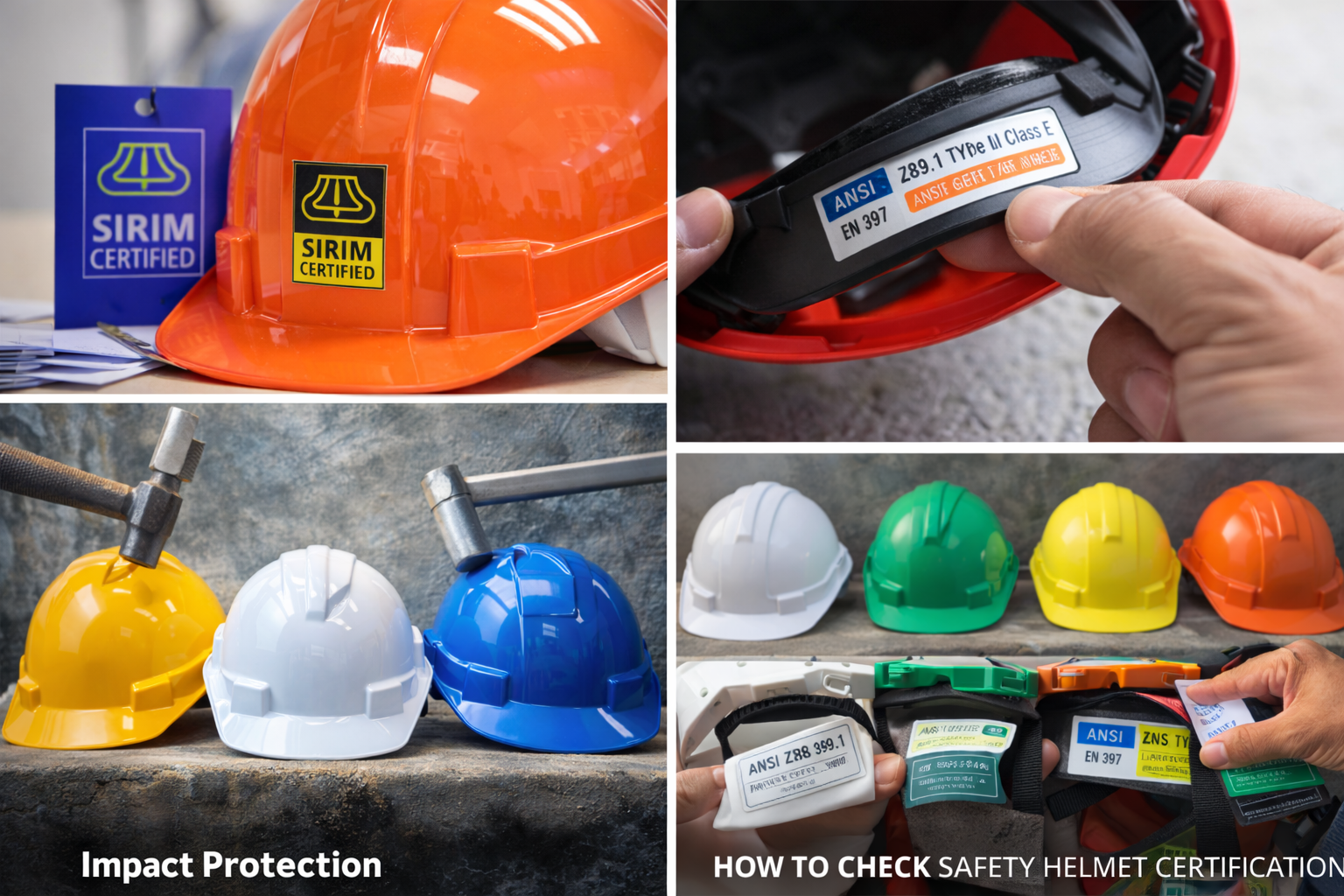
When you see a SIRIM sticker, it confirms the helmet has passed specific tests for shock absorption, penetration resistance, and flame retardancy. For procurement officers, checking for "MS 183" or "MS 1869" on the product label is the quickest way to verify legal compliance during an audit.
3.2 The Global Benchmarks: ANSI vs. EN Standards
While local standards are mandatory, many multinational corporations operating in Johor - especially in the Oil & Gas and Data Center sectors - refer to global benchmarks.
- ANSI/ISEA Z89.1-2014 (USA): This standard is the global leader in categorizing helmets by Type (I or II) and Electrical Class (G, E, or C). If your project follows American engineering specifications, this is the standard you will follow.
- EN 397 (Europe): This standard is common in manufacturing plants and European-led infrastructure projects. It is particularly strict on Lateral Deformation (LD), ensuring the helmet doesn't crush under side-pressure.
Part 4: Industry-Specific Deep Dives (Sector Guides)
4.1 The Construction Sector: Facing the "Kulai Fast Lane"
In the construction industry, particularly with rapid-track projects like the "Kulai Fast Lane" industrial parks, the primary hazards are falling objects and extreme heat.
The Johor Sunlight Factor Johor has one of the highest UV indexes in the region. For outdoor construction workers, we recommend Type I ABS helmets with UV-stabilized coatings.
- Color Coding: While not a law, most Johor sites use White for supervisors/engineers and Yellow for general workers to improve site communication.
- Work at Height: If workers are operating on scaffolding above 2 meters, a 4-point chin strap (meeting EN 12492 or EN 397 retention standards) is mandatory to ensure the helmet stays on during a fall.
4.2 The Oil & Gas Sector: Pengerang & RAPID Standards
The Pengerang Integrated Complex (PIC) and RAPID projects operate under some of the strictest PPE rules in the world, often aligned with PETRONAS Technical Standards (PTS).
- Non-Vented Requirements: In areas with flammable vapors, non-vented helmets are often required to prevent gas accumulation inside the shell.
- Class E Rating: Most sites require an Electrical Class E rating (protection up to 20,000V) as a default safety margin, even for non-electricians.
- Anti-Static Properties: Helmets must often be certified for use in ATEX/Explosive zones to prevent static discharge from acting as an ignition source.
4.3 The Manufacturing & Logistics Sector: Pasir Gudang Hubs
Inside the massive manufacturing plants of Pasir Gudang, the focus shifts from falling objects to internal machinery hazards and heat stress.
- Vented Comfort: Unlike Oil & Gas, manufacturing often allows vented helmets (Class C) to maximize airflow and reduce the risk of heat exhaustion among workers.
- Low Profile Design: In tight spaces like warehouses or assembly lines, low-profile helmets are preferred to prevent the brim from obstructing vision or hitting low-hanging structures.
5: The Buyer’s Master Logic (Procurement & ROI)
5.1 The Total Cost of Ownership (TCO) Strategy
In 2026, professional procurement officers in Johor have moved away from "lowest unit price" buying. Instead, they look at the Total Cost of Ownership.
A budget PE helmet costing RM10 may seem like a bargain, but if it degrades in 12 months due to UV exposure, you will buy three helmets in the time you could have used one high-quality ABS helmet (priced at RM28). When you factor in the administrative cost of processing three purchase orders, delivery fees, and the downtime of re-issuing gear, the "expensive" helmet is actually 40% cheaper over a three-year project cycle.
5.2 The Haisar Decision Matrix: Matching Helmet to Risk
To simplify procurement, we utilize a logic-based selection process. Buying the most expensive helmet for a site visitor is wasteful, just as buying a basic cap-style helmet for a scaffolder is dangerous.
- Task: Work at Height (>2m) → Requirement: Climbing-style, 4-point chin strap, Type II impact rating.
- Task: Electrical Maintenance → Requirement: Non-vented, Class E (20,000V) rated, shell-integrated visor.
- Task: Outdoor Infrastructure → Requirement: Full-brim ABS shell, UV-stabilized coating, moisture-wicking sweatband.
- Task: Factory Floor/Logistics → Requirement: Vented Type I shell, lightweight (under 400g), high-visibility color.
5.3 Transparency in the Supply Chain: Avoiding "Gray Market" PPE
The rise of e-commerce has led to an influx of counterfeit or "gray market" safety helmets in Malaysia. These often look identical to SIRIM-certified products but fail under impact testing. At Haisar, we provide a Compliance Traceability Pack with bulk orders, which includes:
- Batch-specific SIRIM test reports.
- Manufacturer's Certificate of Conformity.
- Warranty documentation against material defects.
6: Maintenance & Compliance (The Inspection Framework)
6.1 The "Shelf Life" vs. "Service Life" Paradox
There is a significant difference between how long a helmet stays "new" in a box and how long it lasts on a site in Pasir Gudang.
- Shelf Life: Most high-quality manufacturers (like those we stock at Haisar) specify a 5-year shelf life in a climate-controlled warehouse.
- Service Life: In Malaysia's tropical climate, the shell should be replaced every 2 to 3 years of active use. The internal suspension, which absorbs sweat and hair oils, should be replaced every 12 months to maintain hygiene and structural integrity.
6.2 The Haisar 5-Point Daily Inspection Protocol
We recommend all safety officers implement this 60-second morning check for their teams:
- The Visual Shell Audit: Look for "chalking" (a sign of UV damage), deep scratches, or any discoloration.
- The Stress Compression: Gently squeeze the helmet from the sides. It should feel firm but slightly flexible. If you hear a "crackling" sound, the plastic is brittle discard immediately.
- The Harness Anchor Points: Ensure the four or six suspension clips are snapped tightly into the shell. A loose harness provides zero shock absorption.
- The Date Wheel Inspection: Check the embossed "Date of Manufacture" wheel inside the shell. If it’s past its 5-year total life, it must be retired.
- Chemical Contamination: Check for any residue of paints, solvents, or heavy oils. These chemicals can microscopically "melt" the plastic polymers, making them prone to shattering upon impact.
6.3 Cleaning Standards for SIRIM Compliance
To keep your gear compliant, avoid using industrial degreasers or petrol.
- Approved Method: Use only mild soap and warm water.
- The Sticker Rule: Never allow workers to apply unauthorized stickers or paint to their helmets. The adhesives in standard stickers can react with the shell material, creating weak points that the SIRIM certification no longer covers.
7: The Future: Smart PPE & Digital Compliance
7.1 The Rise of the "Connected Worker" in 2026
As we look toward the Occupational Safety and Health Master Plan 2026-2030 (OSHMP30), the focus in Malaysia is shifting from passive protection to active monitoring. The industrial safety helmet is evolving from a static piece of plastic into a digital hub for site intelligence.
IoT-Enabled Hazard Detection In 2026, leading construction firms in Johor have begun deploying smart helmets equipped with IoT (Internet of Things) sensors. These devices do more than block impacts; they monitor the environment in real-time.
- Gas & Heat Sensors: Integrated sensors detect hazardous fumes or extreme heat levels that could lead to heatstroke a major risk in Malaysia’s tropical climate.
- Fall Detection: If a worker falls from a scaffold, the helmet’s accelerometer instantly triggers a distress signal to the safety office with the worker’s exact GPS coordinates.
7.2 Augmented Reality (AR) on the Worksite
Augmented Reality is no longer science fiction. In high-complexity sectors like Pengerang's Oil & Gas plants, supervisors are using AR-enabled visors attached to their safety helmets.
- Digital Blueprints: Engineers can view 3D blueprints overlaid directly onto the physical structures they are inspecting.
- Remote Assistance: A technician in Pasir Gudang can share their live helmet-cam feed with an expert in Kuala Lumpur or overseas, receiving real-time guidance through a heads-up display.
7.3 Digital Compliance and Blockchain Tracking
To meet the stricter OSHA 2022/2026 reporting requirements, companies are moving away from paper logs.
- NFC/RFID Tags: Every Haisar helmet can be equipped with a small RFID chip. When a safety officer scans the helmet with a smartphone, they instantly see its Date of Manufacture, the last Inspection Date, and the assigned worker’s name.
- Immutable Safety Logs: By storing inspection records on a digital ledger, companies can prove to JKKP auditors that their PPE fleet is 100% compliant and has never been used past its expiry date.
Part 8: Conclusion & Expert FAQ
8.1 Building a Generative Safety Culture
The ultimate goal of any head protection program is not just to avoid fines it is to build a Generative Safety Culture. This is a state where safety is seen as a core value by every employee, from the boardroom to the factory floor.
At Haisar Supply & Services, we believe that the right equipment is the foundation of that culture. When a worker is provided with a helmet that is comfortable, certified, and technologically advanced, it sends a clear message: Your life is valuable. ### 8.2 Expert FAQ: Top Questions from JKKP Auditors
Q: Can I use an international helmet that doesn't have a SIRIM sticker? A: Under Malaysian law, while ANSI or EN standards are excellent, the product must be approved by DOSH/JKKP. In almost all cases, this requires a SIRIM certification mark. Using unapproved gear can lead to an immediate "Stop Work Order" during an audit.
Q: Does a "bump cap" count as a safety helmet? A: No. Bump caps are designed only for protecting against stationary objects (like low ceilings). They provide zero protection against falling objects and are strictly prohibited on construction sites.
Q: Can I wash the internal suspension in a washing machine? A: It is not recommended. The mechanical action and harsh detergents can weaken the plastic clips. Hand-wash with mild soap and warm water only.
Q: What is the penalty for a worker not wearing their helmet? A: Under the OSHA (Amendment) Act 2022, the employer can be fined up to RM500,000 for failing to ensure PPE use. The worker can also be held liable for failing to follow safety instructions.
Your Journey to 100% Compliance Starts Here
Don't leave your site safety to chance. As Johor’s leading PPE partner, Haisar Supply & Services is here to provide the gear, the expertise, and the long-term support you need.
Ready to upgrade your fleet or conduct a safety audit?
📞 Sales: +60 17-707 0025
💬 WhatsApp: +60 12-570 7015
🌐 Website: www.haisar.com
