Can't find what you're looking for? Get in touch!



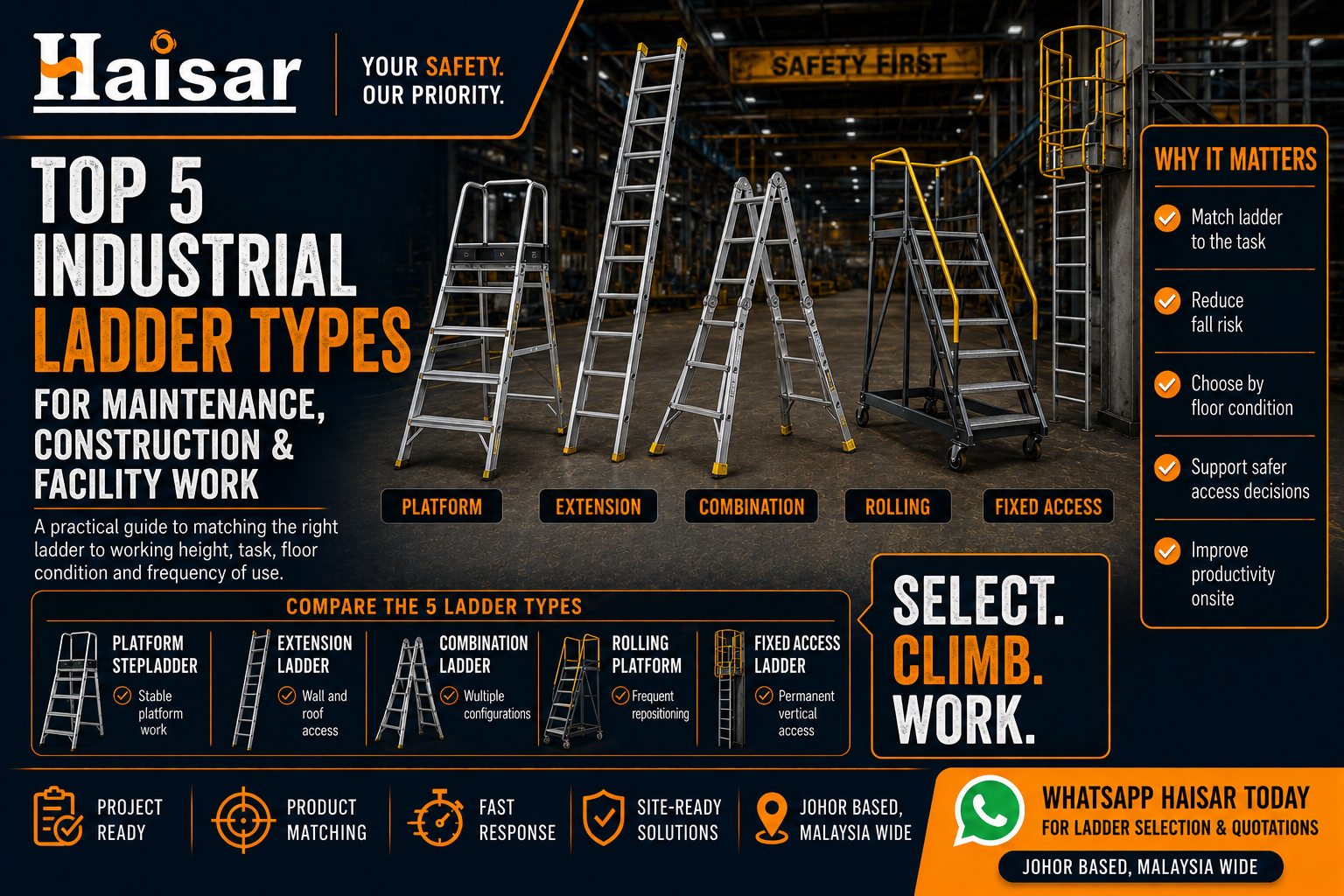
The right ladder for a job and the nearest available ladder are often different objects, and the gap between them is where most ladder-related incidents begin. A single-section straight ladder leaned against a wall is adequate for some tasks and genuinely dangerous for others. A stepladder that was the right tool for a two-hour occasional maintenance job becomes the wrong tool when it is used eight hours a day in a production environment with uneven floors and frequent repositioning. Getting the ladder type right is not pedantry. It is the difference between a tool that performs the task safely and one that introduces a fall risk the user compensates for with posture and grip rather than with appropriate equipment.
This article covers the five ladder types most commonly used in industrial, construction, and facility maintenance environments in Malaysia, what each one is designed for, where it performs well, and where a different type should be selected instead. The ladder selection worksheet at the end translates these factors into a set of questions you can work through before specifying or ordering.
Why Ladder Selection Matters More Than Most Buyers Assume
Ladders are one of the most under-specified purchases in site and facility procurement. A buyer who would spend considerable time specifying the correct respirator for a chemical task or the right harness configuration for a rooftop job will often order a ladder based on approximate height and available budget, without working through the questions that determine whether that ladder is actually suited to the task.
The regulatory backdrop in Malaysia makes this more consequential than it might appear. Under the Occupational Safety and Health Act 1994, the employer has a general duty to provide safe plant and equipment for work. Work at height, including ladder work, is specifically addressed in DOSH's guidelines on working at heights, which require a documented risk assessment before work at height begins and the selection of equipment appropriate for the specific task and environment. A ladder that was selected without considering the task requirements is a ladder whose suitability for that task was never confirmed, and that is a compliance gap as well as a practical risk.
The five types below are ordered by ascending complexity and load rating, since that is roughly the order in which the selection decision moves from straightforward to requiring more specific input.
Type 1: The Platform Stepladder
The platform stepladder is the most versatile and widely applicable ladder type for indoor facility work, and the one most likely to be correctly matched to a broad range of maintenance and overhead tasks at low to medium heights. Unlike a conventional A-frame stepladder, which requires the user to step to a rung and work from a standing position on that rung, a platform stepladder provides a flat standing area at the working height, usually with a handrail on one or both sides of the platform, which allows the user to stand comfortably upright and use both hands for the task rather than one hand for grip and one for work.
For tasks involving sustained work at height, such as electrical panel inspection, overhead pipe connections, light fitting replacement, or equipment maintenance accessed from above, the difference between a rung and a platform is the difference between a task that can be performed with the full use of both hands and one that requires constant attention to balance. In industrial and facility environments where overhead work is frequent and the tasks require tools, the platform stepladder dramatically reduces worker fatigue and, with it, the tendency to take balance shortcuts that are the precursor to most stepladder falls.
Platform stepladders are most effective on level, firm floors. On uneven or sloped surfaces, the four-footed base needs to be adjustable or supplemented with levelling feet or a stabiliser bar, since a platform ladder on a surface where one foot is not fully in contact provides false confidence in its stability. For outdoor use on unprepared ground, Type 3 or Type 5 below is a more appropriate starting point.
The Little Giant Ultra, which Haisar carries, represents the more capable end of this category, combining the flat platform with a tool-holding top cap, adjustable configurations, and a load rating suited to professional industrial use. Where a standard platform stepladder handles the working height but the task requires reaching in multiple directions or repositioning frequently, a multi-position ladder in this category handles those requirements without needing multiple ladder types on the same job.
Type 2: The Single-Section and Extension Ladder
The extension ladder, either a fixed single-section or an extending two-section version, is the correct tool for accessing elevated surfaces such as rooftops, high walls, elevated equipment platforms, and structures where a self-supporting ladder is impractical or where the working point requires leaning against the structure.
The fundamental requirement for safe use of an extension ladder is a secure, stable footing at the base and a firm point of rest at the top, ideally a structural member or a wall surface that can bear the lateral and vertical load from the ladder. On industrial sites and construction environments in Johor, the most common failure in extension ladder use is inadequate footing, either a base placed on soft or wet ground without foot splay stabilisers, or a base placed on smooth concrete without rubber feet fully in contact with the surface.
The working height of an extension ladder is not the same as its closed length or its maximum extended length. The usable working height is the height the user can safely reach while maintaining the three-point contact rule (two feet and one hand, or two hands and one foot on the ladder at all times) from a position where their belt buckle is at or below the highest safe standing rung. For most single-section and extension ladders in industrial grades, the highest safe standing rung is at least three rungs below the top of the ladder, so a six-metre extension ladder does not provide six metres of usable standing height.
Load rating matters more with extension ladders than with platform types because the point loads applied to individual rungs during ascent and descent are higher than the distributed load on a platform surface. Industrial grade ladders should be rated for the combined weight of the user and their tools and equipment. Confirm the load rating from the manufacturer's specification and apply the rating appropriate for the heaviest user plus equipment combination likely to use that ladder.
Type 3: The Multi-Purpose Combination Ladder
The multi-purpose or combination ladder is one frame that can be configured as a stepladder, an extension ladder, a staircase ladder for angled access, and in some models as a scaffold platform base. The appeal for project sites and facilities with varied tasks and limited storage is obvious: one ladder purchase covers multiple use cases that would otherwise require separate ladder types.
The practical limitation is configuration time and user familiarity. A combination ladder reconfigured incorrectly, either with the locking mechanisms not fully engaged or with the configuration not matched to the task, is less safe than a dedicated ladder correctly set up for the same task. On sites with multiple users and frequent repositioning, the configuration discipline required to keep a combination ladder in its correct configuration is harder to maintain than it is in a single-user maintenance context.
Where combination ladders perform well is in facilities management and small maintenance contractor applications, where one or two consistent users access a variety of tasks across the day and the time to reconfigure between tasks is not a constraint. A facility manager who needs a stepladder for internal panel access in the morning, an extension ladder for rooftop condenser access in the afternoon, and a staircase configuration for angled access to a mezzanine is the user the combination ladder was designed for.
For project sites where multiple workers use ladders simultaneously, where task specialisation means each worker is performing one type of task repeatedly, or where the pace of work makes reconfiguration an inconvenience that will be avoided rather than followed, dedicated ladder types for each task are the more reliable approach.
Type 4: The Rolling Platform or Warehouse Ladder
The rolling platform or warehouse ladder, sometimes called a rolling safety ladder, is a self-supporting wheeled ladder with a handrailed platform at the top, designed for use on smooth, level industrial floors in warehouses, racking areas, production facilities, and storage environments where frequent repositioning across the floor is required.
The defining feature is the wheel and locking mechanism combination: the castors allow the ladder to be moved freely when unloaded, and when the user's weight is applied to the first step, the locking mechanism deploys to prevent the ladder moving while in use. This design eliminates the primary failure mode of wheeled ladders in general use, which is the ladder rolling while the user is on it, and makes the rolling platform practical for high-frequency repositioning tasks that would make a non-wheeled stepladder impractical.
In racking and warehouse environments, the selection question for rolling platform ladders is not just the required working height but the aisle width relative to the ladder's base footprint. Rolling safety ladders have a wider base than standard stepladders to maintain stability at height, and a ladder that cannot be positioned squarely in the aisle it needs to serve is a ladder that will be used incorrectly, angled across the aisle or positioned partially outside it, to compensate for the fit problem. Confirm the aisle width against the ladder's base dimensions before ordering.
Rolling platform ladders are not appropriate for uneven surfaces, outdoor use on unprepared ground, or any surface where the castors cannot roll smoothly. Attempting to use a rolling ladder on a surface with threshold strips, drainage channels, or surface irregularities creates instability at the base and negates the locking mechanism's effectiveness. For these environments, a platform stepladder with levelling feet is the appropriate alternative.
Type 5: The Fixed Industrial Access Ladder and Ship's Ladder
Fixed access ladders, permanently mounted to structures, plant, tanks, mezzanine levels, and elevated platforms, are a different procurement category from portable ladders but are worth including in any ladder specification discussion for industrial and facility contexts because they are frequently specified inadequately, particularly regarding handrail configuration and the transition between the ladder and the elevated surface.
A fixed access ladder that does not have a handrail or grab rails extending above the landing level at the top creates a gap in the fall protection provision at the highest-risk transition point: the moment of stepping from the top rung onto the elevated surface. DOSH's guidelines on working at heights and the relevant Malaysian construction and building standards address the minimum requirements for fixed access ladders including landing areas, handrail heights, and step-through widths. These requirements should be confirmed at the design stage for any fixed ladder installation, since retrofitting compliant handrails to a fixed ladder is more disruptive and costly than specifying them correctly at the outset.
Ship's ladders, a steeper-angle fixed stair design with narrow steps that sits between a conventional staircase and a vertical fixed ladder, are increasingly common in compact industrial facilities and plant rooms where a full-width staircase cannot be accommodated. The specification for ship's ladders includes step angle, step depth, tread material, and handrail configuration, all of which affect both the safety in use and the regulatory compliance of the installation.
For Haisar customers specifying fixed access ladders for a new facility or plant installation, the product matching and quotation process requires the installation height, the available footprint, the maximum frequency of use and user load, and any relevant local authority or DOSH requirement for the specific facility type.
The Four Questions That Determine the Right Ladder
These five types cover the broad landscape of industrial and facility ladder applications, but the selection within and between types is driven by four questions that every buyer should resolve before specifying.
The first is working height: specifically the height of the task, not the height of the structure, since these are often different. A maintenance task on a pipe that runs two metres above floor level requires a working height that allows comfortable access to that pipe, not a ladder that extends to the pipe height exactly.
The second is the floor or ground condition. A perfectly capable ladder on a level concrete floor becomes an unpredictable one on a grated surface, a compacted earth access track, or a sloped concrete apron. The floor condition determines whether additional stabilising equipment, levelling feet, or a different ladder type altogether is needed.
The third is task frequency and duration. A ladder that is used occasionally for a brief maintenance visit can be less comfortable and less efficient than one used repeatedly throughout the working day, since the cumulative cost of slight awkwardness compounds across dozens of uses. For frequent use in an industrial maintenance setting, the ergonomics of the working position at height deserve as much consideration as the access height.
The fourth is load rating, covering the combined weight of the user, their tools, and any materials they carry up. Industrial ladder load ratings typically distinguish between domestic or light trade use, general professional use, and heavy industrial use, and the rating should be confirmed against the heaviest realistic user-plus-equipment scenario before purchase.
When sending a ladder enquiry to Haisar, providing the working height, the task description, the floor condition, and the frequency of use gives the team the information needed to match the right ladder type and specification rather than defaulting to the nearest available model.
Request a ladder recommendation by working height, task, floor condition and frequency of use → WhatsApp your ladder requirement directly to +60 12-570 7015 →
Ladder Selection Worksheet
Work through the questions below before submitting a ladder enquiry or purchase order.
| Question | Your Answer |
|---|---|
| What is the task requiring ladder access? | |
| What is the required working height (height of the task, not the structure)? | |
| Is the floor surface level and firm, or uneven or sloped? | |
| Will the ladder be used indoors, outdoors, or both? | |
| How frequently will the ladder be used per day or per week? | |
| Will the user need to reposition the ladder frequently? | |
| What is the weight of the heaviest user plus their tools and equipment? | |
| Does the task require both hands free at working height? | |
| Is the ladder for a single consistent user or multiple different users? | |
| Is storage space a constraint (does a compact or multi-purpose type help)? | |
| Is there a client or principal contractor approved equipment list that applies? | |
| What ladder type does this point to? | Platform stepladder / Extension / Combination / Rolling / Fixed |
| Quantity required | |
| Required delivery date |
Related Reading from Haisar
- Safety Harness Malaysia: Fall Protection Equipment Guide for Work at Height
- Job-Role PPE Matrix: What Electricians, Welders, Riggers, Visitors and General Workers Need
- Fall Protection Equipment in Malaysia: Your Guide to Ensuring Safety at Heights
- Project Mobilisation Procurement Timeline: What to Order 8, 4 and 2 Weeks Before Site Start
- Project Site Consumables Checklist: 15 Items Contractors Commonly Forget
Frequently Asked Questions
Do ladders require any formal inspection or certification under Malaysian regulations? Portable ladders used in the workplace are not subject to the same mandatory third-party certification regime as lifting equipment or pressure vessels under Malaysian law, but the employer's duty under the OSH Act 1994 to provide safe plant and equipment applies to ladders as it does to any other work equipment. In practice, this means ladders should be inspected before each use by the user for visible defects, and subjected to a formal periodic inspection by a competent person at intervals appropriate to the frequency of use and operating environment. Ladders showing damage, deformation, or deterioration of non-slip feet or locking mechanisms should be removed from service immediately. For work at height where a ladder is the means of access, the broader requirements of DOSH's working at heights guidelines, including the risk assessment requirement, apply regardless of the ladder type.
Is a harness required when using a ladder? For most ladder access tasks where the ladder is used as a means of reaching a work position rather than as the work platform itself, and where the user follows the three-point contact rule during ascent and descent, a harness on the ladder itself is not typically required. Where a ladder is used as the working platform for a task that involves sustained work at height, particularly at greater heights or where the user needs to lean or reach significantly to one side, fall protection including a harness connected to an anchor may be appropriate. The risk assessment for the specific task should determine this requirement rather than a generic rule. For fixed vertical ladders at significant height, cage guarding or a ladder safety system with a fall arrest rail may be required depending on the height and the relevant standards applicable to the installation.
What is the maximum safe working height for a portable ladder in Malaysia? There is no single nationally mandated maximum working height for all portable ladder types under Malaysian regulations. The safe working height is determined by the ladder's own rated capacity, the stability of the setup at the proposed height, and the fall protection provisions in place at that height. As a practical reference, many principal contractors and HSE management systems in Malaysia apply additional controls for ladder work above two metres, consistent with the general height threshold used in DOSH's working at heights guidance. For work at greater heights, collective protection measures such as scaffolding, a mobile elevated work platform, or a working at height permit with documented fall protection measures are often a more appropriate solution than a taller ladder, and this should be assessed in the task-specific risk assessment.
Can the same ladder be used for both electrical and general maintenance work? Standard aluminium ladders are electrically conductive and should not be used for tasks involving electrical work near live conductors. For electrical maintenance work, fibreglass ladders with non-conductive rails and rungs are the appropriate type, since the fibreglass material does not conduct electricity at the voltages typically encountered in industrial electrical maintenance. Non-conductive fibreglass ladders are available across the same range of types (stepladder, extension, combination) as standard aluminium models. If a single ladder is being procured for a facility where both electrical and general maintenance tasks will be performed, a fibreglass option eliminates the risk of the ladder being used for electrical work by default without the user checking whether the ladder is electrically rated.
How should ladders be stored to maintain their service life? Ladders should be stored horizontally on racks or vertically against a wall with adequate support points to prevent warping or bending of the rails. Outdoor storage exposed to direct sun degrades the rubber feet and, on fibreglass ladders, accelerates surface weathering that can mask developing cracks. For aluminium ladders stored outdoors, corrosion from salt air in coastal environments such as Pasir Gudang and Pengerang should be considered, and a periodic rinse and drydown can significantly extend service life. Store away from chemicals and solvents that can attack the rail material, the locking mechanisms, or the rubber or plastic components of adjustable and combination models.
