Can't find what you're looking for? Get in touch!



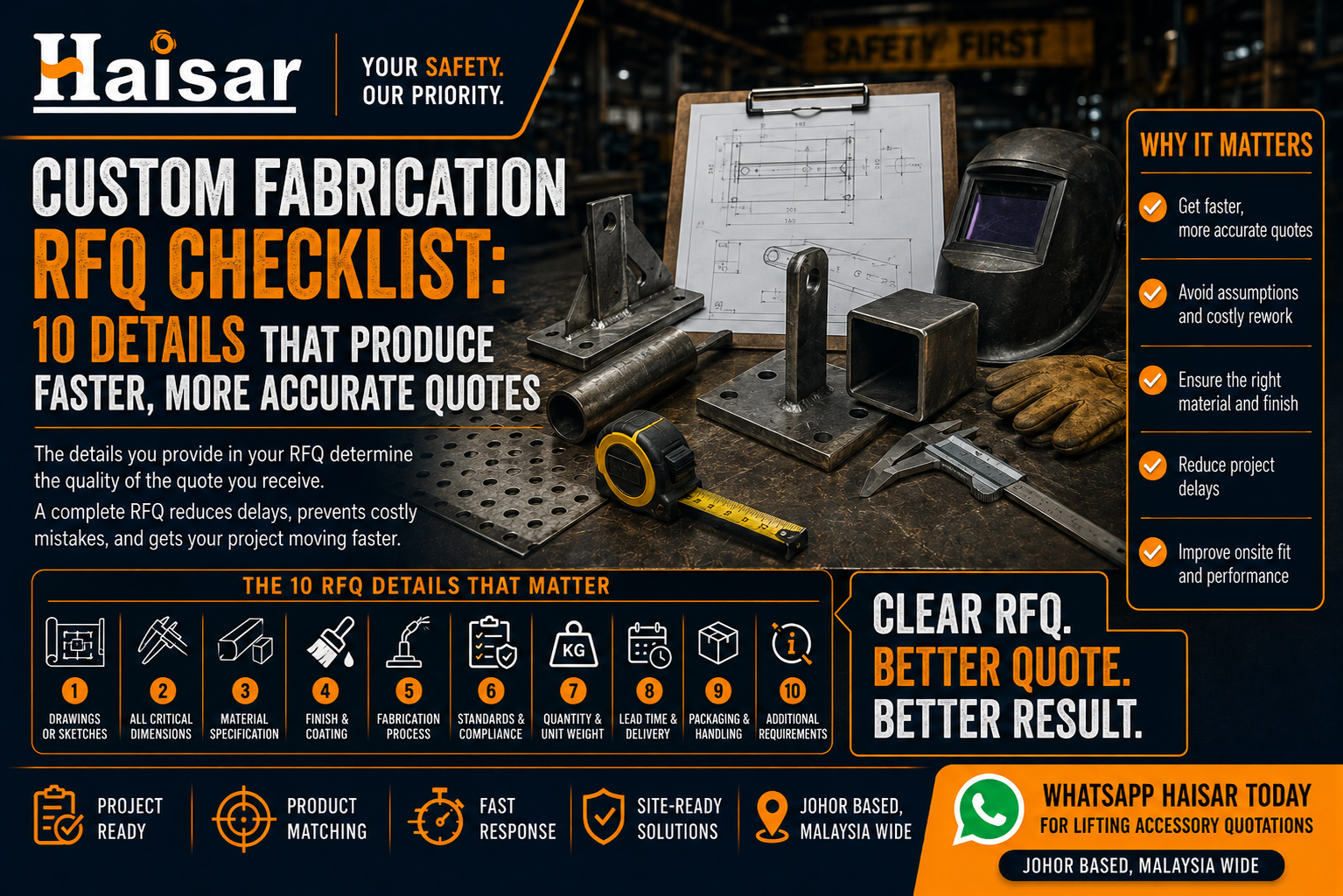
Fabrication quotes take longer than standard product quotes, and the gap between a useful quote and a useless one is almost entirely determined by what you give the fabricator to work with. A request that arrives with a clear drawing, confirmed material specification, and realistic timeline produces a price the fabricator can stand behind and the buyer can approve. A request that arrives as a verbal description of what something should look like produces a price built on assumptions, and those assumptions only become visible when the fabricated item arrives and does not match what was intended.
This pattern repeats on project sites across Johor's industrial corridor constantly. The custom drainage cover that was fabricated in mild steel when stainless was required. The safety bollard with the wrong base plate dimensions for the anchor positions already cast into the concrete. The LOTO station board in the wrong gauge sheet, heavier than needed and overweight for the wall mounting. All of these problems exist at the quotation stage, not the fabrication stage, and all of them are preventable by getting the right ten details into the RFQ before it goes out.
Why Fabrication RFQs Are Different From Standard Product Orders
When you order a catalogued product, most of the specification work has already been done. The manufacturer has defined the material, the dimensions, the finish, and the rated performance, and your job is to confirm you are ordering the right one. Fabrication works the opposite way. You are the one defining all of those parameters, and the fabricator is pricing the work of building to your definition.
This reversal of responsibility means that gaps in your specification are not the fabricator's problem to solve, they are costs that get absorbed into contingency pricing. A fabricator who receives an incomplete brief either prices in a buffer to cover the unknowns, asks a series of clarifying questions that delay the quote by days, or makes assumptions and prices to those assumptions, which may or may not match what you actually needed. None of these outcomes serve the buyer, and all of them are the result of an incomplete RFQ rather than a slow or difficult fabricator.
The ten details below are the ones that make the difference. Some are obvious once stated. Others are consistently missed because they seem like implementation details that can be sorted out later. They cannot.
1. Drawings or Dimensional Sketches, Even Rough Ones
The single most impactful thing you can attach to a fabrication RFQ is a drawing. It does not need to be a professionally drafted isometric or an AutoCAD DXF. A clear hand sketch with dimensions labelled is sufficient for most standard fabrication work and removes more ambiguity from the quotation process than any written description could replace.
What a drawing communicates that a description cannot is the spatial relationship between components. The length, width, and height of a bracket are three numbers. The relationship between the hole positions, the fold lines, the welded joints, and the clearances that the bracket needs to maintain when installed is a drawing. A fabricator working from numbers alone fills in the spatial relationships from experience, which may match your design intent or may not.
If you have an existing item you want replicated or modified, a photograph alongside a sketch showing the modifications is a practical substitute for a formal drawing on most standard fabrication items. For more complex fabrication, particularly anything structural or load-bearing, a formally drawn and dimension-checked drawing is worth the time investment before the RFQ goes out, since errors found in a drawing cost nothing to correct while errors found in a fabricated item cost everything.
2. All Critical Dimensions, Including Tolerances Where They Matter
Dimensions on a fabrication RFQ should cover every measurement that affects whether the item fits its intended location and performs its intended function. Overall length, width, and height are the starting point, not the complete picture. Hole positions and diameters, wall or plate thickness, internal clearances, and any features that interface with existing structures or equipment all need dimensions.
Tolerances matter where the fabricated item needs to fit into an existing space or connect to existing equipment, and where a few millimetres of variation would make the difference between a fit and a failure. A drain cover that needs to sit flush in a frame has a tolerance requirement. A bracket that bolts to a standard flange has hole spacing and diameter tolerances set by that flange standard. A cabinet that needs to fit through a doorway during installation has an overall dimension tolerance set by that doorway. Where tolerances are not specified, the fabricator applies their standard production tolerances, which may be generous enough for general metalwork but not tight enough for your application.
3. Material Specification, Including Grade and Finish
Material specification covers three things that are related but distinct: the base material, the grade within that material family, and the surface finish or treatment required.
The base material choice between mild steel, stainless steel, aluminium, and other options is driven by the operating environment and the functional requirements of the item. Mild steel is the standard default for most fabrication and the lowest cost option, but it requires a protective finish for any environment with moisture, chemical exposure, or outdoor installation, since untreated mild steel rusts in Johor's humidity within weeks of installation. Stainless steel costs more but eliminates the corrosion concern in most environments and is the appropriate choice for food-adjacent applications, chemical environments, and anywhere a maintenance-free finish over the life of the installation is required. Aluminium is relevant where weight is a consideration.
Within mild steel, specifying the grade matters for structural applications, since the yield strength of the steel affects what wall thickness is needed to carry a given load. For most light fabrication, general structural steel is adequate and a grade specification is not needed. For anything that carries load, is used as part of a safety system, or has a minimum rated performance requirement, the grade should be specified or confirmed with a structural engineer before the RFQ goes out.
Surface finish options for mild steel typically include powder coating in a specified colour, hot dip galvanising for outdoor or high-humidity environments where maximum corrosion protection is needed, epoxy paint systems for chemical resistance, and bare or primed finish where the item will be painted by others on site. Specifying the finish in the RFQ ensures the quoted price includes the finish you actually need rather than a bare fabrication price that requires separate finishing work to be added later.
4. Quantity
Fabrication pricing is not linear with quantity in the way that standard product ordering is. The setup cost, which covers drawing interpretation, material procurement, jig preparation, and the initial setup of cutting and welding equipment, is spread across all units in the batch. A single unit carries the full setup cost. Ten identical units share that cost across the batch, reducing the unit price significantly. A hundred units reduce it further.
This means that fabrication quotations are quantity-sensitive in a way that few other procurement categories are, and the quantity specified in the RFQ should be the quantity you actually intend to order, not a placeholder. Quoting for one item and then ordering fifty creates a cost expectation gap that is no one's fault but is still a problem. If you are genuinely uncertain of the final quantity, request pricing at two or three quantity tiers so you can see how the unit price changes with scale, but give the fabricator real options to price rather than a single speculative number.
5. Intended Function and Operating Environment
A fabricator who knows what the item is for and where it will operate can flag potential design issues before fabrication begins. A drainage cover fabricated in the standard gauge for pedestrian areas that will actually be driven over by forklifts needs a different structural approach. A safety bollard specified for indoor use that will actually be installed outdoors needs a different surface treatment and potentially a different base detail. A rack or bracket specified without knowing the maximum load it will carry cannot be confirmed as structurally adequate without that information.
Describing the function and environment in plain language, even briefly, gives the fabricator the context to raise these questions at the quotation stage rather than at the point of delivery. "Indoor use, fixed to a concrete block wall, maximum load is 50kg, chemical splash environment" is a brief but complete functional description that changes the material and finish specification from the default in ways that protect the buyer from a product that fails in service.
6. Connection and Fixing Details
How the fabricated item connects to its surrounding structure is one of the details most often left unspecified in fabrication RFQs, and one of the most frequently responsible for installation problems. A bracket that arrives without the correct bolt holes for the surface it is being fixed to, or with hole patterns that do not match the anchor positions already in place, is a bracket that cannot be installed without modification.
Where the item bolts to an existing structure, specify the bolt size, pattern, and pitch from the existing structure's drawings or by measurement on site before the RFQ goes out. Where the item will be welded to existing steel, specify the parent material, since a weld procedure that works on mild steel may not be the right approach on a high-strength steel structural member. Where the item sits on a surface without fixing, specify whether anti-slip pads, levelling feet, or a permanent base are required.
For items that need to integrate with existing equipment, the relevant equipment drawing or a dimensioned site measurement showing the interface is the most reliable way to communicate the connection requirement without ambiguity.
7. Required Standards or Certifications
Some fabricated items need to meet specific standards or be certified by a qualified person, and this requirement must be in the RFQ for the fabricator to price appropriately. A lifting accessory fabricated from mild steel plate needs to be designed and tested to the applicable working load limit before it can be used, and a fabricator who is not aware of this requirement at the quotation stage will not include it in their price.
For structural steelwork on construction projects, the requirements of the relevant Malaysian construction standards and the conditions of any CIDB registration apply to the fabrication and installation. For pressure vessels and pipe fittings, DOSH inspection and certification requirements apply. For electrical enclosures, the relevant IEC or MS standard for the enclosure rating applies if the item is being specified as a rated enclosure rather than a general metalwork box.
Most light fabrication, such as racks, brackets, covers, bollards, and general site furniture, does not involve mandatory certification requirements beyond the fabricator's standard workmanship quality. But if a certification requirement exists for your specific application, it must be in the RFQ, not raised as an afterthought after the item has been fabricated to a standard that does not meet that requirement.
8. Required Delivery Date and Lead Time Constraints
Fabrication has an irreducible lead time that cannot be compressed below the time needed to procure materials, set up, cut, form, weld, and finish the item. For most standard light fabrication in Johor, a realistic lead time from confirmed order to delivery is two to four weeks for straightforward items. For more complex fabrication, items requiring certified structural calculation, special material grades with longer procurement lead times, or specialist coating systems, four to six weeks or more is realistic.
Communicating the required delivery date in the RFQ allows the fabricator to either confirm feasibility or flag a constraint immediately, rather than discovering the timeline is impossible three weeks into the lead time. If your project timeline is tight and the fabrication lead time is a constraint, stating this in the RFQ and asking whether priority production or material pre-ordering is possible at a cost gives you the information to make a planning decision rather than an uncomfortable surprise.
9. Quantity of Samples or Prototypes Before Full Production
For items being fabricated in quantity, particularly where dimensions need to be confirmed as fitting their intended location, or where appearance or finish needs client or project approval, a sample or first-off article inspection before full production avoids the scenario where an entire batch of incorrectly dimensioned items is completed before the error is discovered.
Stating in the RFQ whether a sample is required, and what the approval process for that sample is, allows the fabricator to include the sample in their pricing and build the approval step into the production schedule rather than treating it as an unplanned delay. This is standard practice on more complex fabrication orders and worth specifying for any item where a dimensional or finish error across the full quantity would be a significant cost.
10. Any Additional Scope Items: Delivery, Installation, and Documentation
The base fabrication quote covers the cost of making the item. Additional scope items that affect total cost and the buyer's planning include delivery to site, installation if the fabricator is providing it, any documentation required alongside the item such as material certificates, weld inspection records, or test certificates, and any ongoing service or warranty terms.
Stating these requirements in the RFQ rather than assuming they are included avoids the cost surprises that arise when a delivered-to-site price is compared against an ex-works price without adjustment. For project procurement where the total installed cost rather than the fabricated item cost is what the budget covers, making the scope explicit in the RFQ produces a quote that is directly usable for budget approval rather than requiring scope adjustments after the fact.
Putting the RFQ Together
These ten details form the basis of a fabrication RFQ that a fabricator can price accurately and a buyer can use to make a real procurement decision. Not every detail applies to every job: a simple mild steel bracket for indoor use with no load rating requirement and no installation scope item does not need the certification or installation detail. But running through the ten headings as a checklist before sending a fabrication enquiry ensures the obvious gaps are filled before the RFQ goes out rather than in the first exchange of clarification emails.
When sending a fabrication RFQ to Haisar, attaching your drawing or sketch, specifying the material and finish, confirming the quantity and required date, and noting the function and operating environment gives the team the information needed to return an accurate quotation rather than a preliminary estimate requiring several rounds of clarification.
Upload your drawings, dimensions, material specification, quantity and required date for a fabrication quotation → WhatsApp your fabrication requirement directly to +60 12-570 7015 →
The Fabrication RFQ Form
Use this form when preparing your next custom fabrication enquiry. Complete as many fields as apply to your item.
Project and Contact Details
| Field | Your Input |
|---|---|
| Project or Site Name | |
| Company Name | |
| Prepared By | |
| Contact Number and Email | |
| Date of Enquiry | |
| Required Quotation By |
Item Specification
| # | RFQ Detail | Your Input |
|---|---|---|
| 1 | Drawing or sketch attached | Yes / No / In preparation |
| 2 | Overall dimensions (L x W x H) | |
| 3 | Critical tolerances | |
| 4 | Hole positions and diameters | |
| 5 | Base material | Mild steel / Stainless steel / Aluminium / Other |
| 6 | Material grade (if known) | |
| 7 | Surface finish required | Powder coat / Hot dip galvanised / Epoxy paint / Bare / Other |
| 8 | Colour (if powder coated) | RAL or colour reference |
| 9 | Quantity required | |
| 10 | Intended function and use environment | |
| 11 | Operating conditions (indoor / outdoor / chemical / food) | |
| 12 | Maximum load or rated performance (if applicable) | |
| 13 | Connection and fixing details | |
| 14 | Interface with existing equipment or structure | |
| 15 | Applicable standard or certification required | |
| 16 | Required delivery date | |
| 17 | Delivery location and site access notes | |
| 18 | Sample or first-off inspection required | Yes / No |
| 19 | Installation scope included | Yes / No |
| 20 | Documentation required | Material cert / Weld records / Test cert / None |
Additional Notes and Scope Items
(Use this space for any requirements not captured above, special packaging, phased delivery, finish references, or revision history if this is a repeat order with modifications.)
Related Reading from Haisar
- Top 10 Details Every Safety Equipment RFQ or BOQ Should Include Before You Request a Quote
- Custom Safety Signage in Johor: Materials, Sizes, Languages and Outdoor Durability
- Project Mobilisation Procurement Timeline: What to Order 8, 4 and 2 Weeks Before Site Start
- Safety Equipment Substitution Guide: How to Approve an Alternative Brand Without Increasing Risk
- 27 Hidden Costs to Check Before Accepting the Cheapest PPE Quotation
Frequently Asked Questions
Do I need a professional drawing before I can request a fabrication quotation? Not necessarily. A clearly dimensioned hand sketch communicates the shape, key dimensions, and spatial relationships well enough for most straightforward fabrication items. What matters is that every critical dimension is legible and labelled, and that the relationship between features, holes, folds, and weld positions is clear enough for a fabricator to interpret without guessing. For structurally complex items, or anything load-bearing that requires engineering sign-off, a formally drawn and reviewed drawing is worth preparing before the RFQ goes out.
What happens if I am not certain of the material specification I need? Describe the operating environment and the functional requirement as clearly as you can, and the fabricator can advise on the appropriate material for the application. The relevant inputs are where the item will be installed (indoor or outdoor, chemical or food environment), what it will carry or do, and how long it needs to last without maintenance. These inputs allow a material recommendation to be made before quotation rather than leaving it as an assumption.
Can Haisar handle both the fabrication and delivery to site in Johor? Yes. Fabrication items can be quoted with delivery included to your project site or facility in Johor. For sites with access restrictions, specific delivery windows, or requirements for tailgate offloading, noting these in the RFQ allows delivery logistics to be factored into the quote from the outset rather than added as a separate arrangement after the item is complete.
What is the standard lead time for custom fabrication items? Lead time depends on the complexity of the item, the availability of the required material grade, the surface finish specified, and the current workshop load. For standard light fabrication in mild steel with standard powder coat finish, two to three weeks from confirmed order is a reasonable planning assumption. For stainless steel items, items requiring certified materials, or items with special finish requirements, allow three to four weeks or more. If your project timeline is tighter than this, raise the constraint in the RFQ so the team can advise on what is achievable.
Should I send fabrication RFQs to multiple suppliers simultaneously? For most fabrication items, getting two or three quotes is reasonable procurement practice. If you do send to multiple suppliers, ensure all of them receive the same drawing and specification, since comparing quotes that were made against different assumptions is not a useful comparison. The checklist in this article is designed partly for this purpose: a completed RFQ form sent to multiple suppliers ensures that all quotes are based on the same inputs and can be evaluated on a genuine like-for-like basis.
