Can't find what you're looking for? Get in touch!



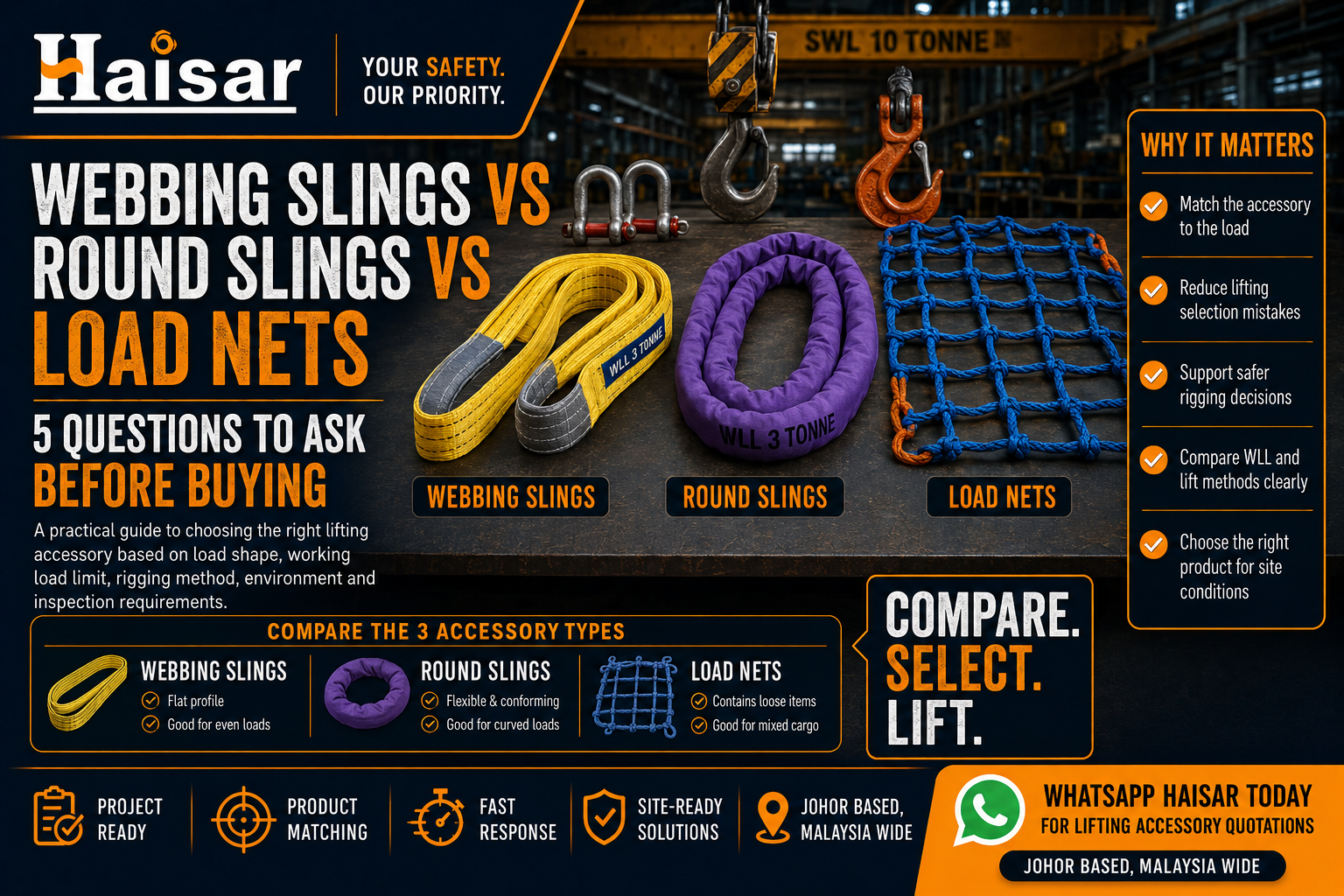
A lifting accessory that looks similar to the one you actually need is not the same thing as the one you actually need. Webbing slings, round slings, and load nets all do the job of connecting a load to a crane or hoist, and at a glance they can seem interchangeable, but each is built for a different combination of load shape, weight distribution, and handling method. Choosing the wrong one does not always fail immediately. It can work for months on lighter or more forgiving loads before failing on the one lift where the load shape or weight finally exceeds what the accessory was actually designed to handle.
This article works through five questions that determine which of the three accessory types is right for a specific lift, and what to check on the product itself once you have made that decision. It is written for procurement officers, riggers, and site supervisors who need to specify the right lifting accessory rather than choosing based on what happened to be available in the store.
Question 1: What Is the Shape and Surface Condition of the Load?
This is the question that does the most work in narrowing down the right accessory, because the three types behave very differently depending on what they are wrapped around.
Webbing slings, flat woven straps typically made from polyester, perform well on loads with relatively even, predictable surfaces, such as pallets, crates, steel beams with smooth edges protected by corner protectors, and machinery with defined lifting points. The flat profile of a webbing sling distributes load over a wider contact area than a round sling of similar capacity, which can reduce the risk of surface damage to softer or coated materials, but that same flat profile means it can be more easily cut or abraded on a sharp or irregular edge if edge protection is not used.
Round slings, made from a continuous loop of polyester yarn protected inside a woven outer sleeve, are more forgiving on irregular or curved surfaces because the inner core can shift and conform to the shape it is wrapped around, distributing load more evenly across an uneven surface than a flat webbing sling would. This makes round slings a common choice for pipes, cylindrical loads, and irregularly shaped fabricated steel where a flat sling would concentrate load unevenly at the points of contact.
Load nets are the right choice when the load itself is not a single defined shape but a collection of smaller items, loose materials, or irregular components that need to be gathered and lifted as one unit, such as bagged materials, scrap, formwork components, or mixed loose cargo. Neither a webbing sling nor a round sling is designed to contain loose or multiple separate items. A net distributes the load across its mesh and contains items that would otherwise need to be palletised or crated before a sling-based lift could even be attempted.
Question 2: What Is the Total Weight and What Working Load Limit Do You Actually Need?
Every lifting accessory carries a Working Load Limit, commonly abbreviated WLL, which is the maximum load the accessory is rated to lift under the specific configuration in which it is being used. This figure is not a single number printed once and forgotten. It changes depending on the sling configuration, meaning whether the sling is used in a straight vertical lift, a choker hitch, or a basket hitch, and the angle at which multiple slings meet above the load.
The most common and most dangerous mistake in lifting accessory selection is using the WLL stated for a vertical straight lift configuration when the actual lift uses a different configuration. A sling used in a choker hitch typically has a significantly reduced WLL compared to the same sling in a straight lift, and a sling used at an angle in a multi-leg lift has its effective capacity reduced further as the angle between the legs decreases from vertical. The WLL tag attached to every compliant sling and load net states the rated capacity for each configuration, and that tag must be read and applied to the actual lift being performed, not assumed from the straight lift figure alone.
For load nets specifically, the rated capacity needs to account for how evenly the load inside the net is distributed. A net rated for a given total weight assumes a reasonably even distribution of that weight across the mesh. A load that is heavily concentrated in one area of the net, rather than spread across it, does not perform at the rated capacity in the area carrying the concentrated weight, and this is a common cause of localised net failure even when the total load is within the stated rating.
Buy with a margin above your actual expected load weight, not at the exact calculated figure, since real lifts rarely involve a perfectly known and perfectly static weight, and dynamic forces during lifting, such as sudden starts, stops, or swinging, can momentarily exceed the static weight of the load.
Question 3: What Lifting and Rigging Method Will Be Used?
The hitch configuration used for the lift affects not just the WLL calculation but which accessory type is practically usable in the first place.
A vertical hitch, where the sling runs straight from the lifting point on the load to the crane hook, is the simplest configuration and works with both webbing and round slings provided the load has a suitable single lifting point or can be safely lifted from two points with two vertical slings.
A choker hitch, where the sling is wrapped around the load and threaded through itself before connecting to the hook, is commonly used when the load does not have a defined lifting point and needs to be cinched around its body for a secure lift. This configuration reduces the sling's effective WLL because of the additional stress placed on the sling at the choke point, and it is also harder to apply cleanly with a webbing sling on a curved load compared to a round sling, which conforms more naturally to the shape being choked.
A basket hitch, where the sling runs under the load and both ends connect to the hook, distributes the load across two points of the sling rather than one, generally allowing for a higher effective WLL than the same sling in a choker configuration, but it requires a load shape that allows the sling to pass underneath cleanly without slipping off either end during the lift.
For loose or multiple-item loads, the load net itself defines the rigging method, since the net is gathered at its corners or attachment points and connected to the hook or spreader bar, and the question becomes whether the net's attachment configuration matches your crane or hoist's hook arrangement, including whether a spreader bar is needed to keep the net opening adequately wide during the lift.
Question 4: What Is the Operating Environment?
The environment the sling or net will be used and stored in affects material choice and expected service life, and this is a factor that is often overlooked until premature wear or damage shows up well before the accessory's expected lifespan.
Polyester, the material used in both standard webbing slings and round slings, has good resistance to most chemicals and reasonable UV resistance compared to some alternative materials, but prolonged outdoor storage in direct tropical sun, common on Johor construction and industrial sites where lifting accessories are sometimes left exposed between uses rather than stored under cover, accelerates degradation of the fibres over time even without any visible damage from use. Slings exposed to chemical splash, particularly acidic or caustic substances depending on the specific chemical, may need a different fibre type altogether, and the manufacturer's chemical resistance documentation should be checked against the specific chemicals present in your environment before assuming standard polyester is adequate.
Wet or humid conditions, a near-constant factor in Johor, are generally well tolerated by polyester slings, but a sling that becomes contaminated with mud, oil, or grit during use should be cleaned according to the manufacturer's guidance before storage, since trapped grit between fibres can cause internal abrasion over repeated use that is not visible from the outside of the sling.
Load nets used outdoors face the additional consideration of wind exposure during the lift itself. A large net lifting loose or lightweight materials in windy conditions can catch wind in a way that a solid load or a tightly slung item would not, and this needs to be assessed as part of the lift plan rather than treated purely as a sling selection issue.
Question 5: What Inspection and Documentation Requirements Apply to Your Site?
Every lifting accessory, regardless of type, requires a documented inspection regime before it can be considered fit for continued use, and the specific requirements depend on your site's lifting operations procedures and the regulatory framework applicable to your sector.
A pre-use visual inspection by the rigger or operator before each lift checks for cuts, abrasion, fraying of the outer sleeve on round slings, discolouration suggesting chemical or heat exposure, and damage to stitching or end fittings. Any sling or net showing damage that compromises its structural integrity must be removed from service immediately, not used for one more lift on the assumption that the damage is minor.
A formal periodic inspection, typically conducted at intervals defined by the manufacturer and your site's lifting equipment management procedure, and often required to be carried out or certified by a competent person, provides a documented record of the accessory's condition over time and supports compliance with the broader machinery and lifting equipment regulations applicable to your workplace. In Malaysia, lifting equipment and lifting gear used in factories and on construction sites fall under inspection and certification requirements administered by DOSH, and the specific requirements for your sector should be confirmed directly with DOSH rather than assumed from general practice.
Documentation that should accompany every lifting accessory includes the manufacturer's certificate of conformity stating the material, construction, and rated WLL across the relevant configurations, and a unique identification tag or marking on the sling or net itself that allows it to be tracked through its inspection history. A sling without a legible WLL tag or identification marking should not be used, regardless of how sound it appears, since there is no way to confirm its rated capacity or inspection status.
Putting the Five Questions Together
These five questions are not independent of each other. The load shape determines whether a sling or net is appropriate at all. The weight and rigging method together determine the WLL you actually need, which may be considerably higher than the static weight of the load once hitch configuration and angle are accounted for. The environment determines whether standard polyester is adequate or whether a different material or more frequent inspection interval is warranted. And the inspection and documentation requirement applies regardless of which accessory you select, since none of these products remain safe indefinitely without ongoing checks.
When sending a lifting accessory enquiry to Haisar, providing the load weight, the load shape and surface condition, the intended rigging method, and the quantity required allows the team to match the correct product type and WLL specification to your actual lift, rather than supplying based on a general description that leaves the configuration details unconfirmed.
WhatsApp your lifting requirement directly to +60 12-570 7015 →
Related Reading from Haisar
- Safety Harness Malaysia: Fall Protection Equipment Guide for Work at Height
- Job-Role PPE Matrix: What Electricians, Welders, Riggers, Visitors and General Workers Need
- Project Site Consumables Checklist: 15 Items Contractors Commonly Forget
- 27 Hidden Costs to Check Before Accepting the Cheapest PPE Quotation
- Top 10 Details Every Safety Equipment RFQ or BOQ Should Include Before You Request a Quote
Frequently Asked Questions
Can a webbing sling and a round sling be used interchangeably if they have the same WLL rating? Not always. Two slings with the same stated WLL in a straight vertical lift can behave differently in a choker or basket configuration, and the practical handling characteristics differ significantly on irregular or curved loads, where a round sling's ability to conform to the load surface gives it an advantage a flat webbing sling does not have. Matching the accessory to the load shape and rigging method matters as much as matching the WLL figure alone.
How is the Working Load Limit affected when using multiple slings at an angle to lift one load? As the angle between multiple sling legs increases from vertical, the load on each individual leg increases even though the total weight of the load has not changed, which means the effective WLL of each sling in that configuration is lower than its rated capacity in a single vertical lift. This is a calculation that should be done by a competent person familiar with the specific rigging configuration and the angle involved, using the sling manufacturer's load angle factor tables, rather than estimated. Using slings at a steep angle without accounting for this reduction is a common cause of lifting accessory failure.
Is a load net always the right choice for loose or bagged materials, or are there situations where it is not appropriate? A load net is appropriate when the items inside it can be safely contained without protruding sharp edges that could damage the net mesh, and when the total weight and its distribution within the net stay within the rated capacity for the way the load is actually arranged. Loads with sharp protrusions, very heavy individual items concentrated in one area of the net, or items that could shift significantly during the lift and create an uneven weight distribution may need a different handling solution, such as palletising before the lift, rather than relying on the net alone to contain an unpredictable load.
How often do webbing slings, round slings, and load nets need to be replaced, even if they pass visual inspection? There is no universal fixed replacement interval that applies regardless of use and storage conditions. Replacement timing depends on frequency of use, load types handled, storage and environmental exposure, and the outcomes of periodic formal inspections. A sling used daily in a harsh outdoor environment will generally need replacement sooner than one used occasionally and stored correctly indoors. The manufacturer's guidance for the specific product, combined with your site's documented inspection findings, should determine replacement timing rather than a generic time-based rule applied across all accessories regardless of actual condition and use.
What documentation should I request when purchasing webbing slings, round slings, or load nets? Request the manufacturer's certificate of conformity confirming the material, construction, and the rated Working Load Limit across the relevant lift configurations, including straight lift, choker, and basket hitch where applicable. Confirm that each individual sling or net carries a legible identification tag with its WLL and unique reference number, since this tag is what supports your ongoing inspection records once the accessory is in service. If your site or client requires specific certification standards or test reports beyond the standard certificate of conformity, confirm this requirement with your supplier before the order is placed, not after delivery.
