Can't find what you're looking for? Get in touch!



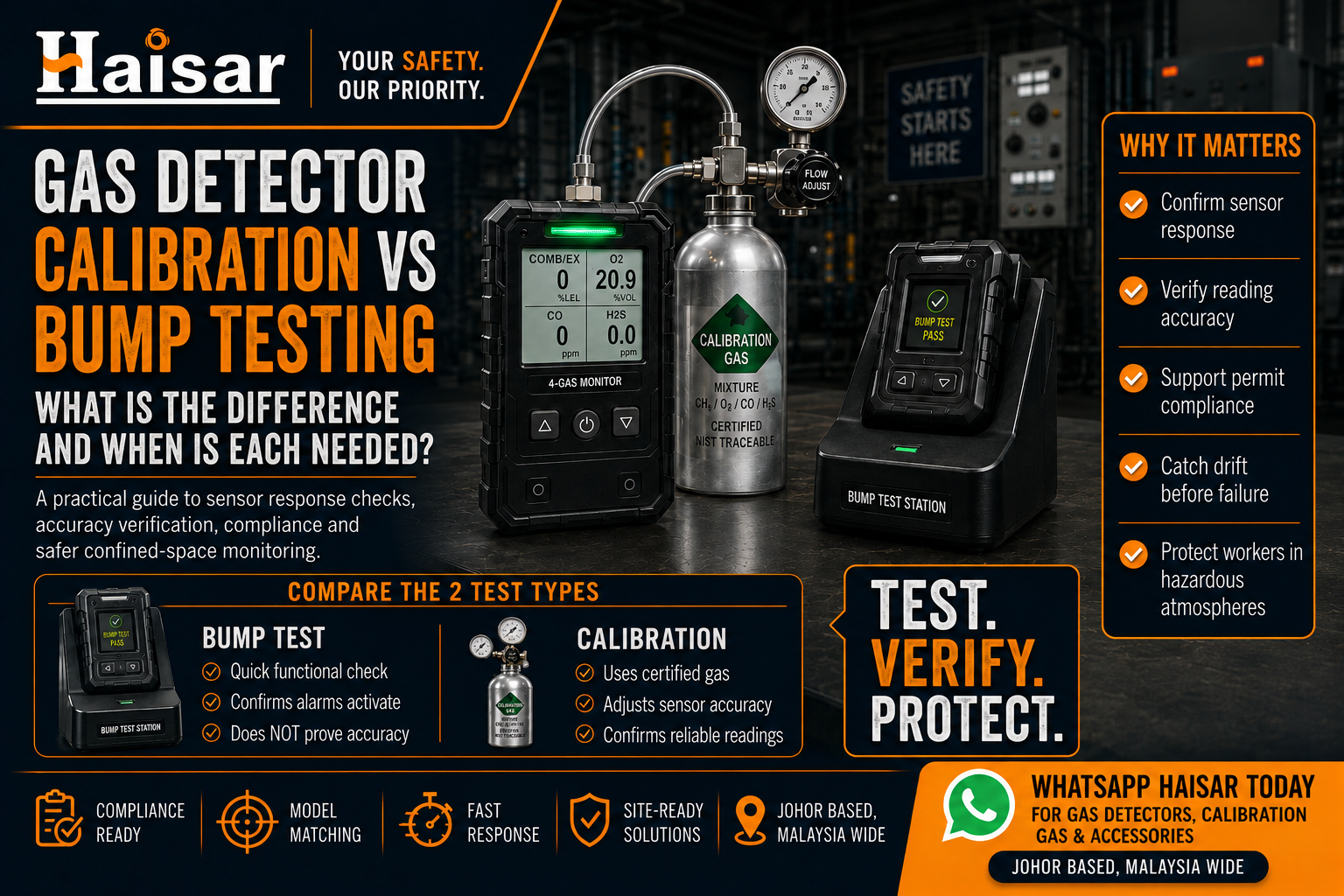
The two questions that come up most often from HSE managers and confined space supervisors when gas detector maintenance is discussed are these: is a bump test the same as a calibration, and if we bump test every day, do we still need to calibrate? The answer to both is no, and understanding why matters more than simply following a schedule someone else set. A gas detector that is bump tested regularly but calibrated infrequently, or calibrated on a fixed calendar interval without daily bump testing, is a gas detector whose reliability is lower than the user assumes. In confined space entry, in flammable atmosphere work, and in any environment where a gas detector's alarm is the primary warning before an irreversible exposure, that gap in reliability is a life safety gap.
This article explains what each process does, why both are needed, what happens when either is skipped, and what the maintenance programme for a gas detector should look like in practice.
What a Bump Test Is and What It Confirms
A bump test, sometimes called a functional test or a confidence check, is a brief exposure of the gas detector's sensors to a known concentration of test gas, at a concentration above the alarm threshold for each sensor being tested. The purpose is not to verify the accuracy of the reading. The purpose is to confirm that each sensor responds to gas and that the alarm activates.
When you perform a bump test correctly, the detector should alarm within a few seconds of the test gas being applied. If it alarms on all sensors, the test confirms three things: the sensor is alive and reacting to gas, the alarm circuit is functional, and the gas inlet is not blocked. If a sensor fails to alarm, or alarms more slowly than expected, the test has identified a problem that would otherwise only be discovered when the detector was needed in an actual gas event.
What a bump test does not confirm is the accuracy of the reading. A sensor that is drifting toward under-reading, meaning it reads a lower concentration than is actually present, can still pass a bump test because passing only requires the reading to reach the alarm threshold, not to read the correct concentration. A sensor could register an alarm at 20 ppm when 50 ppm test gas was applied, pass the alarm-trigger criterion, and yet be reading 60 percent of actual concentration across the measurement range. That drift is invisible to a bump test. It is only revealed by a calibration.
This is the critical distinction. Bump testing tells you the detector is alive. Calibration tells you the detector is accurate.
What a Calibration Does and What It Confirms
A calibration is the process of exposing the gas detector's sensors to a certified reference gas of precisely known concentration, comparing the detector's reading against that known concentration, and adjusting the sensor's response so that the reading matches the reference. After a successful calibration, the detector should read the actual concentration of gas present at the sensor within the instrument's specified accuracy tolerance, typically plus or minus a few percent of the reading.
Calibration uses certified calibration gas, meaning gas in a cylinder whose concentration has been verified against a national or international reference standard and documented in a certificate supplied with the cylinder. Using non-certified gas, or gas from a cylinder whose certificate has expired or whose cylinder has passed its use-by date, produces a calibration that may be inaccurate in ways that are not detectable without comparing against another reference.
Calibration also confirms the alarm set points. After calibration, the detector's low alarm and high alarm thresholds should trigger at the correct concentrations for the gas being detected. This is important because sensor drift can shift the effective alarm set point even when the alarm circuit itself is functional. A sensor that reads 80 percent of actual concentration will trigger its alarm at a higher actual concentration than the set point intended, meaning workers receive less warning time than the alarm threshold was designed to provide.
The outcome of a calibration is a calibration record: the date, the instrument serial number, the test gas used (type and certified concentration), the pre-calibration reading, the post-calibration reading, and the name of the person who performed the calibration. This record is the documentation that a DOSH inspection, a confined space entry audit, or a principal contractor HSE review will ask for.
Why Both Are Needed and Neither Replaces the Other
The reason both bump testing and calibration are needed is that they catch different types of failure.
Sensor degradation over time, exposure to high concentrations of target gas, poisoning from sensor-damaging contaminants such as silicone vapours or lead compounds, and physical blockage of the gas inlet are all failure modes that may not change the calibration date on a sensor but will cause it to fail to alarm in a real gas event. Bump testing, done before each day of use, catches these failures before the instrument enters service in a potentially hazardous atmosphere.
Sensor drift, which changes the relationship between the actual gas concentration and the reading the detector displays, is a gradual process that does not produce a visible failure until the sensor is compared against a reference. Calibration catches this drift and corrects it before it reaches a magnitude where the under-reading is significant enough to affect alarm timing or exposure assessment.
The analogy most gas detector manufacturers use is a useful one. A bump test is like checking that a scale registers a weight when you put something on it. Calibration is like checking that the scale reads the correct weight when you put a known reference weight on it. You need both checks, because a scale that activates when loaded but reads consistently low will give you wrong information even though it appears to be working.
How Often Each Should Be Done
Bump test frequency and calibration interval are the two questions most sites get wrong, usually in the direction of over-relying on periodic calibration and under-performing bump tests.
On bump test frequency, the guidance from most major gas detector manufacturers, including MSA and Dräger whose instruments are widely used in Malaysian industrial and oil and gas environments, is that instruments should be bump tested before each day of use, or before each period of use if an instrument is used less than daily. The International Safety Equipment Association (ISEA) has published guidelines that align with this daily pre-use bump test recommendation. The rationale is straightforward: if a sensor fails overnight or between uses, you want to know before the instrument enters a potentially hazardous atmosphere, not inside it.
Sites that bump test weekly or monthly rather than daily are operating with an instrument whose current functional status is unknown for the period between tests. If a sensor was poisoned by a silicone-containing product used for maintenance on Monday and the next bump test is on Friday, the instrument has been in service for four days with an undetected failure.
On calibration frequency, the manufacturer's recommended interval is the starting point, not the ceiling. Most manufacturers recommend calibration at intervals between one month and six months depending on the instrument model, sensor type, and operating conditions. These are the intervals at which the manufacturer's warranty and performance guarantee apply. Operating the instrument at longer intervals than the manufacturer recommends, and relying on a bump test frequency to substitute for calibration, is not an equivalent programme. It is a reduced programme.
Operating conditions can shorten the recommended calibration interval. High-intensity use, exposure to extreme temperatures, exposure to sensor-damaging contaminants, and storage in poor conditions all accelerate sensor drift. If an instrument is used in conditions harder than those assumed in the manufacturer's recommended interval, or if bump testing identifies response anomalies that suggest sensor degradation, calibration should happen sooner than the standard interval, not at it.
The Regulatory and Permit Context in Malaysia
DOSH's Code of Practice for Work in Confined Spaces, and the broader requirements of the Occupational Safety and Health (Confined Spaces) Regulations 2010, require that atmospheric testing is carried out before entry into a confined space and that the equipment used for atmospheric testing is in calibrated condition. The regulations do not specify a calibration interval by name, but the phrase "in calibrated condition" requires documentation that calibration has been performed, which in practice means a calibration record and a calibration label on the instrument showing the date of last calibration.
A gas detector presented for confined space entry without a current calibration certificate, or with a calibration date beyond the manufacturer's recommended interval, does not meet the regulatory requirement and gives the permit-to-work issuer reasonable grounds to reject the instrument for use on that permit.
For sites operating under PETRONAS contractor requirements or international operator HSE management systems in Malaysia's oil and gas sector, the calibration and bump test requirements are typically more specific than the regulatory minimum, and the documentation standard is higher. Calibration records may need to include the calibration gas certificate number, and bump test records may need to be maintained on a per-day, per-instrument log rather than on a general maintenance record.
What the Maintenance Programme Should Look Like
A practical gas detector maintenance programme for an industrial site or project in Johor covers four elements: pre-use bump testing, periodic calibration, consumables management, and replacement planning.
Pre-use bump testing requires the correct test gas for each sensor type in the instrument. A four-gas monitor detecting oxygen, combustible gas, carbon monoxide, and hydrogen sulphide requires a four-gas calibration mix to bump test all sensors simultaneously, or individual gas exposures if the instrument is being tested sensor by sensor. The test gas cylinder needs to be within its use-by date and the cylinder pressure needs to be sufficient to deliver the test concentration to the sensor. Running a bump test from a nearly empty cylinder can produce an artificially low concentration at the sensor and a false pass. Check the cylinder pressure before each bump test session.
Periodic calibration requires calibration gas at the correct concentration for each sensor, which may differ from the concentration used for bump testing. Calibration gas cylinders carry a certificate with a listed concentration and an expiry date. The certificate must be checked and the gas used within its certified period. An expired calibration gas certificate means the cylinder's concentration cannot be confirmed, and a calibration performed with unconfirmed concentration gas is not a reliable calibration.
Calibration records must be maintained for each instrument. The minimum record includes the instrument model and serial number, the date of calibration, the calibration gas type and certified concentration used, the pre-calibration reading, the adjustment made, and the post-calibration reading. These records should be stored in a manner accessible for audit, either in a physical log book or a digital record, and should be retained for the period required by your site's HSE management system and the relevant regulatory requirement.
Replacement planning for gas detectors is the element most often left to reactive procurement: the instrument is replaced when it fails rather than as part of a planned lifecycle programme. For instruments in active daily use in confined space and hazardous atmosphere applications, maintaining a loan or standby unit that can be deployed when a primary instrument goes in for calibration or is identified as unreliable during a bump test ensures continuity of operations without the alternative of delaying a confined space entry because no calibrated instrument is available.
How Haisar Supports Gas Detector Maintenance
Haisar supplies gas detection instruments, calibration gas in the mixes required for common industrial sensor configurations including four-gas mixes and individual gas cylinders, accessories including bump test station fixtures and calibration gas regulators, and replacement sensors and instruments from the major brands used in Malaysian industrial operations.
When sending a gas detector enquiry, specifying the instrument model and manufacturer, the sensor configuration (gases being detected), whether you need calibration gas, bump test gas, or both, and the quantity of instruments in service allows the team to match the correct gas mix and accessories to your specific instrument and return an accurate quotation.
Request gas detectors, calibration gas, accessories or replacement units based on your instrument model → WhatsApp your instrument model and gas detection requirement directly to +60 12-570 7015 →
Gas Detector Test and Calibration Log
Use this log to record bump tests and calibrations for each instrument in service. Maintain one log per instrument, identified by serial number.
Instrument Details
| Field | Detail |
|---|---|
| Manufacturer and Model | |
| Serial Number | |
| Sensors (gases detected) | |
| Calibration interval (per manufacturer) | |
| Assigned to (person or work area) |
Bump Test Record
| Date | Technician | Test Gas Used | Cylinder Expiry | O2 Response | LEL Response | CO Response | H2S Response | Pass / Fail | Action Taken |
|---|---|---|---|---|---|---|---|---|---|
Calibration Record
| Date | Technician | Cal. Gas (Type and Conc.) | Cert. No. | Cert. Expiry | Pre-Cal Reading | Adjustment Made | Post-Cal Reading | Pass / Fail | Next Cal Due |
|---|---|---|---|---|---|---|---|---|---|
Notes (sensor replacements, instrument damage, anomalous readings)
Related Reading from Haisar
- Top 10 Safety Equipment Brands Available in Johor
- Marine and Offshore Safety Equipment Supplier Malaysia
- Safety Signage Audit Checklist: 12 Locations Every Factory and Project Site Should Inspect
- Project Site Consumables Checklist: 15 Items Contractors Commonly Forget
- Job-Role PPE Matrix: What Electricians, Welders, Riggers, Visitors and General Workers Need
Frequently Asked Questions
Can a bump test be used instead of calibration before a confined space entry in Malaysia? No. A bump test confirms that the sensor responds to gas and that the alarm activates. It does not confirm the accuracy of the reading or the alarm set points. DOSH's requirements for atmospheric testing in confined spaces require equipment in calibrated condition, which means documented calibration against a certified reference gas at the manufacturer's recommended interval. A bump test record does not substitute for a calibration record for the purposes of permit-to-work compliance or regulatory inspection.
What calibration gas mix do I need for a four-gas monitor? The standard four-gas calibration mix for instruments detecting oxygen, lower explosive limit combustible gas, carbon monoxide, and hydrogen sulphide contains 18 percent or similar reduced oxygen concentration to test the O2 sensor response, a percentage of LEL combustible gas (typically methane), a stated ppm concentration of CO, and a stated ppm concentration of H2S, all in a nitrogen balance. The exact concentrations needed depend on your instrument model and the alarm set points configured on it. Confirm the required calibration gas specification against your instrument's calibration manual or the manufacturer's documentation before ordering, since using a calibration gas with concentrations outside the recommended range for your sensor type produces an inaccurate calibration.
What happens if calibration gas is used past its expiry date? Calibration gas cylinders have an expiry date because the gas mixture can change over time due to reactions between components or adsorption onto the cylinder wall. Using expired calibration gas means the actual concentration in the cylinder may differ from the certified concentration on the label, which means the calibration is performed against an uncertain reference. A calibration record using expired calibration gas is not a reliable record. If calibration gas has expired, it should be replaced before calibration is performed, and any calibrations performed with expired gas during the preceding period should be noted and instruments recalibrated with current certified gas.
How should gas detectors be stored to maintain sensor life? Gas detectors should be stored in clean, dry conditions away from chemical vapours, particularly silicone-based products, which can poison electrochemical sensors in instruments that are stored with the sensors exposed. Many instruments can be stored with a dust cap or sensor protector over the gas inlet to reduce passive exposure to damaging vapours during storage. Batteries should be maintained in a charged condition and instruments should not be stored at extreme temperatures, both high and low, beyond the manufacturer's specified storage temperature range. A sensor that has been stored in poor conditions may fail a bump test at the start of the next use period, which is the intended outcome of daily pre-use testing.
Our site has ten gas detectors in service. Is there a way to manage calibration without having all instruments out of service simultaneously? Staggering calibration dates across the fleet is standard practice on sites with multiple instruments. If the manufacturer's recommended calibration interval is ninety days, calibrating two instruments every two to three weeks rather than all ten at the same time ensures that most instruments have a current calibration at any point and that the calibration workload is spread rather than concentrated. Maintaining one or two standby or loan instruments that can cover operational needs when an instrument is sent for calibration prevents the confined space or hazardous atmosphere work programme from being disrupted by calibration scheduling.
