Can't find what you're looking for? Get in touch!



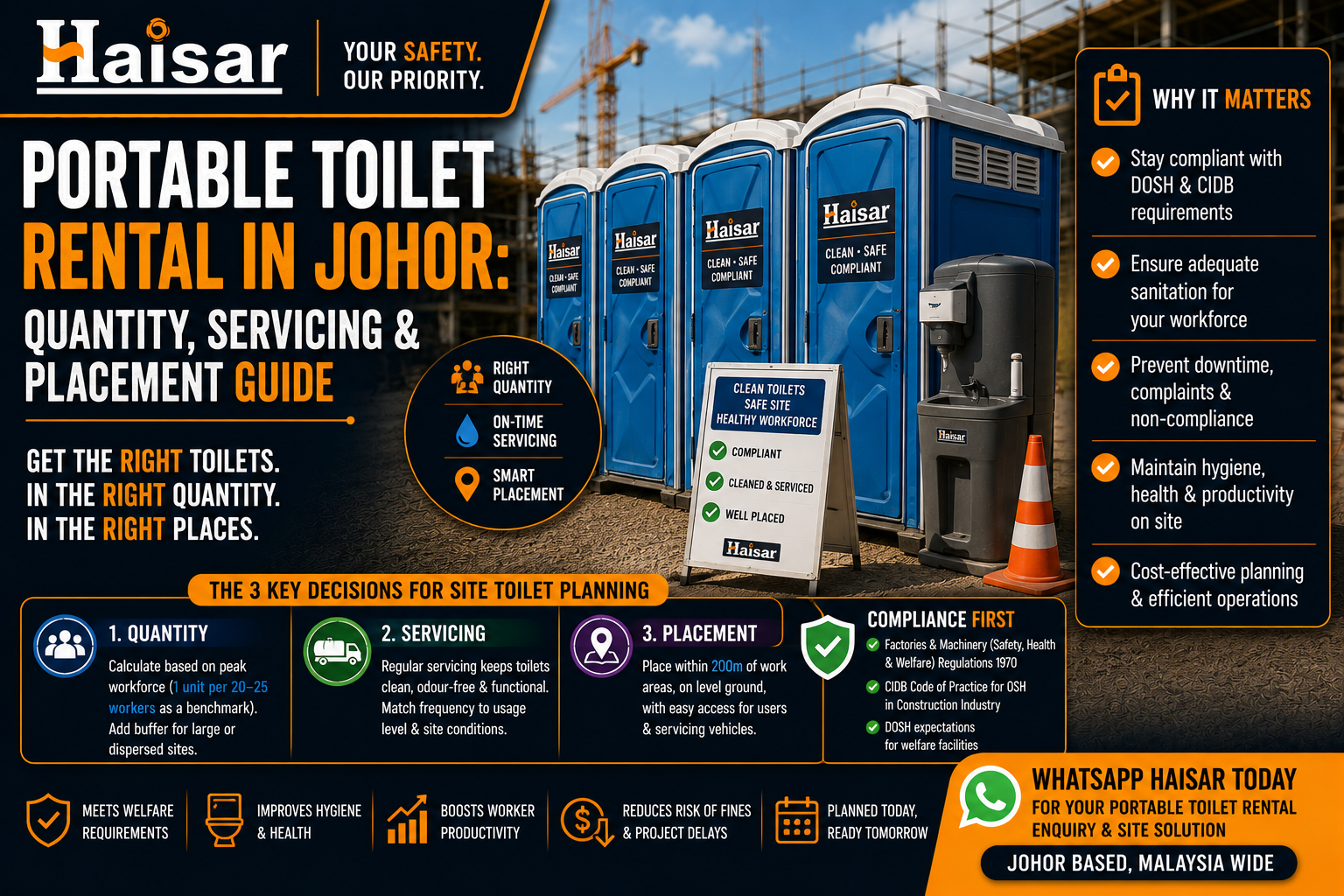
Portable toilet provision on a Malaysian project site tends to be treated as a logistics afterthought — something to sort out the week before mobilisation, in whatever quantity fits the budget line, placed wherever happens to be convenient on delivery day. The result is predictable: too few units for the peak workforce, servicing that does not keep pace with usage, and units placed so far from the work areas that workers either walk ten minutes to use them or do not bother. All three of these outcomes are welfare compliance failures, and all three are preventable with about thirty minutes of planning before the rental agreement is signed.
This guide covers the three decisions that determine whether portable toilet provision on a project site actually works: how many units you need, how often they need to be serviced, and where to put them. It also covers the regulatory context under Malaysian law that makes this a compliance question as much as a logistics one, and what to include in a rental enquiry so that the quotation you receive reflects your actual requirement rather than a default package.
The Regulatory Baseline
The Factories and Machinery (Safety, Health and Welfare) Regulations 1970 specify minimum sanitation provision for workplaces based on the number of workers employed. The specific ratios and requirements in those regulations are the applicable minimum for construction and industrial project sites in Malaysia, and they should be confirmed directly at www.dosh.gov.my before finalising your provision plan, because the thresholds are workforce-size dependent and the regulations apply to both male and female workers with different considerations for each.
CIDB's Code of Practice for Occupational Safety and Health in the Construction Industry also addresses welfare facility provision, including sanitation, as part of the site setup requirements for registered contractors. For projects where a principal contractor is managing the site and is responsible for welfare provision under their contract, their specific requirements may be more prescriptive than the regulatory minimum — and should be obtained from the principal contractor's HSE documentation before procurement.
The practical consequence of this regulatory context is that a project manager who decides portable toilet provision based on cost alone — ordering fewer units than the workforce ratio requires — has made a decision that a DOSH inspection or a client welfare audit can act on. The cost of a non-compliance finding, a corrective action notice, or the emergency procurement of additional units mid-project is always higher than the cost of getting the quantity right at the outset.
How Many Units You Actually Need
The quantity calculation for portable toilets starts with one number: your peak site workforce on a normal working day. Not your total registered workforce, not your average headcount across the project — the maximum number of workers on site simultaneously during a standard working day. This is the figure that drives the welfare provision requirement, because it determines the peak demand on the sanitation facilities at the busiest moments of the working day.
From that peak headcount, the ratio applied by most Malaysian construction and industrial projects, consistent with the intent of the Factories and Machinery Regulations, is one unit per twenty to twenty-five workers for a standard ten-hour site day with normal scheduled breaks. This ratio assumes the unit is being serviced at the appropriate frequency for that usage level — a point addressed in the next section. If servicing frequency is lower than required for the usage volume, the effective ratio needs to be adjusted upward.
Three factors push the requirement above the base ratio and they are worth assessing honestly before you finalise your order:
The nature of the work affects usage frequency. Workers on physically demanding outdoor tasks in Johor's climate — concreting, structural steel erection, civil earthworks, outdoor cable pulling — consume more fluid and require sanitary facilities more frequently than workers in air-conditioned buildings doing light-assembly or document-based work. Outdoor heavy-work sites should apply a tighter ratio than the base calculation, and build in a buffer unit or two beyond the minimum calculated quantity.
The site layout affects effective availability. A ratio of one unit per twenty workers is meaningless if half the workforce is stationed in a work area that is a ten-minute walk from the nearest unit. The effective ratio at each work zone needs to meet the requirement — not the aggregate ratio across the whole site. A large site with dispersed work areas needs units distributed across those areas, not clustered at the site office end of the compound where they are easiest to service.
Project phase affects peak headcount. Most projects have a peak civil or structural phase where the total workforce on site is significantly higher than during the early or late phases. If your portable toilet provision was sized for the average headcount rather than the peak headcount, you will be undersupplied during the busiest and highest-risk phase of the project. Size for the peak and reduce if the project phase changes significantly.
The formula that most experienced project procurement teams use as a working starting point: divide the peak workforce headcount by twenty, round up to the nearest whole number, and add one buffer unit per work zone that is more than two hundred metres from the main welfare facility cluster. That buffer unit exists for two reasons — to absorb demand spikes during scheduled breaks when the full workforce hits the facilities simultaneously, and to provide cover if one unit is taken out of service for cleaning or maintenance during working hours.
For a site of one hundred workers with two dispersed work zones: one hundred divided by twenty equals five units at the main cluster, plus two buffer units for the remote zones, gives seven units as the working order quantity. For a site of fifty workers in a compact compound: fifty divided by twenty rounds up to three units, with one buffer gives four. These are starting points for the quotation enquiry, not guaranteed minimums — confirm against the current DOSH requirements and your principal contractor's specification before finalising.
Servicing Frequency: Where Most Rental Agreements Fall Short
A portable toilet that is serviced once a week is adequate for some applications. A site with a hundred workers using seven units across a ten-hour day is not one of them. Servicing frequency is the variable in portable toilet rental that is most frequently underspecified in rental agreements, most frequently misunderstood by the people signing those agreements, and most directly responsible for the welfare conditions that generate worker complaints and compliance findings.
Servicing a portable toilet involves pumping out the waste tank, cleaning and disinfecting the interior, replenishing the fresh water supply and sanitising chemicals, restocking hand sanitiser and toilet paper, and confirming the unit is functional before leaving. The time between service visits is the period during which the unit's waste tank capacity determines its usability. When the waste tank is at capacity, the unit becomes unusable — and a unit that is unusable at peak demand is a welfare provision failure regardless of how many units are notionally on the rental agreement.
For construction and industrial sites in Johor, a servicing frequency of twice weekly is the practical minimum for a unit serving twenty workers on a standard ten-hour day. For units serving higher headcounts, or for sites where work schedules include Saturday shifts, weekly servicing is inadequate and twice-weekly is the baseline. For sites with very high usage intensity — peak civil works phases, shutdown and turnaround work with extended hours, or any period where the workforce per unit exceeds the base ratio — three services per week per unit may be required to maintain acceptable conditions.
What the servicing frequency should be stated in the rental agreement as a contractual obligation, not a default assumption. Rental agreements that specify "regular servicing" without defining the frequency give the service provider latitude to interpret that requirement in whatever way is most convenient for their routing schedule. The right approach is to state the required servicing frequency explicitly in the rental enquiry — and to confirm that the service provider can meet that frequency given your site location in Johor — before signing the agreement.
Site location in Johor has a meaningful effect on servicing reliability. A project in Pasir Gudang or Kulai close to major industrial routes is straightforward for service providers to reach on a regular schedule. A project in a more remote part of Johor — Kota Tinggi district, Mersing, Pontian, or inland from the coastal industrial corridor — may have fewer service providers able to commit to twice-weekly visits without a longer transit time building into the schedule. For remote sites, confirming service provider coverage before committing to a rental agreement is essential, not optional.
Placement: The Decision That Determines Whether the Units Get Used
The positioning of portable toilet units on a project site is the planning decision that most directly determines whether workers actually use them — which in turn determines whether the welfare provision you have paid for translates into welfare conditions that are acceptable under the regulations. A unit that is inconvenient to reach will not be used. A unit that is placed in a location that workers find undignified or exposed will not be used. A unit that is blocked by vehicle movement routes will not be accessible when it is needed. All of these are placement failures, and they are preventable.
The maximum walk distance from any work area to a sanitary facility that most site welfare guidelines reference is fifty metres, or approximately a one-minute walk at normal pace. This is not a hard regulatory figure in Malaysian regulations but it is the benchmark used by most principal contractors with mature welfare programmes, and it is the figure that makes intuitive sense when you consider that a worker on a physical task who needs to walk five minutes each way to reach a facility is losing ten minutes of rest or work time per visit. At a site with a hundred workers, that aggregated time loss is material.
From a placement perspective, this fifty-metre guideline means that for any active work zone of meaningful size, there needs to be at least one unit within that distance. A central cluster of units at the site welfare area does not satisfy this requirement for work zones at the perimeter of the site or at the far end of a linear project route. The practical implementation is a cluster at the main welfare facility — which benefits from being close to the service vehicle access point and reduces servicing time — supplemented by individual or paired units positioned within the fifty-metre radius of each active remote work zone.
The surface on which a portable toilet unit is positioned matters more in Malaysian conditions than it might in a temperate climate. A unit on a sloped or unstable surface can shift or tip, creating both a safety hazard and a hygiene incident. Units need to be placed on level, compacted ground or on a paved surface. For sites with soft ground or earth surfaces, a concrete block or temporary hardstanding beneath the unit base prevents the unit from sinking into the ground after heavy rainfall — which is not a hypothetical scenario in Johor.
Privacy and orientation are legitimate placement considerations. A unit positioned so that the door opens toward the main site traffic area, toward the site office, or toward a break area where workers are seated will be used less frequently than one positioned with a degree of natural privacy. Orienting the door away from the primary lines of sight is a minor adjustment at delivery that makes a meaningful difference to utilisation.
Accessibility for service vehicles needs to be planned at the same time as worker accessibility. A portable toilet unit that workers can easily reach but that a service truck cannot access without crossing through an active work zone, through a restricted access area, or over ground that will not support the vehicle's weight during the rainy season, will not be serviced at the agreed frequency regardless of what the contract says. The servicing access route should be identified and confirmed as viable before finalising unit positions.
What to Include in Your Rental Enquiry
A rental enquiry that gives Haisar everything needed to return an accurate quotation covers six items. The peak workforce headcount, from which the quantity calculation is made. The site address and general location within Johor, which affects service route planning and frequency confirmation. The rental duration from delivery date to collection date, including any anticipated extension. The required servicing frequency in visits per week per unit. Any specific site access constraints — security gate procedures, access hours, vehicle size restrictions — that affect delivery, collection, and servicing visits. And the required delivery date aligned to your mobilisation schedule.
With those six inputs, a quotation can be prepared that covers the unit quantity, the servicing programme, delivery and collection, and the rental rate for the agreed duration — all as a single confirmed package rather than a series of separately negotiated line items.
Request a portable toilet rental quotation with your workforce size, duration, location and servicing frequency → WhatsApp your site details directly to +60 12-570 7015 →
Related Reading from Haisar
- Site Cabin Supply in Johor: 5 Best Layouts for Project Offices, Stores and Guard Houses
- Project Mobilisation Procurement Timeline: What to Order 8, 4 and 2 Weeks Before Site Start
- First Aid Kit Requirements for Malaysian Workplaces
- Safety Signage for Workplaces: Types Every Factory and Project Site Needs in Malaysia
- Industrial Safety Equipment Johor: Complete Guide for Businesses and Factories
Frequently Asked Questions
Is there a legally defined ratio of portable toilets per worker under Malaysian regulations? The Factories and Machinery (Safety, Health and Welfare) Regulations 1970 specify minimum sanitation provision requirements for workplaces, with ratios based on workforce size. The current thresholds should be confirmed directly with DOSH at www.dosh.gov.my or with a qualified safety officer before finalising your provision plan, as the requirements are size-dependent and distinguish between male and female worker provisions. The ratios referenced in this article — approximately one unit per twenty to twenty-five workers as a starting point — are practical planning figures consistent with industry practice, not a statement of the regulatory minimum. The regulations are the authoritative reference.
What happens to servicing schedules during public holidays or Hari Raya periods? This is one of the most operationally significant questions in portable toilet rental for Malaysian project sites, and it is worth raising explicitly with your rental provider before signing the agreement. If the site continues to operate during a public holiday period but the servicing schedule does not, units will reach capacity during a period of continued use without a service visit. Most service providers can arrange advance servicing before a holiday period and a catch-up service immediately after, but this needs to be agreed and scheduled in advance — it will not happen automatically. For projects running through Hari Raya Aidilfitri or Chinese New Year, when the longest consecutive public holiday periods occur, the servicing plan for that period should be confirmed as part of the rental agreement, not as an afterthought when the holiday is approaching.
Can portable toilet units be relocated once they have been delivered to site? Yes, but relocation requires the service provider's involvement for units that need to be pumped out before moving — a partially filled unit that is tipped or dragged across site creates an obvious hygiene problem. For minor positional adjustments on a firm, flat surface, units can typically be moved a short distance by the site team. For relocations of more than a few metres, or onto different ground conditions, the service provider should carry out a pump-out and reposition as part of a scheduled service visit. If site layout changes mean that unit positions need to change significantly during the project — which is common as construction phases progress and work zones shift — notify the service provider in advance so the repositioning can be incorporated into the next service visit without a separate call-out charge.
What is the minimum notice period for delivery in Johor? This depends on the service provider's current availability and the project location within Johor. For projects in Johor's main industrial corridors — Pasir Gudang, Kulai, Senai, Johor Bahru — lead times of three to five working days for standard configurations are typical when units are available. For larger quantities or remote locations, one to two weeks is a more reliable planning assumption. Aligning this with the mobilisation timeline article's four-week procurement window means portable toilet rental should be confirmed on order at the four-week mark before site start, with delivery scheduled for the week of mobilisation setup.
Should portable toilet provision be the employer's or the principal contractor's responsibility? On most construction and industrial projects in Malaysia, the principal contractor is responsible for site welfare provision — including sanitation — as part of their site management obligations under the construction contract and under the relevant CIDB and DOSH requirements. However, on some projects, welfare provision for individual contractor teams working in segregated areas is the responsibility of those contractors rather than the principal contractor. The contractual responsibility should be confirmed in the subcontract documents before mobilisation, because the welfare compliance obligation follows the responsibility — and a contractor who assumed the principal contractor was handling provision and discovers on site that they are not has a welfare gap that needs to be resolved urgently.
Can units be rented for short durations — for a site survey period, a public event, or a one-week shutdown? Yes. Short-term rental for durations of a few days to a few weeks is standard for temporary events, short-duration site activities, and plant shutdown and turnaround work. The servicing frequency for short-duration rental with high usage intensity may be higher than for longer-term project rental — daily servicing during a five-day plant shutdown with a large turnout workforce is not unusual. Specify the usage intensity and duration clearly in the rental enquiry so that the quotation covers the actual servicing requirement rather than a standard weekly schedule that would be inadequate for the event or activity.
