Can't find what you're looking for? Get in touch!
WEAR PPE
Haisar signage supply category
Mandatory PPE Signs
Hard-hat, eye, hearing, respiratory, footwear and other mandatory-area signs.



01 / SAFETY SIGNAGE MALAYSIA
Quick answer: workplace safety signs in Malaysia should match the actual hazard, required action and location, use the correct safety colour / symbol system, remain visible and legible, and be reviewed when the workplace changes. The current Malaysian reference is MS 2558:2022, which establishes workplace safety signs, identification colours and design principles and aligns its graphical-symbol approach with ISO 7010 and Malaysian regulatory requirements.
This rebuild keeps the existing article's strong 12-location audit structure while making it Haisar's main authority page for workplace-sign audits, sign categories and project signage procurement.
02 / CURRENT STANDARD
MS 2558:2022 — Safety and health signage used in the workplace - Specification (Second revision) replaced MS 2558:2014. It covers safety signs, identification colours and design principles for incident prevention, fire protection, health-hazard information and emergency evacuation.
The 2022 revision updates signs and design principles in line with ISO 7010 and relevant national requirements.
Important: do not describe every sign merely as “ISO 7010 compliant.” For Malaysian workplace procurement, MS 2558:2022 is the stronger local reference where it applies, while sector-specific rules can still add or change requirements.
Reference: Department of Standards Malaysia - MS 2558:2022.
03 / SIGN CATEGORIES
| Category | Typical use | Examples |
|---|---|---|
| Prohibition | Stops an unsafe / unauthorised action. | No smoking, no entry, no mobile phone where prohibited. |
| Warning | Alerts people to a hazard. | High voltage, forklift traffic, overhead load, chemical hazard. |
| Mandatory | States an action / PPE requirement. | Wear helmet, eye protection, safety footwear, hearing protection. |
| Safe condition / emergency | Identifies routes and emergency facilities. | Emergency exit, assembly point, first aid, eyewash / shower. |
| Fire equipment | Identifies fire-fighting / alarm equipment. | Fire extinguisher, hose reel, alarm / call point. |
Colour is not enough: use the correct shape, symbol, contrast, wording and location. A home-made sign that happens to be red, blue or yellow is not automatically correctly designed.
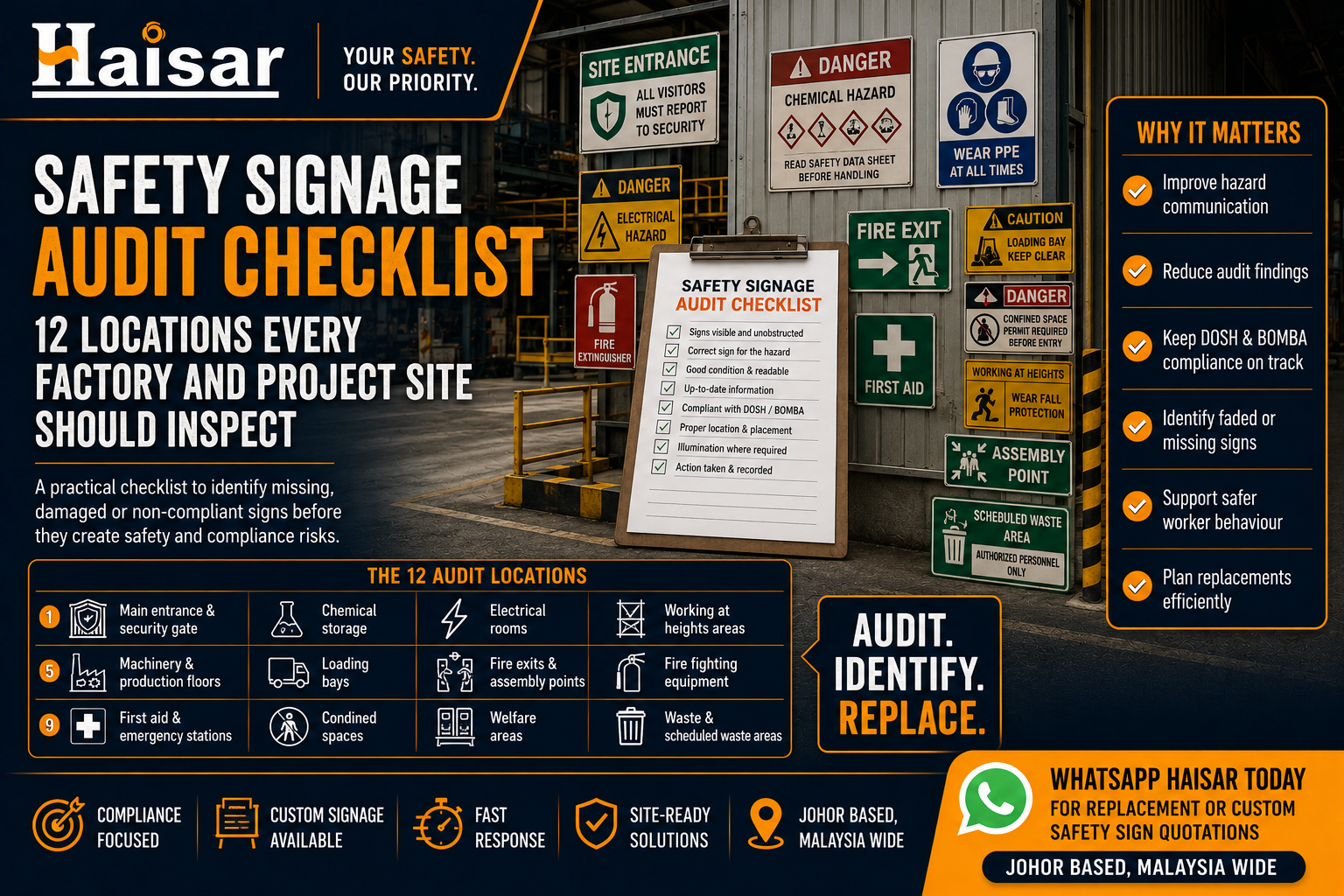
04 / 12-LOCATION AUDIT
Keep the current article's 12-location structure, but compare every sign against the current hazard, current layout and current standard.
| Location | What the audit should verify |
|---|---|
| Main entrance & security | Site rules, visitor reporting, required PPE, access restrictions and emergency information. |
| Chemical storage / handling | Chemical warnings, PPE, ignition controls, eyewash / shower and spill-response information. |
| Electrical switch rooms / MCC | Electrical / high-voltage warning, access restriction and task-specific electrical safety notices. |
| Work at height areas | Fall-hazard warnings, access restriction, scaffold status and required PPE. |
| Machinery / production | Machine hazards, isolation instructions, mandatory PPE and restricted zones. |
| Loading bays / receiving | Vehicle / forklift movement, pedestrian routes and loading-bay hazards. |
| Fire exits / escape routes | Exit signs, direction arrows and assembly-point route information. |
| Fire-fighting equipment | Extinguisher, hose reel, alarm and other equipment-location signs. |
| First aid & emergency equipment | First aid, AED where provided, eyewash / shower and emergency-response locations. |
| Confined spaces | Entry restriction, permit / authorisation information and rescue-related notices. |
| Welfare / common areas | Hygiene, emergency information and facility-specific restrictions. |
| Scheduled-waste / waste storage | Hazard identification, segregation, PPE and applicable waste notices. |
05 / PLACEMENT & LANGUAGE
Use recognised graphical symbols first where applicable, then add supporting wording in languages the workforce and visitors can understand when needed by the site / client. Multilingual wording should support not replace the standard graphical message.
06 / FIRE & EMERGENCY SIGNS
Keep exit / directional information consistent with the current approved evacuation route.
Identify the actual designated point and add directional signs where it cannot be seen directly.
Equipment-location signs should remain visible even when normal workplace activity surrounds the equipment.
Workers should be able to identify emergency medical / flushing equipment quickly from relevant hazard areas.
Related guides: Emergency Evacuation Plan Malaysia and Workplace Fire Safety Malaysia 2026.
07 / HAISAR SIGNAGE SUPPLY
Haisar lists Safety Signages & Installations within its project-supply range. Because many signs are customised rather than fixed catalogue SKUs, the main categories below use clean illustrative visuals instead of invented product models.
Hard-hat, eye, hearing, respiratory, footwear and other mandatory-area signs.
High-voltage, forklift, overhead-load, hot-surface and chemical-hazard applications.
Exit, assembly point, first aid, eyewash / shower and emergency-direction signs.
Fire extinguisher, hose reel, alarm / call-point and other fire-equipment location signs.
Haisar's SIGN.B is listed for parking lots, entrances and temporary traffic warning, with metal / PVC pole-base options, 500 mm sign face, 5 ft pole height, engineering-grade reflective sheeting and customisable legends.
Product: Traffic Safety Pole Signboard.
Haisar's site-setup offering includes site-rules boards, HSE notice boards, visitor instructions, emergency signs, PPE signs, fire-equipment signs and custom project signage.
08 / INSPECTION & REPLACEMENT
Practical audit method: photograph each location, record required sign / current condition / corrective action, then link replacements to a site drawing or area register.
09 / BUYING MISTAKES & RFQ
Include category, symbol, size, material, mounting and location not just text.
Use MS 2558:2022 as the local workplace reference where applicable.
Viewing distance, lighting and approach direction affect visibility.
Use standard symbols and add supporting text where the workforce / client requires it.
UV, rain, heat, chemicals and cleaning can destroy unsuitable materials.
A location-based sign schedule reduces omissions and duplicate purchasing.
Send it once to Haisar for a location-based quotation.
10 / FAQ, SOURCES & INTERNAL LINKS
MS 2558:2022, Safety and health signage used in the workplace — Specification (Second revision), is the current published Malaysian Standard and replaced MS 2558:2014.
ISO 7010 is important for graphical safety symbols, but for Malaysian workplace signage MS 2558:2022 is the stronger local reference where it applies.
Typical systems distinguish prohibition, warning, mandatory, safe-condition / emergency and fire-equipment messages using different colours, shapes and symbols. Do not use colour alone.
Use recognised graphical symbols and add supporting languages needed for the actual workforce, visitors and client / project requirements.
Inspect it as part of routine safety / facility audits and whenever hazards, layout, emergency routes or processes change. Replace damaged, faded, obstructed or incorrect signs.
Yes. Haisar lists Safety Signages & Installations within its project-supply range and supports custom project signage.
This article is a general workplace-signage audit and procurement guide. Final signage should follow applicable Malaysian Standards, current site risk assessment, approved fire / emergency arrangements, sector-specific rules and client requirements.
Send your location schedule, artwork / symbols, material, quantity, installation requirement and delivery date to Haisar.

We provide top-tier safety equipment and solutions tailored to meet the diverse needs of their clients.