Can't find what you're looking for? Get in touch!



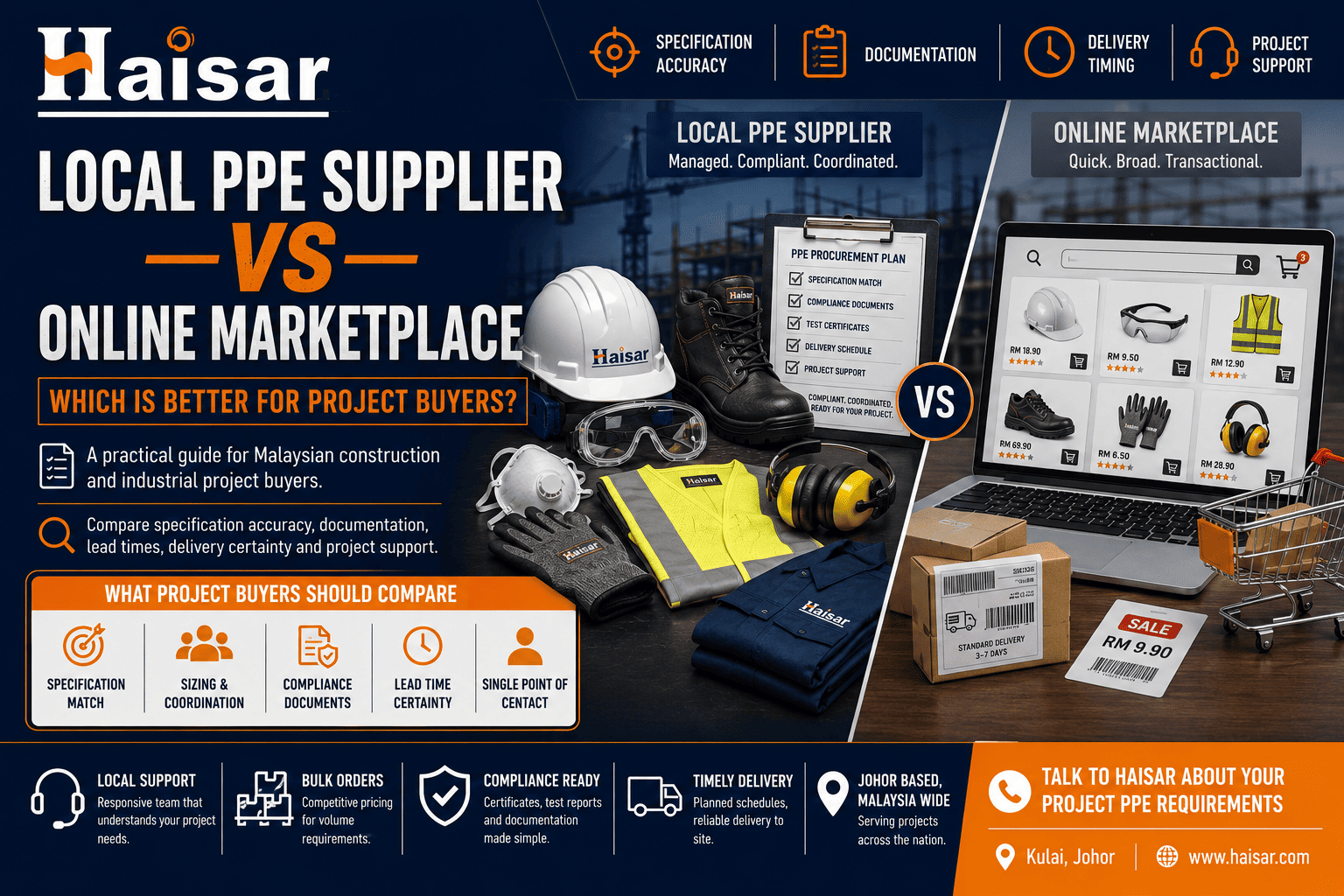
Most procurement managers buying PPE for a construction or industrial project in Malaysia have used both channels at some point. An online marketplace order for a fast top-up. A local supplier relationship for the project bulk. And at some point, most have also experienced the failure mode of each.
The marketplace delivered the wrong cut-resistance rating. The local supplier quoted a six-week lead time two weeks before mobilisation. The marketplace shipped from a Peninsular warehouse but did not update the product listing to reflect the out-of-stock position at the Johor fulfilment centre. The local supplier's sales rep promised a non-standard item was available and it was not.
Neither channel is inherently better. What matters is understanding what each channel is actually good at, where each one fails, and which one is better aligned with the specific requirements of PPE procurement for a project buyer in Malaysia. That is what this guide sets out to answer.
What "Project Buyer" Means in This Context
This comparison is not aimed at facilities managers buying a box of disposable gloves for a maintenance crew, or HR teams sourcing branded polo shirts for a new intake. It is aimed at procurement managers, HSE officers, and project teams buying PPE for a defined project scope with a workforce headcount, a start date, a specification requirement, and a compliance obligation.
Project buyers have a specific set of needs that look different from retail PPE buyers.
Specification accuracy matters more than price. The PPE must match the hazard profile of the site. A hard hat must meet the right impact class. Cut-resistant gloves must reach the right EN 388 level. FR coveralls must meet NFPA 2112 or EN ISO 11612 depending on the client's specification. Getting the specification wrong has consequences that extend well beyond the cost of replacing the item.
Volume and sizing create complexity. A project order might involve forty pairs of safety boots across fourteen shoe sizes, three hundred disposable respirators, sixty full-body harnesses in two sizes, and custom-embroidered FR coveralls in seven sizes with the client's logo. This is not a checkout basket. It is a coordinated procurement engagement.
Documentation is non-negotiable. DOSH compliance, PETRONAS contractor audit, client HSE inspection, or internal safety management system requirements all demand that PPE on site has the supporting documentation: CE certificates, EN standard test reports, product data sheets, SIRIM markings where applicable. A supplier who cannot produce documentation is a compliance liability.
Delivery timing is tied to the project programme. PPE must arrive before the workforce mobilises. For items with production lead times - FR coveralls, custom workwear, embroidered garments — orders must be placed weeks before they are needed. A delayed delivery is not an inconvenience. It is a mobilisation risk.
With these requirements in mind, the comparison between local suppliers and online marketplaces looks very different from a standard price-and-convenience analysis.
What Online Marketplaces Do Well
Online marketplaces - Lazada, Shopee, and their B2B equivalents - have genuine strengths that explain their growth as a PPE procurement channel in Malaysia.
Price transparency and comparison. Marketplace listings make it easy to compare prices across multiple sellers for standard commodity items. For basic safety glasses, disposable nitrile gloves, or standard safety helmets where the specification is simple and widely met, a marketplace buyer can quickly identify the lowest available price for an equivalent item.
Speed for standard stock items. For items that are genuinely in stock and available for same-day or next-day dispatch from a warehouse close to the project site, marketplace logistics can be fast. For top-up orders of commodity consumables, this speed is a real operational advantage.
Low friction for one-off purchases. No account setup, no purchase order process, no minimum order requirement. For a facilities team that needs ten pairs of gloves by tomorrow, a marketplace handles that transaction efficiently.
Broad product range in a single interface. A marketplace aggregates products from hundreds of sellers. The buyer can find items from multiple categories in a single browsing session without managing multiple supplier relationships.
These are genuine advantages. For the right purchase type - commodity items, small quantities, standard specifications, no documentation requirement, no time pressure on delivery certainty - a marketplace can be the efficient choice.
The problem is that project PPE procurement is rarely the right purchase type for marketplace buying.
Where Online Marketplaces Fail Project Buyers
The strengths of online marketplaces - aggregated sellers, price competition, self-service purchasing - become liabilities when applied to project PPE procurement.
Specification accuracy is not guaranteed. A marketplace listing for "cut-resistant gloves" does not guarantee the cut resistance level. The listing may describe the product as Level 5 protection. The actual product may be manufactured to a superseded standard, tested to a different EN 388 methodology, or simply mislabelled. The buyer has no technical adviser to verify the specification before the order is placed. The verification happens when the item arrives on site, which is often too late.
For commodity items bought in small quantities, receiving the wrong specification is a manageable inconvenience - return the order and try again. For a project order of three hundred units placed four weeks before mobilisation, receiving the wrong specification is a procurement failure that may delay the start of work.
No sizing consultation. Project buyers ordering wearable PPE need size confirmation across their full workforce. A marketplace has no mechanism for this. The buyer selects sizes based on their own estimate, the items arrive, and any sizing errors create shortages that require additional orders. For custom-sized items like safety footwear or FR coveralls, sizing errors are particularly costly because the items cannot simply be exchanged at a counter.
Documentation is inconsistent. Marketplace sellers operate across a wide range of documentation practice. Some provide CE certificates with delivery. Many do not. Some will provide test reports on request, after the order is placed and the items have shipped. Others cannot provide documentation at all because they are reselling grey market product without original manufacturer documentation.
A project buyer who needs documentation available at audit cannot rely on a marketplace to deliver it consistently. The documentation chase happens after the order, not before, which means compliance risk is only resolved, if it is resolved, after the items are already on site.
Delivery certainty is lower than it appears. Marketplace stock positions are updated inconsistently. An item that shows as available may be out of stock at the closest warehouse. Delivery date estimates are generated algorithmically and do not account for the specific logistics situation at the time of dispatch. For a project buyer with a hard mobilisation date, marketplace delivery uncertainty is a risk that cannot be managed by checking a product listing.
No support for complex orders. Placing a project PPE order across multiple categories, multiple sellers, multiple delivery locations, and multiple specification requirements on a marketplace involves managing dozens of separate transactions. There is no account manager to coordinate. There is no consolidated invoice. There is no single point of contact when something goes wrong. Each seller is a separate transaction, and the buyer is the only person in the process with a view of the full order.
Returns and replacements are slow. When a marketplace order arrives with wrong specification, wrong sizing, or missing documentation, the resolution process runs through the marketplace's dispute mechanism. For project buyers, this process is too slow to be practically useful. The project does not pause while a return is processed.
What a Specialist Local PPE Supplier Provides
A specialist local PPE supplier like Haisar Supply and Services is a different type of procurement partner from a marketplace seller. The comparison is not simply between a physical supplier and a digital one. It is between a transactional channel and an advisory relationship.
Specification matching before the order. A specialist supplier engages with the buyer's specification requirements before a purchase order is raised. For a project with a defined PPE schedule, the supplier reviews the specification for each item, confirms that the product being proposed matches the required standard and protection class, and flags any discrepancies before they become a delivery problem. This advisory function is not available from a marketplace. It is the core value of a specialist supplier relationship for project buyers.
Sizing and customisation coordination. For wearable items, a specialist supplier manages the sizing data collection, confirms size availability across the full range required, and produces a consolidated size confirmation before the order is finalised. For custom items including embroidered FR coveralls, branded workwear, and logo-marked hard hats, the supplier manages the customisation production process and the quality check before dispatch. This coordination is invisible to the buyer because the supplier carries it. The result is that the order arrives complete and correctly specified.
Documentation as a standard process. A specialist supplier with a documented compliance process collects and files product documentation as a standard part of the order process. CE certificates, EN test reports, product data sheets, and manufacturer declarations are assembled with the order, not chased after the fact. For project buyers who need documentation available at audit, this eliminates a compliance risk that marketplace procurement cannot address.
Lead time management and pre-ordering. A specialist supplier knows the lead times for every product in their range - what is in local stock, what needs to be ordered from the brand principal, and what requires production time. For project buyers with a defined mobilisation date, the supplier can work backwards from the required on-site date and identify the order placement date for every item. This lead time visibility turns PPE procurement from a reactive function into a planned one.
Single point of contact for the full order. A project PPE order placed with a specialist supplier is managed as a single engagement. One account manager. One consolidated delivery or coordinated delivery schedule. One set of documentation. One invoice. When something requires attention - a specification query, a sizing change, a delivery update - there is one person to contact who has a complete view of the order.
Local delivery knowledge. A Johor-based PPE supplier understands the logistics of delivering to Pengerang, Pasir Gudang, Johor Bahru industrial estates, and active construction sites across the region. Delivery to a site address with an access permit requirement, a security gate, and a stores receiving process is a routine engagement for a local supplier. It is an exception that marketplace logistics systems are not designed to handle.
Relationship continuity across the project. A project involves replenishment orders, specification changes, emergency top-ups, and end-of-project documentation requests. A specialist supplier maintains the project record across these transactions. A marketplace buyer starts from zero with each order.
The Specification Risk That Project Buyers Cannot Afford to Take
Among all the differences between marketplace and specialist supplier procurement, the specification risk is the one that project buyers should weigh most carefully.
PPE specification errors are not quality complaints. They are safety compliance failures with potential consequences under Malaysian OSH law, client contractual requirements, and the personal liability of the HSE officer or procurement manager who approved the incorrect item for site use.
The OSH (Use and Standards of Exposure of Chemicals Hazardous to Health) Regulations and DOSH's enforcement framework place the responsibility for ensuring PPE is fit for purpose on the employer and the HSE officer accountable for site safety. "I ordered it from a marketplace listing that said it was Level 5" is not a defence in a DOSH inspection or an incident investigation.
A specialist supplier who has reviewed and confirmed the specification for every item in the order before it ships gives the buyer a documented basis for the specification decision. The buyer's project record includes the supplier's specification confirmation alongside the product documentation. This is a meaningful compliance record. A marketplace order history is not.
For project buyers working on PETRONAS contractor sites, international client-operated facilities, or sites where the principal contractor's HSE management system requires documented PPE compliance, the specification confirmation that a specialist supplier provides is not a convenience. It is part of the compliance record that the project requires.
The Cost Comparison That Project Buyers Actually Need to Make
Marketplace buyers often anchor on unit price as the primary comparison metric. This produces a misleading cost analysis for project procurement.
The relevant cost comparison is not unit price versus unit price. It is total procurement cost including the costs of specification errors, sizing corrections, documentation chase, delivery uncertainty management, and coordination time.
A marketplace order for three hundred disposable respirators at 15% below the specialist supplier's unit price saves approximately RM450 on a RM3,000 order. If two hundred of those respirators arrive at the wrong filter standard and must be returned and replaced, the cost of the return process, the replacement order, the expedited delivery to meet the site schedule, and the HSE manager's time spent managing the non-conformance easily exceeds the unit price saving many times over.
The unit price comparison only holds when the order arrives correctly, on time, with full documentation, without any follow-up action required. For project PPE orders, this is a best-case scenario with a marketplace channel, not the baseline expectation.
With a specialist supplier, the correct specification, complete documentation, and managed delivery are the standard service, not the exception. The unit price premium, where it exists, is the cost of the advisory and coordination service that the marketplace does not provide.
For project buyers whose orders are large enough, complex enough, or compliance-critical enough that a single specification or documentation failure creates a significant cost or risk, the specialist supplier model is more cost-effective than the marketplace unit price comparison suggests.
When Each Channel Makes Sense for PPE Procurement
A balanced answer to the local supplier versus marketplace question acknowledges that both channels have a place in a project buyer's procurement toolkit, but in different purchase situations.
Marketplace buying makes sense for: Small quantities of commodity consumable items with simple specifications. Top-up orders where the item's specification is already confirmed and the only variable is availability. Low-value urgent purchases where the consequence of a specification error is low. Items where documentation is not required and sizing is not complex.
Specialist local supplier procurement makes sense for: Full project PPE orders across multiple categories. Any item with a specification that must match a defined standard or protection class. Wearable items requiring sizing coordination. Custom workwear including FR coveralls, embroidered garments, and branded items. Any order where documentation must be available for compliance purposes. Items with production or ordering lead times that require advance planning. High-value orders where the cost of an error or non-conformance exceeds any unit price saving.
For most project PPE procurement in Malaysia — construction, oil and gas, EPC, manufacturing, data centre, marine and shipyard — the procurement requirements fall predominantly in the specialist supplier category. The project scope is defined. The specification is set. The workforce size determines the quantity. The mobilisation date sets the delivery timeline. The compliance framework requires documentation. These are not the conditions where marketplace procurement delivers its advantages.
How Haisar Supply and Services Works With Project Buyers
Haisar Supply and Services Sdn Bhd is a Johor-based specialist PPE and safety equipment supplier serving construction and industrial projects across peninsular Malaysia.
For project buyers, Haisar engages from the specification stage. Our team reviews the PPE schedule or specification document, confirms the product match for every line item, advises on standard equivalences and substitutions where required, and produces a consolidated quotation against the full project scope. This pre-order specification review is a standard part of our engagement process, not an optional add-on.
We supply across all PPE categories: head protection, eye and face protection, hearing protection, respiratory protection, hand protection, foot protection, body protection and FR workwear, working at heights equipment, chemical handling PPE, electrical safety equipment, fire safety and emergency responder equipment, and custom-embroidered workwear. For most project scopes, we cover the full PPE schedule from a single supplier relationship.
Documentation management is a standard process at Haisar. Every order ships with the relevant product documentation assembled and organised. For project buyers who need documentation available for DOSH inspection, client audit, or internal HSE management system requirements, our documentation process means this is handled at the order stage, not after delivery.
Our Kulai, Johor base gives us strong delivery coverage across Johor's industrial zones including Pengerang, Pasir Gudang, Senai, Johor Bahru, and active project sites across the region. For projects elsewhere in peninsular Malaysia, we coordinate logistics to project sites as part of the order management process.
We understand the specific regulatory and client requirements of the sectors we serve. PETRONAS contractor site requirements, DOSH compliance standards, CIDB project registration, and international client specifications are part of our daily work. When a buyer's project operates under a client-imposed specification framework, we engage with that framework from the start rather than leaving the buyer to translate between the client's requirements and our standard product range.
Talk to Haisar About Your Project PPE Requirements
If you are planning a project PPE order - whether you are working from a full PPE procurement plan or starting from a site specification document - contact our team to discuss your requirements.
We will review your specification, confirm product availability and lead times across all categories, advise on sizing coordination for wearable items, and provide a consolidated quotation that covers your full project scope. The engagement starts with a conversation, not a purchase order.
Haisar Supply and Services Sdn Bhd (985158-T) | Kulai, Johor, Malaysia | www.haisar.com
