Can't find what you're looking for? Get in touch!



Most PPE procurement in Malaysia happens reactively. A site supervisor runs out of gloves mid-project and raises an urgent purchase order. A new hazard is identified during a toolbox talk and the HSE manager realises the site does not have the right respirator. The shutdown team arrives on Monday morning and three sizes of FR coveralls are missing from the order because nobody confirmed the full size distribution.
Reactive procurement is expensive, slow, and creates compliance gaps at the moments when compliance matters most. The project has not stopped. The work is happening. The workers are there. And the PPE is not.
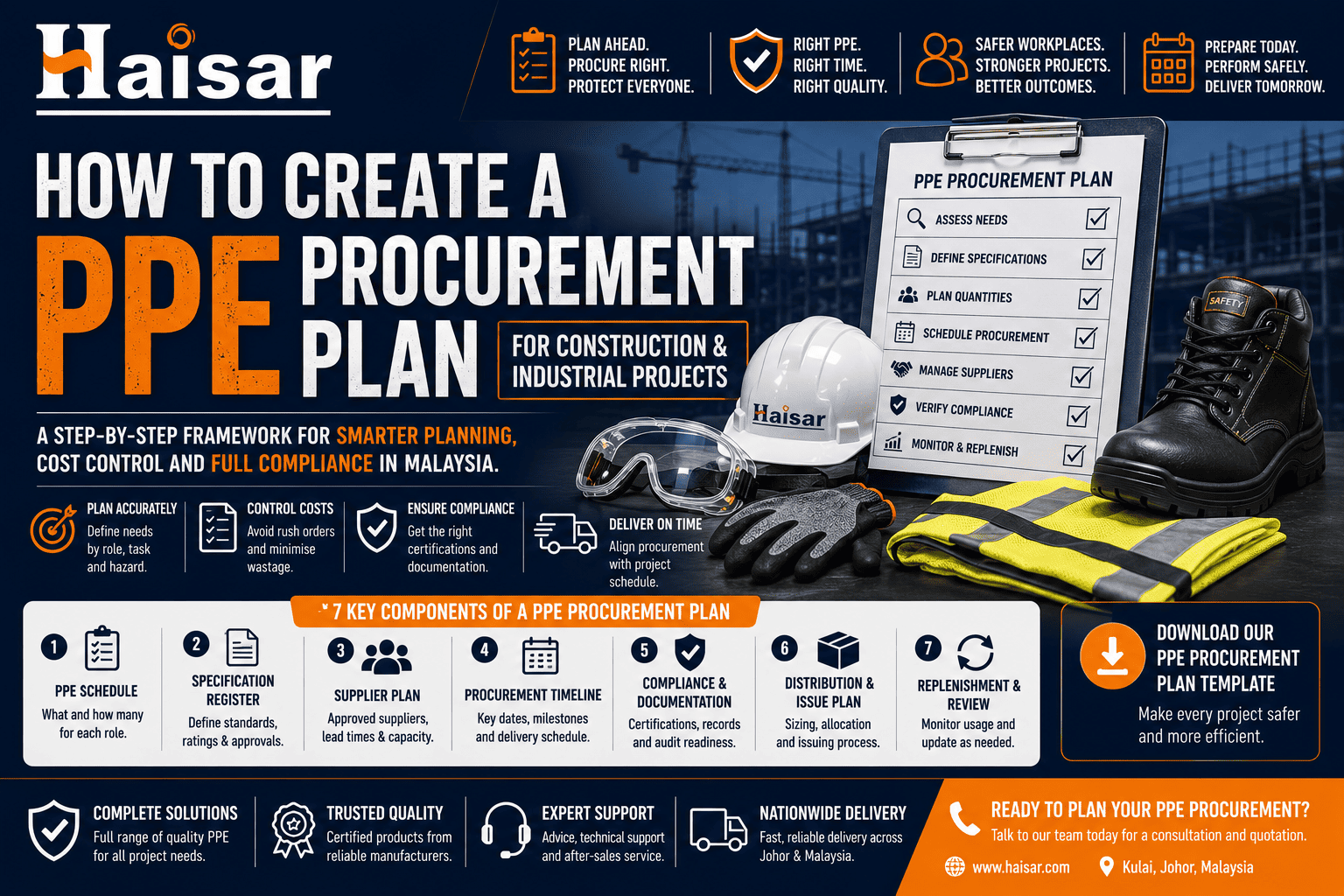
A PPE procurement plan solves this by turning a reactive function into a planned one. It maps the full scope of PPE requirements to the project programme, establishes the specification for every item before the first purchase order is raised, identifies lead times before they become delivery problems, and creates a documentation and approval framework that survives the change of personnel and programme shifts that every project experiences.
This guide explains how to build a PPE procurement plan for a construction or industrial project in Malaysia, step by step, with a downloadable template at the end that gives your team a starting framework for every future project engagement.
Why Projects in Malaysia Need a PPE Procurement Plan
The case for a formal PPE procurement plan is strongest in the environments where it is least commonly used. Not on heavily regulated PETRONAS-operated sites where the contractor management system imposes procurement discipline through its own requirements. On construction projects, EPC engagements, facility maintenance contracts, and manufacturing expansion projects where the principal contractor has defined safety specifications but the sub-contractor or facilities team is left to manage the detail of PPE procurement for themselves.
These are the environments where the common procurement failures cluster.
Workers mobilise without adequate PPE. The project starts on time. The PPE arrives a week later. In the interim, workers are on site without the required equipment. The site HSE plan specifies full compliance from day one. The procurement plan did not exist, so nobody planned the PPE delivery to precede the workforce arrival.
Wrong specification delivered. A sub-contractor procurement manager reads "safety gloves" on the specification sheet and sources the cheapest available option. The site specification requires cut-resistant gloves at EN 388 TDM Level C for metal racking installation. What arrives is general-purpose synthetic gloves at Level A. Technically gloves. Wrong specification. A PPE procurement plan with a specification column prevents this.
Compliance documentation unavailable at audit. The principal contractor conducts a safety audit six weeks into the project and asks for certification documentation for all PPE on site. Nobody collected it. The sub-contractor who supplied the FR coveralls cannot produce FR test certificates because nobody asked for them at the order stage. A PPE procurement plan with a documentation requirement column prevents this.
Budget overrun from reactive purchasing. Emergency orders placed at short notice, premium freight charges on expedited deliveries, and premium pricing from local suppliers when the planned supplier is out of stock all add cost that was not in the project budget. A procurement plan with lead times identified in advance eliminates most emergency ordering.
Replenishment gaps mid-project. Consumable PPE is not replenished until the site store is empty. Disposable respirators run out on the day a dusty concrete cutting activity is scheduled. A procurement plan with consumption rates and replenishment triggers prevents the gap.
The Components of a PPE Procurement Plan
A PPE procurement plan for a construction or industrial project in Malaysia is a structured document covering seven components. Each component addresses a different dimension of the procurement challenge.
Component 1: PPE Schedule — What and How Many
The PPE schedule is the master list of every item of PPE required for the project. It is organised by PPE category and by workforce role, because different roles require different specifications and different quantities.
The schedule captures for each line item: the PPE category and item description, the required specification including product standard and protection class, the applicable certification requirement, the quantity required by role, and the total quantity across all roles.
The quantity calculation has two parts. The initial issue quantity, which is the number of units needed to equip the full workforce at the start of the project. And the replenishment quantity, which is the estimated consumption of disposable and limited-life items across the project duration.
For items with a defined service life, including safety helmet replacement triggers, harness formal inspection intervals, and FR coverall replacement schedules, the replenishment quantity accounts for expected replacement during the project rather than just initial issue.
Component 2: Specification Register — What Exactly
The specification register defines every item in the PPE schedule to the level of detail that prevents specification drift between the plan and the purchase order.
For each item, the specification register records: the product name and category, the applicable standard (MS EN ISO 20345, EN 388, NFPA 2112, etc.), the required performance level or protection class, the certification requirement (SIRIM, CE marking, EN standard certificate), any additional properties required (anti-static, ESD, chemical resistant, FR rated), the preferred brand where the principal contractor or client requires an approved brand, and any customisation requirements including branding, embroidery, or company colours.
The specification register is reviewed and approved by the HSE manager or the project safety engineer before any purchase order is raised. This approval step prevents specification decisions from being made by procurement staff without the technical knowledge to make them correctly.
Component 3: Sizing Data — Who Gets What Size
For all wearable PPE items, the sizing data component captures the individual size requirements for each worker or, where the individual workforce is not yet confirmed, a planned size distribution across the expected workforce composition.
The sizing data collection process differs by item category. For safety footwear, individual shoe size data must be collected for every worker because footwear sizing has no adequate statistical substitute. For coveralls, a measurement-based sizing approach or a trial-fitting session with size samples produces the most accurate individual size data. For hard hats with adjustable suspension systems, a single standard size covers most adults and individual sizing is not required.
For projects where the full workforce is not confirmed at the time of procurement planning, the sizing data component includes a sizing collection timeline that captures the data before the order is placed rather than after.
Component 4: Lead Time Analysis — When to Order
Lead time analysis identifies the time between placing an order and receiving delivery for each item in the PPE schedule, and works backwards from the required on-site date to determine the latest date each order must be placed.
Items fall into three categories based on lead time. In-stock items that are available from the supplier's current stock and can be delivered within a few days. Ordering-lead-time items that are not held in stock and require ordering from the supplier's source, typically one to four weeks. Production-lead-time items that require manufacturing including custom FR workwear, embroidered garments, and custom-colour items, typically two to six weeks from order confirmation.
The lead time analysis produces a procurement calendar that shows the order date for every item in the PPE schedule. Orders for items with the longest production lead times must be placed first, often before other project procurement activities have begun.
For the Malaysian context, lead time analysis must account for public holidays including Hari Raya, Chinese New Year, and national public holidays that affect supplier operations and logistics networks. A two-week delivery window that spans a major public holiday becomes a three or four week window in practice.
Component 5: Supplier Assignment and Approval
The supplier assignment component identifies the supplier for each item or item group in the PPE schedule and records the approval status of that supplier against the project's or client's requirements.
For PETRONAS contractor sites, CIDB-registered projects, and international client-operated facilities, the approved vendor list requirement means that only suppliers on the approved list can be used for specified categories. The supplier assignment component must confirm the approval status before the order is placed, not after.
For items where multiple suppliers are identified, the component records the primary supplier and the backup supplier for each item, so that a supply failure with the primary supplier does not require a reactive search for an alternative under time pressure.
The supplier assignment component also records the agreed payment terms, the minimum order quantity, and the documentation to be provided with each order, creating a reference that procurement staff can use without needing to renegotiate these terms with the supplier for each purchase order.
Component 6: Approval and Authority Matrix
The approval matrix defines who has authority to approve different categories of procurement decision within the project structure. This component is particularly important for large projects where multiple people are involved in procurement decisions across different cost levels and different safety risk categories.
The approval matrix typically defines: who can approve the specification for each PPE category (typically the HSE manager or project safety engineer), who can approve purchase orders below a defined value threshold (typically the site manager or project manager), who must approve purchase orders above the value threshold (typically the project director or finance manager), who can authorise specification changes from the approved specification register (typically the HSE manager only, with notification to the principal contractor where required), and who can approve supplier substitutions where the assigned supplier cannot fulfil the order (typically requires both HSE manager and project manager sign-off).
A clear approval matrix prevents two common problems. Procurement staff raising purchase orders against non-approved specifications because the HSE manager was not consulted. And procurement decisions being delayed because the approval authority is unclear and multiple people believe it requires the other person's sign-off.
Component 7: Documentation and Compliance Register
The documentation register is the tracking component that ensures every item of PPE on site has the associated compliance documentation available for inspection.
The register lists every item in the PPE schedule and records for each: the documentation required, the supplier responsible for providing it, the date the documentation was received, the storage location, and the review date for documentation with time-limited validity including calibration certificates and pressure test records for insulating gloves.
For projects operating under PETRONAS contractor requirements or international client specifications, the documentation register often forms part of the formal HSE management system documentation submitted to the principal contractor or client. Building the register format to align with the submission requirement from the start eliminates a reformatting exercise under time pressure before the submission is due.
Calculating PPE Quantities for a Project
Quantity calculation for a PPE procurement plan involves two separate exercises that are often conflated: initial issue quantities and replenishment quantities.
Initial issue quantities are calculated from the workforce size, role distribution, and the items each role requires. A straightforward matrix multiplication: number of workers in each role multiplied by the quantity of each PPE item required for that role, summed across all roles.
A practical complication is that the workforce on a large construction or industrial project in Malaysia rarely stays constant. Early-phase civil and structural activities involve a different workforce profile from late-phase electrical and commissioning activities. The PPE procurement plan should account for the project phases and the workforce composition in each phase, ordering PPE for each phase when that phase's workforce size is confirmed rather than ordering the full project total at the outset.
Replenishment quantities cover consumable PPE items that are used up during the project. Disposable respirators consumed at a rate dependent on the dusty or chemical activities in each project phase. Disposable gloves consumed at a rate dependent on the hand hazard frequency. Safety glasses replaced at a rate dependent on the work environment.
For each consumable item, the replenishment quantity is estimated from the consumption rate multiplied by the project duration. The consumption rate is best estimated from historical data on comparable projects. Where historical data is not available, a standard consumption allowance per worker per week provides a starting basis that can be adjusted as actual consumption rates are observed during the project.
For items with a defined replacement trigger rather than a time-based consumption rate, including safety helmets after impact, harnesses after fall arrest events, and gloves after chemical contamination, the replenishment quantity is estimated as a percentage of the initial issue quantity based on the expected frequency of replacement triggers in the project environment.
Coordinating PPE Procurement Across Multiple Suppliers and Sub-Contractors
On large construction and industrial projects in Malaysia, PPE procurement involves more than one purchasing entity. The principal contractor may supply certain PPE centrally. Sub-contractors may supply their own workforce PPE subject to the principal's specification. A single PPE supplier may not cover all required categories, requiring coordination across multiple supplier relationships.
Effective coordination across this complexity requires a single accountable point of contact on the project side who owns the PPE procurement plan and is responsible for ensuring that every procurement decision by every party in the supply chain is consistent with the specification register.
For principal contractors managing PPE compliance across a sub-contractor base in Johor, the most effective model is central specification approval combined with distributed procurement authority. The HSE manager approves the specification for every PPE category. Sub-contractors are free to procure from any supplier who can meet the approved specification, but only against that specification and only with the required documentation.
This model maintains compliance control without creating a procurement bottleneck at the principal contractor level while allowing sub-contractors the flexibility to use their established supplier relationships.
Where the principal contractor chooses to supply PPE centrally rather than relying on sub-contractor procurement, the bulk supply model described in Haisar's bulk PPE supplier guide provides the consolidation and coordination capability that central supply requires.
PPE Procurement Plan Template: Structure Summary
The downloadable PPE procurement plan template covers the following structure, ready for adaptation to your specific project.
Section 1: Project Information. Project name and number, site location, planned start date, planned completion date, principal contractor, site HSE manager, PPE procurement coordinator.
Section 2: PPE Schedule. Table with columns for PPE category, item description, applicable standard, protection class or rating, certification required, roles requiring the item, quantity per role, total initial issue quantity, estimated replenishment quantity, and total order quantity.
Section 3: Specification Register. Detailed specification for each line item in the PPE schedule including brand preference, customisation requirements, and documentation to be supplied.
Section 4: Sizing Data Collection. Sizing schedule template for wearable items with workforce name, role, and size fields for each garment and footwear category.
Section 5: Lead Time Analysis. Table with columns for each PPE item, supplier, lead time category (stock, order, production), required on-site date, latest order date, and order placed date.
Section 6: Supplier Register. Supplier name and contact, approved status for the project, items assigned, payment terms, minimum order quantity, and documentation commitment.
Section 7: Approval Matrix. Table defining the approval authority for specification approval, purchase order value thresholds, specification changes, and supplier substitutions, by named role.
Section 8: Documentation Register. Table for tracking required and received documentation for each PPE item, with received dates, storage location, and validity review dates.
Section 9: Replenishment Schedule. Calendar view of replenishment order dates for consumable items based on the consumption rate and project duration.
Haisar Supply and Services: PPE Procurement Partner for Malaysian Projects
Haisar Supply and Services Sdn Bhd supports procurement managers and HSE officers on construction and industrial projects across Johor and peninsular Malaysia with the full scope of PPE supply and procurement coordination. We engage from the specification stage, provide lead time visibility across our full product range, maintain documentation management as a standard process, and deliver against committed timelines.
For projects using the PPE procurement plan framework in this guide, Haisar can act as the primary PPE supplier across all categories in the PPE schedule, simplifying the supplier coordination component by reducing multi-supplier management to a single relationship for most or all of the plan's requirements.
We supply to projects across Johor's active industrial sectors including oil and gas, construction, renewable energy, data centres, power generation, marine and shipyard, and manufacturing, and we understand the specific regulatory and client specification requirements of each.
Download the Haisar PPE Procurement Plan Template
The complete PPE procurement plan template covering all eight sections described in this guide is available for download. Use it as the starting framework for your next project and adapt every section to your specific project scope, workforce, and timeline.
Download the PPE Procurement Plan Template
Or contact our team directly to discuss your project PPE requirements. We will work through the procurement planning process with you and provide a consolidated quotation against your project specification.
Explore Our Products and Services at haisar.com
Haisar Supply and Services Sdn Bhd (985158-T) | Kulai, Johor, Malaysia | www.haisar.com
